BLACK IS BEAUTIFUL
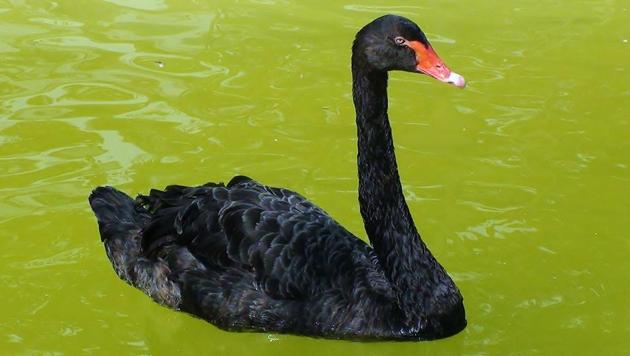
Of the 32 species on display at India’s longest walk-in aviary inaugurated last week at Chhatbir Zoo, there would be none so elegant and enigmatic as the Black swan. Human cultures celebrate white swans as the epitome of grace but the black counterpart is a beauteous contrast and as darkly charming as lord Krishna was to a bevy of ivory ‘gopis’.
Acquired from Mysore zoo in 2008-’09, the Black swan lived a life of sedate oblivion at Chhatbir till the aviary came up and thrust the bird into the limelight. While the swan dominates aquatic exhibits at the new aviary, it is accommodative and tolerant of other species sharing captivity.
The swan is a bird native to Australia but exported across the globe as a popular ornamental waterfowl species. Swans swimming in a merry brook coursing through verdant gardens conjure ethereal visions of an earthy paradise! The swan is a herbivore and possessed with a long and graceful neck, takes feed along with water for an easy swallow. Zoo keepers feed this bird on the pond’s slanting slope and the swan picks small amounts of food and sips water with each intake.
Black swans tilt towards monogamy but one-quarter of all pairings are homosexual, the two loving males sometimes adopt a female, mate with her and then drive her off to incubate eggs. Both partners, whether homosexual or otherwise, share incubation and cygnet-rearing duties.
{{/usCountry}}Black swans tilt towards monogamy but one-quarter of all pairings are homosexual, the two loving males sometimes adopt a female, mate with her and then drive her off to incubate eggs. Both partners, whether homosexual or otherwise, share incubation and cygnet-rearing duties.
{{/usCountry}}A bugle-like, musical sound is the signature call but a range of soft, crooning notes and the occasional whistle when disturbed add to the svelte swan’s rich repertoire of vocalisations.
THE DOLPHIN RIDDLES
The Indus dolphin (Platanista gangetica ssp. minor) seems to be in fine fettle, if the latest World Wildlife Fund (WWF)-India survey of the Beas Conservation Reserve is anything to go by. The survey conducted between May 3 and 6, 2018, estimated the number of dolphins at 5 to 11. However, a few years back, the very same WWF-India estimated dolphins at three times the number (18 to 35) and those surveys were conducted by WWF’s then senior project officer Shahnawaz Khan and project officer Gitanjali Kanwar and published in scientific journals. Since then, no dolphin mortality has been officially reported from the Beas. Questions arise: are some dolphins dead but unreported, was Khan’s estimate inflated or is the latest survey an underestimate?
Indus dolphins were discovered at Harike in 2008. However, the dolphin does not find mention in India’s Wildlife (Protection) Act, 1972, though the International Union for Conservation of Nature declared it an endangered species. The Wildlife Act places the Gangetic dolphin (Platanista gangetica ssp. gangetica) under Schedule I but omits reference to the Indus dolphin despite the Punjab forests and wildlife preservation department having written for its inclusion to the Union ministry of environment and forests in 2008. So, were a poacher to be nabbed with an Indus dolphin, under what provision of law should the department book the offender?
Declaration of the Beas as a conservation reserve and fishing ban is a welcome step by the Punjab government but mortal threats to the dolphin are extant and comprise plastic nets used by poacher fishermen and stoppage of Beas waters to repair irrigation works, as evidenced in March 2017 and April 2018. Question is, why were threats underplayed in the rosy picture projected by the WWF’s latest assessment? Why has the WWF in its latest report made no attempt to reconcile the yawning gap in numbers?
I sought the WWF-India’s response to these contradictions. “In our latest survey, we relied upon the services of Indus dolphin specialist, Gill Braulik. Khan had over-estimated dolphin numbers in the earlier surveys of the WWF. I do agree there is need to remove the ambiguity and place the Indus dolphin in the Wildlife Act, especially as ongoing research suggests the Indus and Gangetic dolphins are separate species. There are threats and we need to operationalise the declaration of the Beas as a conservation reserve to ensure dolphins are safe,” Suresh Babu, director (rivers, wetlands and water policy), WWF-India, told this writer.
The author can be contacted at vjswild1@gmail.com