Volcano-like features seen in polar regions of Saturn’s moon Titan by NASA’s Cassini spacecraft could be evidence of explosive eruptions that may continue today, according to a new paper by Planetary Science Institute Senior Scientist Charles A. Wood and coauthor Jani Radebaugh of Brigham Young University.
Morphological features such as nested collapses, elevated ramparts, halos, and islands indicate that some of the abundant small depressions in the north polar region of Titan are volcanic collapse craters, according to “Morphologic Evidence for Volcanic Craters near Titan’s North Polar Region” that appears in the Journal of Geophysical Research: Planets. A few similar depressions occur near the south pole of Titan.
“The close association of the proposed volcanic craters with polar lakes is consistent with a volcanic origin through explosive eruptions followed by collapse, as either maars or calderas,” Wood said. “The apparent freshness of some craters may mean that volcanism has been relatively recently active on Titan or even continues today.”
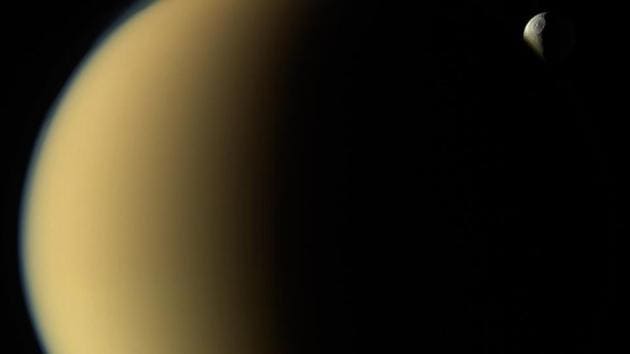
The Cassini mission revealed many landforms on Saturn’s moon Titan that are like those found on Earth. Sand dunes, river valleys and lakes are all a result of actions by the atmosphere on the surface, driven by solar heating.
“We demonstrate that there is also evidence for internal heat, manifest at the surface as cryovolcanoes, made from melting the water ice crust into liquid water that erupts onto Titan’s surface,” Wood said. “These features are roughly round, with raised rims, and they sometimes overlap each other. They are consistent with the shapes of other volcanic landforms on Earth and Mars formed by the explosion, excavation and collapse.
{{/usCountry}}“We demonstrate that there is also evidence for internal heat, manifest at the surface as cryovolcanoes, made from melting the water ice crust into liquid water that erupts onto Titan’s surface,” Wood said. “These features are roughly round, with raised rims, and they sometimes overlap each other. They are consistent with the shapes of other volcanic landforms on Earth and Mars formed by the explosion, excavation and collapse.
{{/usCountry}}“That these features are at the polar regions, near the lakes of methane, may indicate methane, nitrogen or some other volatile may power them. The features appear relatively fresh, meaning they could still be forming today,” Wood said.
Wood’s research was funded by a grant to PSI from NASA’s Cassini mission.