In March 2018, scientists deposited approximately 30 dump truck loads of coffee pulp on an abandoned pasture in southern Costa Rica. They spread about 360 cubic meters of the material into a layer roughly 0.4 to 0.5 meters deep across a 35-by-40-meter plot and left an adjacent plot of similar size untreated as a control. Two years later, canopy cover above 2 meters had reached more than 80 percent in the treated plot, while the control remained far less developed.
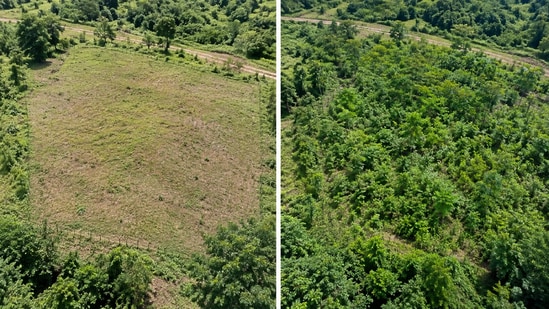
The results were reported in the 2021 study Coffee pulp accelerates early tropical forest succession on old fields, by Rebecca J. Cole and Rakan A. Zahawi. The experiment was designed to test whether coffee pulp could overcome some of the barriers that slow forest recovery on degraded agricultural land. Rather than planting trees, the researchers examined whether the nutrient-rich material could suppress pasture grasses, alter soil conditions, and create an environment where naturally dispersed seeds could establish.
Changes in the pasture due to coffee waste
The coffee pulp rapidly changed the vegetation on the soil surface. Within about three months, the layer had lost roughly half its original depth, while the pasture grass underneath had been killed and was beginning to decompose. By the end of the two-year monitoring period in March 2020, only about 5 to 10 centimeters of the original coffee pulp layer remained. Grass cover in the treated plot was nearly eliminated, while more than 80 percent of the control plot was still covered by grass.
The decomposing material also changed the soil environment. After two years, the treated plot had significantly higher levels of carbon and nitrogen, along with higher concentrations of several nutrients, including phosphorus, sulfur, iron, and manganese. At the same time, the coffee pulp altered ground cover by increasing herbaceous vegetation and leaf litter. Together, these changes reduced the dominance of pasture grasses and created conditions that favored the establishment of woody plants from seeds arriving naturally from the surrounding landscape.
{{/usCountry}}The decomposing material also changed the soil environment. After two years, the treated plot had significantly higher levels of carbon and nitrogen, along with higher concentrations of several nutrients, including phosphorus, sulfur, iron, and manganese. At the same time, the coffee pulp altered ground cover by increasing herbaceous vegetation and leaf litter. Together, these changes reduced the dominance of pasture grasses and created conditions that favored the establishment of woody plants from seeds arriving naturally from the surrounding landscape.
{{/usCountry}}Woody vegetation responded quickly. After the first year, the treated plot had 16 times the density of woody stems larger than 1 centimeter in diameter compared with the control. By the end of the second year, woody-stem density was more than 20 times higher, while mean basal area was nearly 30 times greater. Average canopy height reached about 4.3 meters in the coffee pulp plot, compared with about 1.4 meters in the control. Vegetation taller than 5 meters covered about 39 percent of the treated plot, compared with less than 3 percent of the untreated plot. Overall canopy cover above 2 meters was about 83 percent in the treated area after two years.
The woody plants were mainly early-successional species, including Heliocarpus appendiculatus and Cecropia obtusifolia. The researchers found that these trees arrived through wind and animal seed dispersal rather than being planted with the coffee pulp. The material therefore did not create a forest on its own. Instead, the findings suggest that it helped remove some of the conditions that had been blocking natural forest succession, particularly the dense pasture grasses that can compete with young trees.
Another waste product had been tried out
Coffee processing waste was not the first agricultural by-product tested as a restoration tool in Costa Rica. In an earlier experiment, researchers examined a former cattle pasture in northwestern Costa Rica where an estimated 12,000 metric tons of processed orange peels and pulp had been applied to about 3 hectares of land in 1998. The 2018 study published in Restoration Ecology found that 16 years after the application, the treated area had three times the woody plant species richness of an adjacent control area. Tree species evenness, measured using the Shannon Index, was also three times higher, while aboveground woody biomass was 176 percent higher than in the control.
Both studies provide field examples from Costa Rica in which agricultural by-products were associated with changes in degraded land that favored forest regeneration. The coffee experiment, however, was a single-site study monitored for only two years, and its authors said that longer-term and replicated testing would be needed to determine whether the approach works across different landscapes. They also noted practical and environmental limitations. Moving large quantities of agricultural waste requires suitable road access and relatively flat land, while runoff and the movement of organic material or contaminants into surrounding areas could pose environmental risks.
The Costa Rican experiments therefore offer a more specific lesson than the idea that coffee waste can simply be used as an easy substitute for reforestation. In the coffee study, the pulp altered ground cover and soil conditions, suppressed pasture grasses, and was followed by rapid establishment of naturally dispersed trees and shrubs. The earlier orange-waste experiment similarly showed longer-term changes in woody vegetation. Both findings point to agricultural waste as a possible tool for helping natural forest succession, but the researchers emphasized that its effectiveness, environmental risks, and costs need to be tested under a wider range of conditions before the approach can be applied at larger scales.