A sponge doesn’t look like a survivor. It is soft, amorphous, and usually attached to a rock. But one sponge just beat the odds in a busy marina in Spain. A Frontiers in Marine Science study, published in July 2026, tested whether five sponge species could survive life in a port. The team was headed by Manuel Maldonado, from the Center for Advanced Studies of Blanes.
Why ports are tough
The authors say that water in harbors does not tend to circulate well in general, and pollution can build up as a result. However, at this particular test site, conditions were relatively favorable by harbor standards: measurements showed the water was relatively clear and well-oxygenated, with pollution coming mainly from fuel spilled by recreational boats, especially during the busy summer season, rather than from stagnant or oxygen-poor water.
How the experiment worked
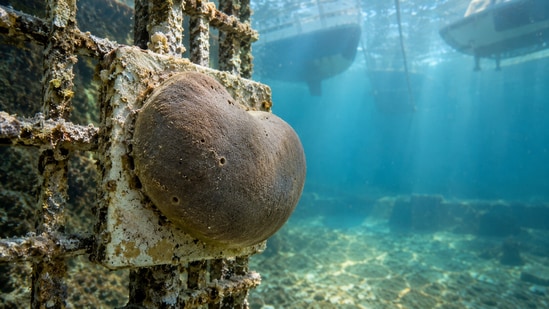
The team worked at Marina Palamós in Girona. They collected sponges from rocky walls 19 miles (30 km) away and glued sponges to ceramic plates. Then the plates were attached to metal grids attached to the marina's seawall. A total of 42 sponges were put in the water across four species, starting in November 2024. The team photographed them until February 2026, a span of 455 days. Separately, the team also tried to prepare a fifth species, the chicken-skin sponge Corticium candelabrum, but all 15 individuals collected died in the lab before they could even be attached to a plate, so none of them ever made it into the marina.
One sponge came out on top
The chicken kidney sponge was the clear winner. At the end, 22 of the 24 placed in the port were still alive, a survival rate of 91.7%. The other two weren't confirmed dead from pollution, one detached from its plate by accident shortly after deployment, and the other appeared to deliberately pull itself free after reshaping its body, a behavior linked elsewhere to self-cloning. Researchers counted both as losses for the survival count, but say their true fate is unknown. Three other species slowly shrunk and died in about 165 days: Crambe crambe, Scalarispongia scalaris, and Ircinia oros.
{{/usCountry}}The chicken kidney sponge was the clear winner. At the end, 22 of the 24 placed in the port were still alive, a survival rate of 91.7%. The other two weren't confirmed dead from pollution, one detached from its plate by accident shortly after deployment, and the other appeared to deliberately pull itself free after reshaping its body, a behavior linked elsewhere to self-cloning. Researchers counted both as losses for the survival count, but say their true fate is unknown. Three other species slowly shrunk and died in about 165 days: Crambe crambe, Scalarispongia scalaris, and Ircinia oros.
{{/usCountry}}A sponge that can move
This sponge has a surprising trick: it can crawl. One sponge traveled 12.7 centimeters (about 5 inches) total on its plate. Seven of the 24 broke into pieces at least once, creating clones. According to the study, this growth in clones expanded the group living in the harbor from the original 24 sponges up to 40 by the end of the monitoring period. The sponges lost, often early on, an average of about 18.6 percent of their body area. Many then remained steady. One sponge even deteriorated twice and recovered both times.
A Turkish hint
This is where the 2019 paper, ‘Development of an Integrated Mariculture for the Collagen-Rich Sponge Chondrosia reniformis’ published in Marine Drugs, comes in. Mert Gökalp and colleagues grew chicken kidney sponges close to the Bodrum Peninsula in Turkey, at a site that was a fish farm and at a cleaner site. After 13 months, 86 percent survived at the fish farm site, compared with 39 percent at the cleaner site (counting sponges caught on plates below). The authors suggested that occasional strong currents at the cleaner site may have knocked sponges off their plates. Maldonado's team notes that harbors contain a mixture of organic waste, heavy metals, and fuel pollution, so the two settings are different.
What the study didn't show
The experiment was not designed to test if sponges can clean up a port. It was a first step in finding out which species could survive. The results for two failed species were preliminary, as the samples were small, with only five and three sponges. There was no control group outside the harbor for comparison. Two chicken kidney sponges were counted as dead after being removed from their plates, but their final fate is unknown. When the team checked the plates in September 2025, during the experiment, it found no young sponges from sexual reproduction.
Why the finding matters
Researchers consider sponges useful for restoration because they add structure to the seafloor and filter water. The authors also caution that tolerance cannot be assumed across species, as only one of five passed this test. For now, the chicken kidney sponge is a hopeful candidate, not a proven fix.