Since 1978, China has planted about 66 billion trees and hopes to add another 34 billion by mid-century. Now, a study by Yuhang Luo and colleagues in Geophysical Research Letters in 2026 has checked how those forests compare with natural ones. It turned out that planted forests gained leaf area 66% faster. It sounds like a big win, but the full story is more interesting than the number.
Why is China planting so many trees
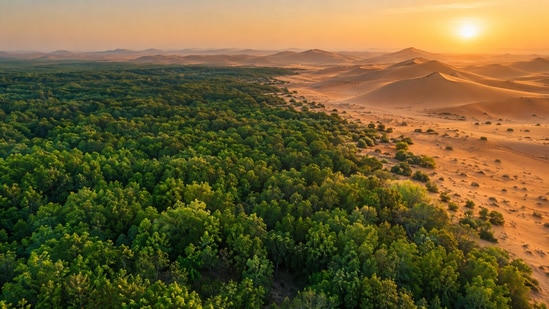
The trees are part of a huge reforestation effort, including the Great Green Wall to slow the spread of the Gobi and Taklamakan deserts. Planted forests are forests people create intentionally. Natural forests grow by themselves. Scientists know these forests absorb carbon dioxide from the air, but they have not fully understood how they differ from natural forests. Luo, a landscape ecologist at Peking University in Shenzhen, noted that most global ecosystem models do not distinguish well between the two types of forest. This matters for carbon accounting and climate policy.
What the satellites revealed
Using satellite data, the team kept an eye on leaf area index, or how dense a forest's canopy is. It is an important driver of carbon uptake. The majority of the 66% gap was due to age, because planted forests are on average much younger than natural forests, and young trees grow faster than old trees. Even when the researchers compared forests of similar age and growing conditions, planted forests still grew 4.6% faster in leaf area, a smaller edge that age cannot explain. The difference was even greater in mixed and evergreen forests.
How management helps trees
Management also plays a role. Planted forests tend to feature fast-growing species such as eucalyptus and poplar. People often care for them, removing competing vegetation and even adding fertilizer. These practices lessen competition for light, water, and nutrients and increase the fertilizing effect of rising CO2 in the air. The team suggested the planted trees may be responding more strongly to that extra CO2. But the advantage has a time limit. The gap is highest in planted trees of 30-40 years old and then declines noticeably after age 40. Natural forests grow more slowly but steadily, so they have the advantage in the long term.
Why experts are cautious
{{/usCountry}}Management also plays a role. Planted forests tend to feature fast-growing species such as eucalyptus and poplar. People often care for them, removing competing vegetation and even adding fertilizer. These practices lessen competition for light, water, and nutrients and increase the fertilizing effect of rising CO2 in the air. The team suggested the planted trees may be responding more strongly to that extra CO2. But the advantage has a time limit. The gap is highest in planted trees of 30-40 years old and then declines noticeably after age 40. Natural forests grow more slowly but steadily, so they have the advantage in the long term.
Why experts are cautious
{{/usCountry}}Luo cautioned that planted forests can be a powerful tool for carbon uptake in the short term, but natural forests are irreplaceable for long-term storage and resilience. Some experts doubt that leaf cover captures everything that matters. Kevin Dsouza, who worked on reforestation models during his postdoctoral research at the University of Waterloo and was not involved in the study, called leaf area a reasonable proxy, though not the full picture. Carbon is also stored in wood, bark, roots, and soil. He pointed to another study of Chinese forests, which found that natural forests stored more above-ground carbon in their early years than planted forests. That shows different measures of forest growth do not always point the same way.
China's wider greening
This is part of a larger pattern. Satellite data from 2000 to 2017, analyzed in a 2019 Nature Sustainability paper by Chi Chen and colleagues, showed that China alone was responsible for about 25% of the global net increase in leaf area. Forests contributed 42% of China's growth and croplands 32%.
What the findings mean
Luo added that it is not just about planting more trees. It’s also about what species you choose, when you plant them, and how you care for them over time. He hopes the findings will help inform future reforestation efforts, helping people decide when to plant, what to plant, how long the benefits last, and what current climate models are getting wrong. This could help new forests deliver greater climate benefits.