The Indian Space Research Organisation (ISRO) is slated to launch the Earth Observation Satellite (EOS-08) aboard the Small Satellite Launch Vehicle (SSLV) -D3 (third development flight).
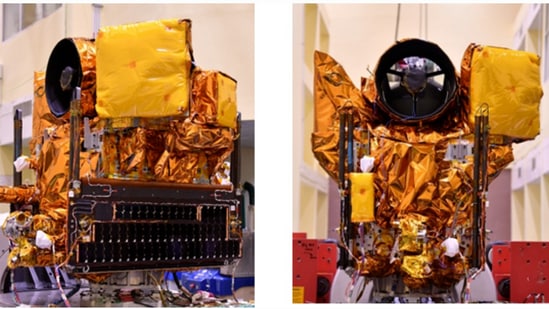
The mission's primary goals, according to the space agency, are to design and build a microsatellite, develop payload instruments compatible with the microsatellite bus, and integrate new technologies needed for future operational satellites.
Follow- ISRO EOS 08 launch LIVE Updates
All about the payloads that EOS-08 will carry
EOS-08 features three payloads: the Electro-Optical Infrared Payload (EOIR), the Global Navigation Satellite System-Reflectometry payload (GNSS-R), and the SiC UV Dosimeter.
- The EOIR payload is equipped to capture images in both the Mid-Wave IR (MIR) and Long-Wave IR (LWIR) bands, suitable for day and night operations. It is used for satellite-based surveillance, disaster monitoring, environmental observation, fire detection, volcanic activity tracking, and monitoring industrial and power plant-related disasters.
- The GNSS-R payload showcases the ability to use GNSS-R-based remote sensing for applications including ocean surface wind analysis, soil moisture evaluation, cryosphere research over the Himalayan region, flood detection, and monitoring inland water bodies.
- The SiC UV Dosimeter is designed to monitor UV irradiance at the Crew Module viewport in the Gaganyaan Mission and functions as a high-dose alarm sensor for gamma radiation.
More about EOS-08: It has a mission life of 1 year
According to ISRO, the spacecraft is designed to operate in a Circular Low-Earth Orbit (LEO) at an altitude of 475 km and an inclination of 37.4 degrees. Its mission duration is one year.
{{/usCountry}}According to ISRO, the spacecraft is designed to operate in a Circular Low-Earth Orbit (LEO) at an altitude of 475 km and an inclination of 37.4 degrees. Its mission duration is one year.
{{/usCountry}}The satellite weighs approximately 175.5 kg and generates around 420 W of power. It will be launched using the SSLV-D3/IBL-358 launch vehicle.
EOS-08 represents a significant advancement in satellite mainframe systems, featuring an Integrated Avionics System known as the Communication, Baseband, Storage, and Positioning (CBSP) Package. This system consolidates multiple functions into a single, efficient unit.
The EOS-08 mission enhances satellite technology through X-band data transmission by integrating innovative techniques. It employs pulse shaping and Frequency-Compensated Modulation (FCM) to optimise X-band data transmitters.
The mission also includes an auto-launch pad initialization feature, showcasing its dedication to advanced mission management.