Nasa has launched a sounding rocket from the agency’s Wallops Flight Facility in Virginia to test a supersonic parachute for landing its next rover on Mars.
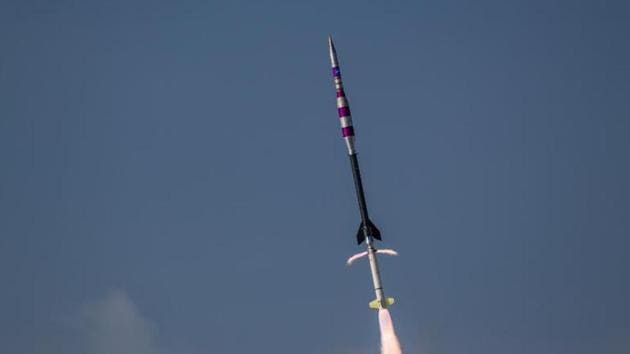
The rocket launched on Friday carried the Advanced Supersonic Parachute Inflation Research Experiment (ASPIRE) from Nasa’s Jet Propulsion Laboratory (JPL) in Pasadena, California.
The payload descended by parachute and splashed-down in the Atlantic Ocean 28 miles from Wallops Island, Nasa said.
The parachute was successfully recovered and returned to Wallops for data retrieval and inspection.
The suborbital launch was designed to mimic conditions that the parachute might experience during a Mars landing, Space.com reported.
“This is really a strength test of that Mars 2020 (rover) design,” Jeremy Hill, a mechanical engineer at JPL, was quoted as saying during a webcast of the launch.
“We want to get as close to the Martian environment as we can.”
The payload is a bullet-nosed, cylindrical structure holding a supersonic parachute, the parachute’s deployment mechanism, and the test’s high-definition instrumentation -- including cameras -- to record data.
The Mars 2020 rover mission is scheduled to launch in July/August 2020 when Earth and Mars are in good positions relative to each other for landing on Mars.
{{/usCountry}}The Mars 2020 rover mission is scheduled to launch in July/August 2020 when Earth and Mars are in good positions relative to each other for landing on Mars.
{{/usCountry}}The mission takes the next step in addressing questions about potential for life on Mars by not only seeking signs of habitable conditions on Mars in the ancient past, but also searching for signs of past microbial life itself.