NASA’s robotic spacecraft Osiris-Rex is set to begin on Tuesday a delicate operation to store the precious particles it scooped up from the asteroid Bennu, but which were leaking into space when a flap got wedged open.
The probe is on a mission to collect fragments that scientists hope will help unravel the origins of our solar system, but that hit a snag after it picked up too big of a sample.
Also Read: NASA to announce ‘exciting new discovery’ about Moon today
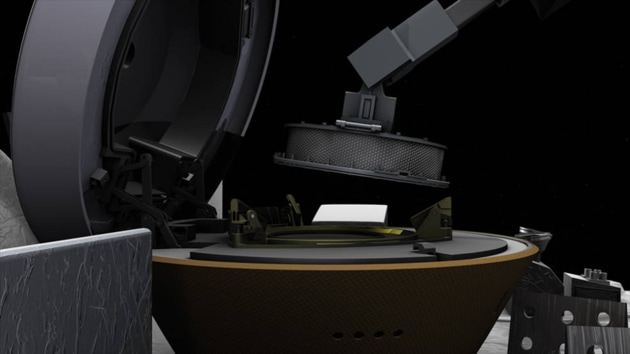
Fragments from the asteroid’s surface are in a collector at the end of the probe’s three-meter (10-foot) arm, slowly escaping into space because some rocks have prevented the compartment closing completely.
That arm is what came into contact with Bennu for a few seconds last Tuesday in the culmination of a mission launched from Earth some four years ago.
The probe is thought to have collected some 400 grams (14 ounces) of fragments, far more than the minimum of 60 grams needed, NASA said previously.
Scientists need to stow the sample in a capsule that is at the probe’s center, and the operation was moved up to Tuesday from the planned November 2 date due to the leak.
{{/usCountry}}Scientists need to stow the sample in a capsule that is at the probe’s center, and the operation was moved up to Tuesday from the planned November 2 date due to the leak.
{{/usCountry}}Also Read: NASA calls this image ‘galactic attraction’. Check it out to see why
“The abundance of material we collected from Bennu made it possible to expedite our decision to stow,” said Dante Lauretta, project chief.
Osiris-Rex is set to come home in September 2023, hopefully with the largest sample returned from space since the Apollo era.
The stowing operation will take several days, NASA said, because it requires the team’s oversight and input unlike some of Osiris-Rex’s other operations that run autonomously.
After each step in the process the spacecraft will send information and images back to Earth so scientists can make sure everything is proceeding correctly.
The probe is so far away that it takes 18.5 minutes for its transmissions to reach Earth, and any signal from the control room requires the same amount of time to reach Osiris-Rex.