The mystery of illuminating rocks has intrigued scientists for centuries. The 1800s was the first time when geologists were enlightened about the afterglow of the hackmanite mineral or tenebrescent sodalite that causes bright pink glow when broken or in the dark.
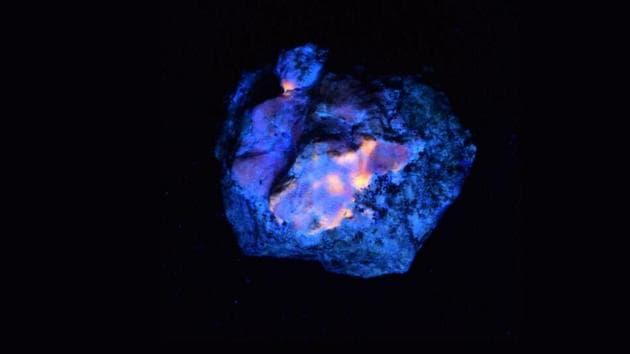
A new study around the same mystery details how certain hackmanites retain their natural lumination when they move into darker surroundings. The study was published in Chemistry of Materials, a peer-reviewed scientific journal, published by the American Chemical Society.
The study is important as it helps understand the illumination of the rock in the dark to develop synthetic materials that can glow without any source of power and be used as emergency signals. A lot of research has been done with synthetic hackmanites that has led to the creation of a material, which can emit a light longer than natural hackmanite. However, the conditions affecting the glow are yet to be discovered, said materials chemist Isabella Norrbo from the University of Turku in Finland.
A mix of both experimental and computational data was studied to determine that the concentrations and balance of sulfur, potassium, titanium, and iron are key to hackmanite glow . Researchers discovered titanium as the chief element that actually illuminates in the dark, while the glow is enabled by electron transfer. However, titanium in isolation is not enough until there is an amalgamation of other elements to trigger the glow.
{{/usCountry}}A mix of both experimental and computational data was studied to determine that the concentrations and balance of sulfur, potassium, titanium, and iron are key to hackmanite glow . Researchers discovered titanium as the chief element that actually illuminates in the dark, while the glow is enabled by electron transfer. However, titanium in isolation is not enough until there is an amalgamation of other elements to trigger the glow.
{{/usCountry}}Hackmanite samples from Greenland, Canada, Afghanistan, and Pakistan were procured for the research and a global team of chemists, mineralogists, geologists, physicists, statisticians, and other scientists worked to understand the hackmanite glow.
The big mystery was also about why some types of hackmanite illuminate and others don’t, which was solved after a careful comparison of various samples. The team found out the presence of orange photoluminescence that turns absorbed photons into light, blue luminescence that emits light without any heat and purple photochromism which is a chemical process of modification due to electromagnetic radiation.
The glow of the rocks is the result of a nexus of chemical processes and natural elements found in them. Scientists believe that through this better result can be yielded for synthetic material but the longevity of the luminescence is also an important factor to study and work on, since desired chemical elements can be added to synthetic material but their properties cannot be predicted.