
 E-Paper



Scientists find footprints of prehistoric crocodile that walked on two legs
The fossil tracks include footprints that are 18-24 cm (7-10 inches) long, which scientist believe, may have been made by a three-metre (10-foot) long ancestor of the present-day crocodile, over 100 million years ago.

 Prefer HTon Google


Some ancient crocodiles, who scientists had till now believed to have walked on all four legs just like their modern-day counterparts, may have moved around on only two legs, a new research suggests.
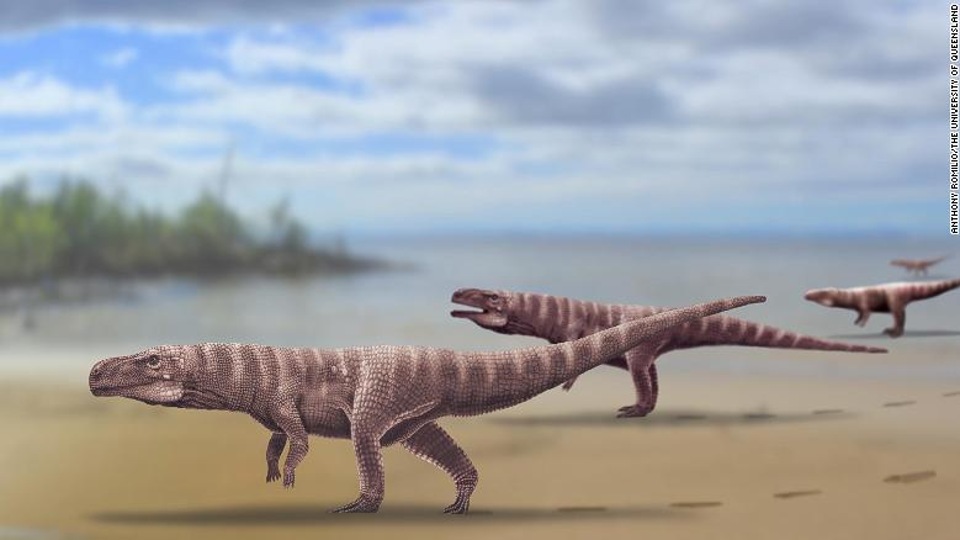
The evidence has come from well-preserved fossil tracks found at the Jinju Formation in South Korea, according to a study by a team of researchers from China, Australia and the US.
The fossil tracks include footprints that are 18-24 cm (7-10 inches) long, which scientist believe, may have been made by a three-metre (10-foot) long ancestor of the present-day crocodile, over 100 million years ago.
Named Batrachopus grandis, these creatures walked around “like a crocodile balancing on a tight-rope,” according to team leader Kyong Soo Kim from South Korea’s Chinju National University of Education, reports news agency AFP.
“They were moving in the same way as many dinosaurs, but the footprints were not made by dinosaurs,” Kim said.
“The narrow trackways were made entirely by the back limbs, with clear heel to toe impressions and skin traces in some areas,” according to a release about the study recently published in the journal Scientific Reports.
Similar footprints found earlier at other sites in South Korea were thought to belong to giant pterosaurs or prehistoric flying reptiles who walked on two legs.
But the team of palaeontologists that made the present discovery say that they likely belonged to a particularly large and previously undiscovered species of bipedal crocodile that walked on two legs because it was semi-adapted to land.
Researchers reached this conclusion on the basis of the width of the trackways and a lack of any tail-drag marks.
“Our trackways are very narrow-looking - more like a crocodile balancing on a tight-rope,” Kyung Soon Kim was quoted in a BBC report. .
“When combined with the lack of any tail-drag marks, it became clear that these creatures were moving bipedally.
“They were moving in the same way as many dinosaurs, but the footprints were not made by dinosaurs. Dinosaurs and their bird descendants walk on their toes.
“Crocodiles walk on the flat of their feet leaving clear heel impressions, like humans do,” Kim added.
The Batrachopus grandis that lived in the Early Cretaceous period, however, wasn’t the only bipedal crocodile . According to the present study, crocodiles that walked on two legs may have roamed the Earth much earlier during the early Mesozoic era that started about 250 million years ago.


