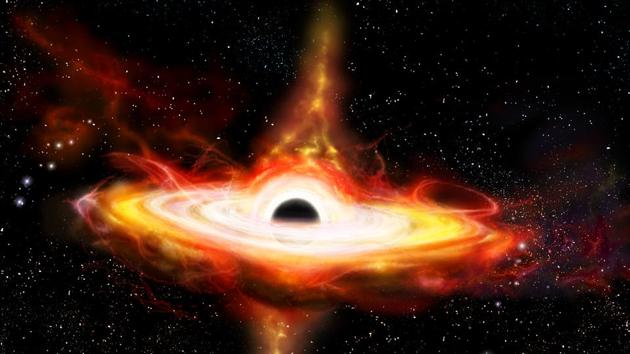
The world, it seems, is soon to see the first picture of a black hole. On Wednesday, astronomers across the globe will hold “six major press conferences” simultaneously to announce the first results of the Event Horizon Telescope (EHT), which was designed precisely for that purpose.
The EHT is unlike any ever devised. “Instead of constructing a giant telescope that would collapse under its own weight, we combined several observatories as if they were fragments of a giant mirror,” Michael Bremer, an astronomer at the Institute for Millimetric Radio Astronomy in Grenoble, told AFP.
In April 2017, eight such radio telescopes scattered across the globe, in Hawaii, Arizona, Spain, Mexico, Chile, and the South Pole, were trained on two black holes in different corners of the Universe to collect data.
Of all the forces or objects in the Universe that we cannot see — including dark energy and dark matter — none has frustrated human curiosity so much as the invisible maws that shred and swallow stars like so many specks of dust.
Astronomers began speculating about these omnivorous “dark stars” in the 1700s, and since then indirect evidence has slowly accumulated. “More than 50 years ago, scientists saw that there was something very bright at the centre of our galaxy,” Paul McNamara, an astrophysicist at the European Space Agency and an expert on black holes, told AFP. “It has a gravitational pull strong enough to make stars orbit around it very quickly — as fast as 20 years.” To put that in perspective, our Solar System takes about 230 million years to circle the centre of the Milky Way. Eventually, astronomers speculated that these bright spots were in fact “black holes” -- a term coined by American physicist John Archibald Wheeler in the mid-1960s -- surrounded by a swirling band of white-hot gas and plasma.
{{/usCountry}}Astronomers began speculating about these omnivorous “dark stars” in the 1700s, and since then indirect evidence has slowly accumulated. “More than 50 years ago, scientists saw that there was something very bright at the centre of our galaxy,” Paul McNamara, an astrophysicist at the European Space Agency and an expert on black holes, told AFP. “It has a gravitational pull strong enough to make stars orbit around it very quickly — as fast as 20 years.” To put that in perspective, our Solar System takes about 230 million years to circle the centre of the Milky Way. Eventually, astronomers speculated that these bright spots were in fact “black holes” -- a term coined by American physicist John Archibald Wheeler in the mid-1960s -- surrounded by a swirling band of white-hot gas and plasma.
{{/usCountry}}The studies that could be unveiled next week are likely to zoom in on one of the two black holes the EHT focussed on.
Oddsmakers favour Sagittarius A*, the black hole at the centre of our own elliptical galaxy that first caught the eye of astronomers. Sag A* has four million times the mass of our sun, which means that the black hole it generates is about 44 million kilometres across. That may sound like a big target, but for the telescope array on Earth some 26,000 light-years (or 245 trillion kilometres) away, it’s like trying to photograph a golf ball on the Moon.
The other candidate is a monster black hole — 1,500 times more massive even than Sag A* — in an elliptical galaxy called M87. It’s also a lot farther from Earth, but distance and size balance out, making it roughly as easy (or difficult) to pinpoint.
One reason this dark horse might be the one revealed next week is a light smog within the Milky Way. “We are sitting in the plain of our galaxy — you have to look through all the stars and dust to get to the centre,” said McNamara. The data collected by the far-flung telescope array still had to be collected and collated. “The imaging algorithms we developed fill the gaps of data we are missing in order to reconstruct a picture of a black hole,” the team said on their website.
Astrophysicists not involved in the project, including McNamara, are eagerly waiting to see if the findings challenge Einstein’s theory of general relativity, which has never been tested on this scale. Breakthrough observations in 2015 that earned the scientists involved a Nobel Prize used gravitational wave detectors to track two black holes smashing together.
As they merged, ripples in the curvatures of time-space creating a unique, and detectable, signature. “Einstein’s theory of general relativity says that this is exactly what should happen,” said McNamara. But those were tiny black holes -- only 60 times more massive than the Sun -- compared to either of the ones under the gaze of the EHT. “Maybe the ones that are millions of times more massive are different -- we just don’t know yet.”