
 E-Paper



Solar storms: Where to spot aurora in India today?
In the past 1-2 days, Earth has been bombarded by multiple X-class flares and coronal mass ejections, with more anticipated in the coming days.

 Prefer HTon Google


Powerful solar storms have lit up Earth's skies in a few days, marking the strongest event in over two decades. On a rare occurrence, even at mid-latitudes, like Ladakh, dazzling auroras adorned the sky.
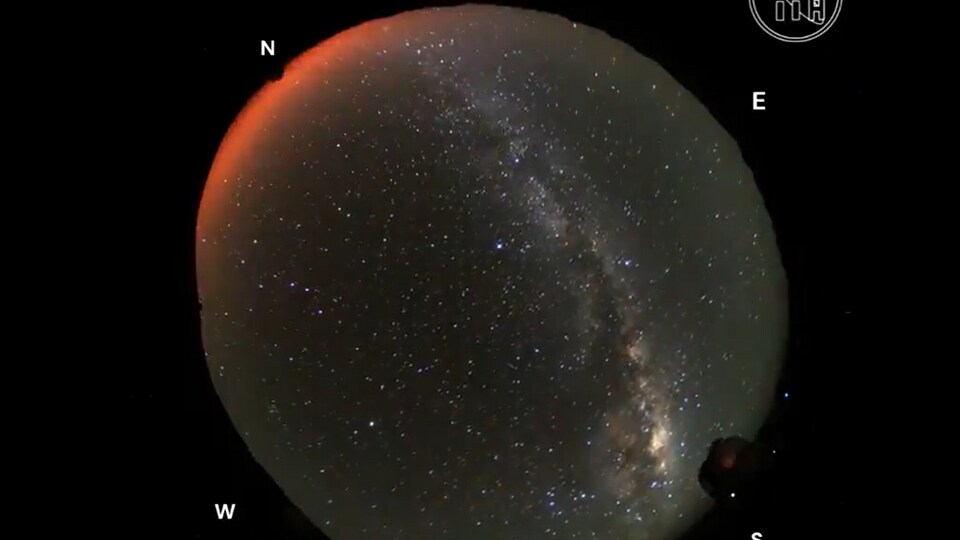
Auroras spotted in Ladakh
Auroras, a natural spectacle, result from the interplay between Earth's magnetic field and charged particles carried by the solar wind. Typically, they are visible in regions closer to the poles and are thus called northern or southern lights, depending upon the location.
However, on a rare occasion, researchers from the Indian Institute of Astrophysics (IIA) captured stunning auroral activity at Hanle and Merak in Ladakh using all-sky cameras on Saturday.
ALSO READ- Severe solar storm: Northern lights to be visible across almost all of US
What has caused rare auroras in Ladakh?
The US National Oceanic and Atmospheric Administration (NOAA) Space Weather Prediction Center has reported the occurrence of a severe (G4) Geomagnetic storm, classified as G4 on NOAA's scale.
This is the biggest Geomagnetic storm since 2003 in terms of its strength as the flaring region on the Sun was as big as the historically important Carrington event that took place in 1859.
ALSO READ- Ladakh sky shines: Solar storms bring aurora even at mid-latitudes in India
What is the reason for this massive solar storm?
The recent surge in solar storms can be attributed to a massive sunspot cluster known as NOAA Region 3664, dwarfing Earth by 17 times in size. Forecasts suggest further activity from this region.
Since 2019, only three severe (G4) geomagnetic storms have occurred in this solar cycle. The last extreme (G5) event took place during the Halloween Storms in October 2003, resulting in power outages in Sweden and damaging transformers in South Africa.
ALSO READ- Nature's light show: The magic of Northern Lights explained
More solar storms predicted
In the past 1-2 days, Earth has been bombarded by multiple X-class flares and coronal mass ejections, with more anticipated in the coming days.
NOAA predicts that geomagnetic storming will persist overnight, with varying intensity. By early Sunday and into Sunday night, the next major solar ejections, travelling at speeds of up to 1800 kilometers per second, will impact Earth's magnetic field and reach the outer atmosphere.
A G4 Watch remains in effect for May 12, NOAA said..


