Many animals avoid hornets because their stings are dangerous. The Asian giant hornet is the world's largest hornet species, and its sting can cause intense pain and tissue damage. Its venom can also have potentially fatal effects on small vertebrates.
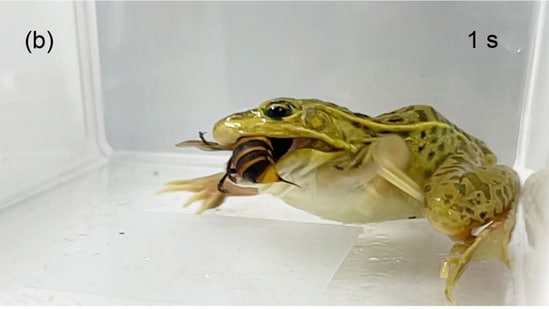
But one small frog in Japan appears not to avoid hornets. Shinji Sugiura, an ecologist at Kobe University, found that the black-spotted pond frog hunts, is stung by, and eats hornets, including the Asian giant hornet, also known as the murder hornet.
A frog that fears no sting
Sugiura's 2025 study, published in Ecosphere, examined how black-spotted pond frogs responded to worker hornets from three species: Vespa simillima, V. analis, and V. mandarinia, the Asian giant hornet. For the experiments involving V. mandarinia, he preferentially used larger frogs because he assumed smaller frogs would be unable to fit the large hornets into their mouths.
What Sugiura observed was difficult to overlook. Most frogs lunged forward to catch the hornets, receiving stings to sensitive areas such as the mouth and eyes but continuing their attacks. Despite being stung, most frogs eventually consumed their prey. The study found that 93% of frogs consumed V. simillima, 87% consumed V. analis, and 79% consumed V. mandarinia.
The findings are notable because hornet venom can be dangerous to small vertebrates. The study cites earlier research showing that a single sting from V. mandarinia can deliver a lethal dose of venom to mice weighing 270 grams, while the frogs used in Sugiura's experiments weighed between 6 and 76 grams. Many frogs were stung repeatedly, yet none died and all resumed normal behavior shortly afterward.
{{/usCountry}}The findings are notable because hornet venom can be dangerous to small vertebrates. The study cites earlier research showing that a single sting from V. mandarinia can deliver a lethal dose of venom to mice weighing 270 grams, while the frogs used in Sugiura's experiments weighed between 6 and 76 grams. Many frogs were stung repeatedly, yet none died and all resumed normal behavior shortly afterward.
{{/usCountry}}The results indicate that the frogs can tolerate repeated hornet stings while continuing to capture and consume their prey. However, the study did not determine exactly how the frogs achieve this tolerance.
A clue from a different kind of toxin
Nobody has pinned down exactly how the pond frog manages this yet, but earlier work on other venomous and poisonous animals offers a useful starting point. A 2021 paper in the Journal of General Physiology, led by researcher Fayal Abderemane-Ali, examined poison frogs and poison birds that produce a potent neurotoxin called batrachotoxin. The researchers investigated whether changes in sodium channels, which are involved in nerve signaling, could explain how these animals avoid being harmed by the toxin. Their tests showed that the sodium channels of the tested poison bird and frog species remained sensitive to batrachotoxin, rather than carrying the proposed mutation thought to make the channels resistant. The study instead identified specialized proteins in the animals' blood plasma that bind to batrachotoxin and help prevent it from reaching its targets.
That study involved a completely different toxin and different animals, so it cannot explain the pond frog's ability to eat hornets on its own. What it does show is that resistance to a potent toxin can involve mechanisms beyond changes in nerve channels, including proteins in the blood plasma. Sugiura's study similarly raises the possibility that frogs could help researchers investigate how vertebrates tolerate the painful and potentially lethal effects of hornet stings, although the mechanism behind the pond frog's tolerance remains unknown.
Further research will be needed to explain how the pond frog tolerates these encounters. For now, the experiments show that the frogs can capture and eat several hornet species even after being stung repeatedly.