Kolkata:In the surreal silence of Hisor Central Stadium – except for the tie against Tajikistan, India’s matches felt like closed-door affairs – Khalid Jamil’s instructions boomed and bounced off the rafters. “Hold, hold”, “no foul, no foul”, “second ball, second ball”, “up, up”, you could hear India’s men football team head coach and see him live every moment of the CAFA Nations Cup matches on the touchlines.
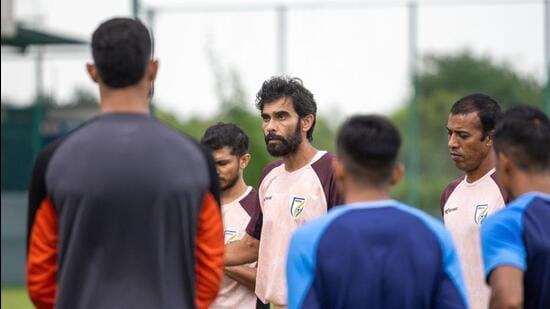
Usually in black, his beard scruffy and hair tousled, Jamil was a prominent physical and aural presence in the technical area. Off the field, Jamil, 48, speaks softly, is unfailingly polite and self-effacing to a fault.
“Everyone was under pressure and wanted results for a long time. The important thing is India won (a bronze) but it was all down to the players,” he says in an interview over the phone from Mumbai, his first since the third-place finish in Tajikistan on September 8.
“It never felt like I was missing under-23 players (unavailable because of Asian qualifiers) or the seven from Mohun Bagan Super Giant or the fact that many players had not done pre-season training,” he says.
“The desire that I saw in the players from the time of the camp in Bengaluru gave me the hope we will achieve something.” To elucidate, he says: “It wasn’t till the end against Iran that Sandesh (Jhingan) told me he was feeling little pain.” Having suffered a jaw injury in the 11th minute, Jhingan played the full match and will be out for four weeks.
“Rahul (Bheke) is quiet but a lion on the pitch. Anwar Ali is calm. In the last game (against Oman), substitutes came on and made the difference. Joh hua automatic tha. Everyone wanted to prove themselves. The new players went above and beyond what I had asked of them.”
{{/usCountry}}“Rahul (Bheke) is quiet but a lion on the pitch. Anwar Ali is calm. In the last game (against Oman), substitutes came on and made the difference. Joh hua automatic tha. Everyone wanted to prove themselves. The new players went above and beyond what I had asked of them.”
{{/usCountry}}In Tajikistan, Jamil handed debuts to left-back Muhammad Uvais, defensive midfielders Danish Farooq and Nikhil Prabhu and attacker Jithin MS.
Twelve in the squad were also part of the 0-0 draw against Bangladesh, a result that had India team director Subrata Paul saying that players had lacked desire. Manolo Marquez, Jamil’s predecessor, had said players could have shown more pride while pulling on the India shirt. Jamil took no credit for the shift in attitude but said: “I had no reason to doubt their commitment.”
The Sandhu boost
It helped that India got off to a good start beating Tajikistan, “but for me it was important that we were not over-confident.” Crucial to India beating higher-ranked Tajikistan 2-1 was Gurpreet Singh Sandhu who made a string of saves, including a penalty. The goalkeeper had been ignored by Marquez but selected by Jamil even though he had played no football in between.
“My first call on being appointed head coach was to Gurpreet and I told him he was needed,” says Jamil. “If you ask me who is the best player in India, my answer is: Gurpreet. I think he is one of the best goalkeepers in Asia. I told myself that my biggest mistake will be not calling Gurpreet. What did I do to help him? Gave him confidence. Bas baat khatam.”
A reflex save from Sandhu, 33, against Afghanistan fetched India the point they needed to make the third-place play-off against Oman where he turned saviour by saving the last shot in the tie-breaker.
Jamil said it was the backline and Sandhu that helped India stay organised in defending set-pieces. “I didn’t plan much. (Forward) Irfan (Yadwad), who defended the near post well, was constantly guided by Gurpreet. Sandesh, Gurpreet, Anwar and Rahul organised the zonal and man-marking routines.”
Jamil’s focus on positives was understandable given that India had not won a competitive match in 2024 and then beat two higher-ranked opponents (Tajikistan and Oman) in one tournament. That the goals came from set-plays, long throws by Uvais and Bheke, is not a problem, he says. “If it had been the other way round, I would have been asked why India are scoring only from open play.”
What does worry him is the lack of efficiency in the front third. “It is the one thing we have to improve,” he says. “We have time now.”
Jamil wants to start preparing for the Asian Cup qualifiers against Singapore from September 20. On Sunday, he named 30 probables, including Sunil Chhetri, for the camp. Not on the list are Mohun Bagan and FC Goa players who will join after their Asian Champions League 2 matches, according to an All India Football Federation (AIFF) release.
India’s gritty show in Tajikistan has, Jamil says, given him a selection headache. “I will evaluate everyone with an open mind. But if they are equal, the players from CAFA will be preferred.”
At the bottom of the pile in the qualifiers, Jamil termed each match as “do-or-die”. Asked if India would eschew possession like they did in Tajikistan, Jamil said there will not be any one way of playing. “If I feel there are games where we need to keep the ball, we will. But let us not forget, Singapore is an away game (October 9). Smart thinking and not losing concentration will be important.”