
 E-Paper



Magnus Carlsen's back-to-back Armageddon losses: Unraveling the 'King's' strange struggle
Magnus Carlsen's record in Armageddon games has been astonishing. Despite his recent setbacks, his overall win rate in this format is an incredible 78.38%.

 Prefer HTon Google


Magnus Carlsen, widely hailed as the "King of Armageddon" for his unparalleled prowess in this high-stakes chess format, has surprisingly suffered back-to-back losses. This unexpected turn has left chess enthusiasts and experts alike pondering the reasons behind the reigning world No. 1 recent struggles in a format where he has historically dominated.
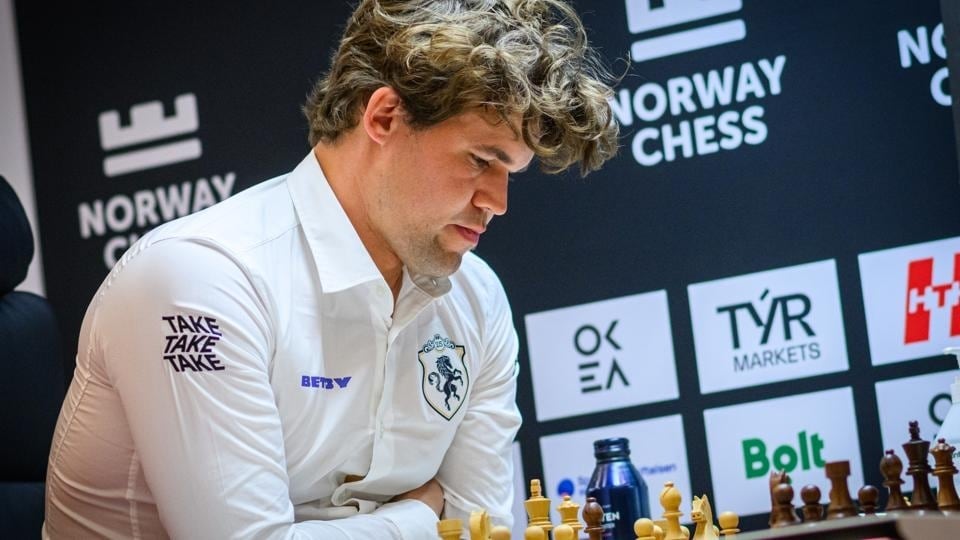
What is Armageddon in Chess? Understanding the Ultimate Tie-Breaker
Armageddon chess is the trickiest and most thrilling format in competitive chess, serving as a decisive tie-breaker when traditional games end in a draw. It introduces unique dynamics, making it a true test of nerve, strategy, and time management.
Here's a breakdown of the Armageddon rules and why it's so intense:
Unequal Time Controls: The defining characteristic of Armageddon is its unequal time allocation. Typically, White receives more time on the clock than Black (e.g., White gets 10 minutes, Black gets 7 minutes).
ALSO READ: In beating Gukesh, Carlsen shows why he is still king
Draw Odds for Black: This is the critical twist. If the game ends in a draw, Black is declared the winner. This means White must win to score, while Black can win by either achieving a checkmate or simply drawing the game.
High Stakes: Due to the draw odds, both players are under immense pressure. For White, a draw is as detrimental as a loss, and for Black, a draw is as good as a win.
Last Resort Tie-Breaker: Armageddon games are typically reserved as the final tie-breaking method after other formats, such as rapid or blitz games, have failed to produce a clear winner. They are the ultimate decider.
Example: Armageddon in Norway Chess 2025 In prestigious tournaments like Norway Chess 2025, if a standard game concludes in a draw, an Armageddon game is played to determine the winner for that round. White gets 10 minutes on the clock and needs a win to score, whereas Black gets 7 minutes and needs a win or even a draw to secure the point. This format ensures a decisive outcome for every match.
MUST READ: Magnus Carlsen's humble reaction after defeating D Gukesh sums up GOAT status: ‘I was by no means better’
Magnus Carlsen's Dominance: A Glimpse into the "King's" Reign
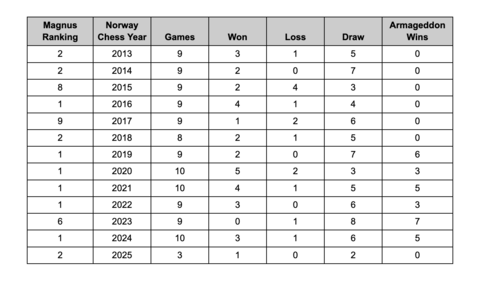
Magnus Carlsen's record in Armageddon games has been nothing short of astonishing. Despite his recent setbacks, his overall win rate in this format is an incredible 78.38%. This remarkable statistic underscores his mastery and ability to perform under extreme pressure.
Since the introduction of Armageddon as a tie-breaker in Norway Chess in 2019, Carlsen has consistently proven his mettle. He has won (Ranked 1) in five out of six tournaments until last year (Source: Norway Chess official website), a testament to his strategic brilliance and composure in this unforgiving format.
The Mystery of the Back-to-Back Losses
The recent back-to-back Armageddon losses for Magnus Carlsen are an anomaly in his otherwise stellar record. While the specific details of each loss would require a deeper analysis of the individual games, several factors could contribute to such an unexpected streak:
Opponent's Preparation: Opponents are undoubtedly studying Carlsen's Armageddon strategies more intently, perhaps finding new ways to exploit his preferences or tendencies.
Form and Fatigue: Even the greatest players experience fluctuations in form or fatigue, which can impact decision-making in high-pressure, time-constrained environments.
Psychological Pressure: While Carlsen is known for his mental fortitude, the cumulative pressure of maintaining such a dominant record could inadvertently add an extra layer of psychological burden.
Uncharacteristic Errors: Armageddon's unforgiving nature means that even a single uncharacteristic error can lead to a loss, especially in time trouble.
Regardless of the immediate reasons, these recent losses present a fascinating storyline in Magnus Carlsen's illustrious career. They serve as a reminder that even the "King of Armageddon" is not immune to the unpredictable nature of chess, and that the game continues to evolve with new challenges and strategies. Chess fans worldwide will undoubtedly be watching closely to see how Carlsen adapts and reasserts.


