
 E-Paper



Neeraj Chopra-inspired Indian javelin revolution seeks a fighting chance
The Tokyo Olympics gold won by the 23-year-old has added verve to javelin throwers, but coaching and infrastructure are major hurdles for the aspirants.


Nikunj Singh breathes in deeply a couple of times, and then, holding the javelin above his head, starts to move from the top of the runway. He takes a few strides then picks up speed, finally blocking his left leg by abruptly halting before hurling the spear. He sends two more javelins soaring as his father Anil Singh records each throw on his mobile. “How was the power? Was the angle of attack right?” Nikunj asks his father after the series. He walks down to pick up the javelins and begin a fresh series of throws.
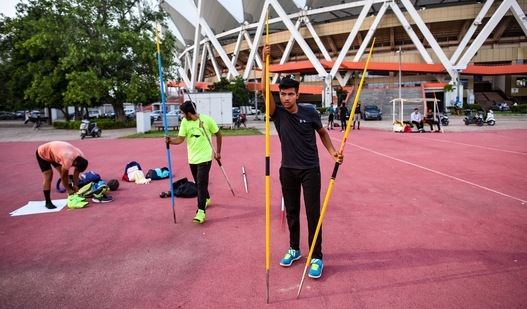
It is a routine Nikunj has stuck to for two years, without no trainer or coach. His father is his only guide. Tired of trying to find a coach for his son, Anil Singh left his job, becoming a self-taught coach. Having started with no knowledge of the sport, Singh now rattles off technical details about angle and speed of release, explaining the difference between a power thrower and a flexible thrower. From Nikunj’s diet to gym workload, his father manages everything.
“There are only a few javelin coaches in India and even they want to train those who have reached a certain level, touched close to 75m. Nobody wants to teach a newcomer,” says Singh. “My wife is a teacher. She asked me to help our son and since then my sole focus has been to see that Nikunj represents India and wins medals,” says the father, who brings his 21-year-old son on a bike daily from Punjabi Bagh in west Delhi to the Jawaharlal Nehru Stadium.
Vetter’s technique
Nikunj took up javelin on a whim in 2018 after finishing school and watching German star Johannes Vetter. Till then, he was into baseball but didn’t like the game. He learnt his javelin basics from Navy coaches at the JLN Stadium, but once they were transferred he was on his own from May 2019. He has made rapid progress though and is one of Delhi’s top throwers. He won the state meet in January throwing 67.76m. He wants to gain a few more metres to be selected to the national camp in Patiala.
“The only way forward is to get into NIS Patiala, and for that I need to improve to 75m. We have specialist foreign coaches and other facilities at NIS. You can train on your own till a point because everyone has a different technique. If you push yourself, there are chances of injury,” says Nikunj.
“I follow the routine I learnt in my first five months from Navy coaches Jagmohan Singh and Amrinder. My father and I watch my videos and see throws of Vetter and others whose techniques are similar, on YouTube. It helps us correct the mistakes,” says Nikunj.
The dizzying night of August 7 in Tokyo, when Neeraj Chopra hurled the spear for Olympic gold, validated the sporting pursuit of Nikunj and his father.
“We started our journey with hope and positivity and we still carry that. But the attitude of people around us has suddenly changed after Neeraj. People now look at us with intrigue and excitement,” says Singh. “From toll plaza to petrol pumps, when they see us with javelins, they smile and say, ‘Beta, bhala phekte ho. Acche se practice karna, Neeraj jaisa gold lana hai (you throw well. Practice well and bring gold like Neeraj).
“Earlier, people used to look at us as if my son was wasting his time and I was crazy. Even coaches would tell us to get a good job and leave. But my son has a dream and we are chasing that.”
Chopra’s gold has turned the focus on javelin throwers in India. Everyone now wants to take up the event. There is a rush to find coaches, academies and to buy equipment, but it stops there. There is total lack of infrastructure, coaches and sports science to sustain this sudden burst of interest in javelin.
“It is an expensive sport. You need diet, good javelins, coaches. Support comes only when a thrower has achieved something at international level,” says Singh.
Calls for coaching
Kashinath Naik, the 2010 Commonwealth Games bronze medallist who is now a coach, gets numerous calls from across the country after Chopra’s success.
The Army coach, who has been part of national camps, says, “I give them some advice or put them on to coaches I know so that they can at least start. But for the majority, I can’t do anything. There are not more than eight to 10 javelin coaches in the country with good knowledge of the sport. Many of the current throwers are also working without a proper full-time coach. We need more coaches, equipment and good structure to take advantage of this momentum.”
At the Sports Authority of India (SAI) facility in the Nehru Stadium, there is no javelin coach. Former national champion Sunil Kumar Goswami takes personal interest and trains seven throwers. He can teach only those who can bring their own javelin.
Anuj Dedha, 23, held a javelin for the first time after seeing Chopra. He comes from Indirapuram, Ghaziabad to train under Goswami.
“I know I took up the sport late but I am fascinated by Neeraj Chopra. I want to become a professional thrower,” says Dedha. “It’s a sport that has flamboyance. When you see Neeraj flexing his muscles, running in and throwing a spear, you feel like trying something like that,” says Dedha, who bought a javelin for ₹10,000 to begin training.
Those who can’t afford to buy must borrow or give up the thought of becoming a javelin thrower.
“It’s not something you can ask every beginner to spend. Even shelling ₹5,000-10,000 for a javelin is not easy for some families. The locally made javelins easily break. So, you need to buy two-three javelins,” says Goswami.
He says the sooner a young boy or girl starts with a good javelin the better. A range javelin (a make) may cost anywhere between ₹60,000 up to ₹1.5 lakh. “When a child is growing up, the muscles and tissues are soft and he needs to start with good equipment so that he is not injured and can learn the right technique.”
It is not only the starters, but high-end javelins of Nemeth and Nordic are out of reach even for top throwers. “We train with local javelins and get to use these good javelins only during competitions,” said a national level thrower from Sports Authority of India’s Bhiwani Centre. “There is no dedicated javelin coach at the centre. One who trains us is a decathlon coach.”
He says, “Neeraj was able to win an Olympic gold because he got the facilities from a young age, had foreign coaches and sponsors. If we get all these things, there is a lot of potential in India.”
Not much improvement
Satendra Kumar, who runs an academy in Bajna, Uttar Pradesh, near the Yamuna Expressway, says nothing has changed at grassroots, except that it has created a buzz.
“The only change is that people now know about javelin and kids want to become Neeraj Chopra. I even get calls from 30-year-olds that they want to start javelin. Where are the facilities, equipment, coaches? Even after Neeraj nobody wants to spend a penny on the sport at the grassroots. I have been trying to find sponsors or get some financial help but you get only promises,” says Kumar.
Kumar has around 30 javelin throwers in his academy, some national medallists. His trainee Jay Kumar competed at the World U20 Athletics Championships in Nairobi recently, finishing seventh with a throw of 70.34m. Seven of his trainees are national medallists at the junior level.
“We have throwers from Baghpat, Allahabad, Bihar in our academy. It’s a small set up with a hostel and gymnasium I opened a year-and-a-half ago. I started because we faced big problems during our days,” says Kumar.
Uttar Pradesh is the throws hub but there is no infrastructure. "The only place we have synthetic track in the state is Lucknow. In Allahabad, from where so many throwers come, there is no coach,” says Kumar.
“My academy has juniors who are doing exceptionally well at national level but they all train with locally available javelins. I cannot afford high-end javelins. Strength and conditioning is an important part of throwing and my gym needs better training apparatus. When these kids get international quality javelin in competition, they are not able to throw properly. If they train with such javelins regularly, it will help them increase their range by four to five metres,” says Kumar, a contemporary of Shivpal Singh, who competed at the Tokyo Olympics.
Poverty no bar
Prasanta Goswami of Tripura threw with one of the ‘range javelins’ at the National Open Championships in Warangal last month for the first time and felt like keeping it in a showcase.
“Forget throwing with it, I saw a proper javelin for the first time. The feeling was so good but its trajectory was difficult to handle. I have trained with javelins made of bamboo and aluminum designed by my coach,” says Goswami.
Javelin is a passion for Goswami, but it is hard to continue. A daily wage labourer, he has to support his family but still finds time to train. Goswami got to compete in his first domestic competition in Warangal and then in the National Under-23 Athletics Championships in New Delhi.
Chopra has sparked a fire in Goswami despite his harsh life. His coach Nitai Karmakar, who was a decathlete, sought help from a local politician, who sponsored his trip to Warangal and Delhi. At Warangal, he stepped on a synthetic track for the first time. He was the youngest competitor at Warangal, achieving a personal best of 64.70m. In Delhi, he was sixth with a throw of 63.75.
Karmakar sees huge potential in his ward and is trying to get financial help. “Only after Neeraj are people giving some positive response. A local politician decided to fund his trip. He comes from a very poor family and slogs in the day, and when he comes for training I can’t push him much. Yet, he has such passion and dedication that he is the best thrower in the state and is now competing at national level,” says Karmakar.
Rohit Yadav, one of India’s top throwers and current under-18 national record holder (81.75m), also had a tough journey coming from a small village in Jaunpur in Eastern Uttar Pradesh, learning with bamboo javelins with no coach.
“I loved the first time I threw a bamboo javelin and the way it got stuck in the field. My father was an athlete. He took me to a senior javelin thrower and he introduced me to the sport. I followed whatever he told me and trained on my own for the first couple of years, gathering as much information as possible,” says Yadav.
Online coaching project
He started posting his videos on Facebook and that’s how he connected with Michael Musselman, a former javelin thrower from Peru who runs Indianjavelin.com, providing online coaching to Indians. It was Yadav’s first professional guidance. “It was all online training. I used to send my videos and they would point out my faults. I got to learn new things about training, javelin-specific exercises, etc. in the one-and-a-half-years with them. It was an important phase because I could have gone nowhere else and I wanted to leave home after becoming a decent thrower.”
The brain behind the Indianjavelin.com initiative was Neeraj Chopra’s former coach, the late Australian Gary Calvert, under whom he won gold in the Junior World Championships in 2016. After Calvert’s sudden while he was China’s national coach, his friend Musselmann and co-founder Aditya Bhargava continued with the project and expanded the company—Ammentum Sport—which now makes javelins, especially for hard Indian grounds, called 8758 Gold Line javelins—the name given after Chopra’s 87.58m golden throw.
“We did a lot of research on the materials to use for Indian fields so that it doesn’t break easily. The product has been very well received and with Chopra’s feat the market is growing,” says Bhargava.
“Along with the equipment we help them with online coaching. It’s a platform for young Indian throwers who struggle to find coaches. They can use our expertise. Besides Musselmann, we have Thomas Alan Petranoff. Now we have Indian coaches, doing workshops with them and sending them on the ground to help our trainees. We’ve helped over 200 throwers but after Neeraj we are getting so many queries from parents and kids,” says Bhargava.
American Tom Petranoff is a former world record holder, won silver in the inaugural world championships in 1983 and took part in the 1984 and 1988 Olympics. He also designed a javelin for indoor competition.
Yadav too is flooded with requests to guide youngsters. Being a training partner of Chopra, he is approached with intrigue. “They ask me “you have been training with Neeraj”. I help the kids, explain basics. That is a good way to start to take help from your seniors,” he says.
“Going forward every state should have sports hostels and academies for javelin throwers. The national camp can only accommodate the best, but we have so many throwers. Nobody should be left out.”


