Jannik Sinner’s second successive Wimbledon title was secured through a performance that revealed almost everything distinctive about him. Alexander Zverev took the opening set, served with authority and kept the final balanced for nearly two hours, but Sinner did not panic, search for inspiration or dramatically alter his game. He simply continued applying pressure until the match changed shape.
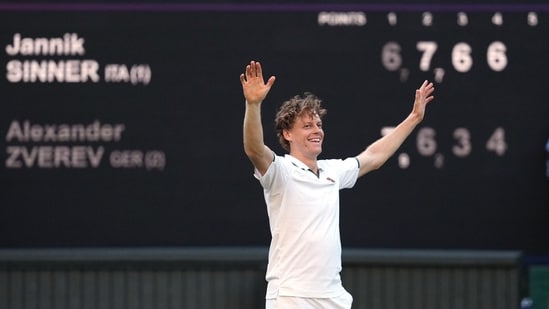
After losing the first set tie-break, Sinner dominated the second, broke twice across the next two sets and completed a 6-7(7-9), 7-6 (7-2), 6-3, 6-4 victory. Neither Zverev in the final nor Novak Djokovic in the semi-final managed to break his serve, underlining just how complete and controlled his game has become on grass.
That is what makes Sinner unique. His tennis is built less around moments of genius than the gradual removal of his opponent’s possibilities. Carlos Alcaraz overwhelms players with imagination, Djokovic traditionally suffocated them through defence and tactical flexibility, Roger Federer accelerated matches through variety and first-strike elegance, while Rafael Nadal turned matches into physical and emotional ordeals.
Sinner’s method is different; he creates controlled violence. The ball travels quickly from both sides, yet his game rarely looks rushed. His forehand can finish points, but opponents cannot simply direct traffic towards his backhand and wait for a weaker reply. His power is almost evenly distributed across both wings, which fundamentally changes the geometry of a rally.
{{/usCountry}}Sinner’s method is different; he creates controlled violence. The ball travels quickly from both sides, yet his game rarely looks rushed. His forehand can finish points, but opponents cannot simply direct traffic towards his backhand and wait for a weaker reply. His power is almost evenly distributed across both wings, which fundamentally changes the geometry of a rally.
{{/usCountry}}Most players need time to manufacture their preferred pattern. Sinner can attack without running around the backhand, defend without surrendering court position and redirect pace before his opponent has recovered.
A game with no obvious escape route
Sinner’s greatest weapon may not be any individual stroke. It is the absence of a comfortable place for opponents to play.
Go towards his backhand, and he can absorb speed, change direction or strike down the line. Attack the forehand, and he can produce greater acceleration. Leave the ball short, and he steps inside the baseline. Push him behind it, and his balance allows him to defend before turning the next shot into a neutralising stroke.
His contact point is particularly important. Sinner takes the ball early with compact swings, reducing the time available to the man across the net.
He does not always hit spectacular winners. Often, he produces three or four consecutive shots that are fractionally too deep, too quick or too clean. The opponent is not destroyed by one blow; he is displaced by accumulation.
The transformation of Sinner’s serve has completed his structure. Earlier in his career, the serve was a developing element rather than the foundation of his game. Technical adjustments have since made it a reliable source of protection and easy points.
At Wimbledon, that improvement became decisive. Grass rewards the biggest servers, but Sinner does not need to dominate through speed alone. His placement opens the court, his first groundstroke immediately establishes control, and his return ensures opponents receive little relief in their own service games.
The psychological effect is brutal. Even when an opponent is holding serve, he knows Sinner is making clean contact. Even when Sinner falls behind, there is rarely any visible disorder. The pressure survives the scoreboard.
The emotional stability was central to the final. Losing a 79-minute opening set could have provoked frustration, particularly after Sinner had failed to convert opportunities. Instead, his level became cleaner. He lost only two points in the following tie-break and then took control once the match moved beyond pure serving.
Also Read: Jannik Sinner net worth: How much will he earn in prize money after Wimbledon win?
His resilience is therefore not theatrical. Sinner does not advertise suffering or use emotion to ignite himself. He processes setbacks internally, returns to the next point and trusts the quality of his repeatable patterns.
That may be his defining advantage over the coming decade. Alcaraz might possess more natural variety and a higher capacity for spontaneous brilliance, but Sinner’s strength lies in how little it depends on spontaneity.
Wimbledon confirmed that he can survive an uncomfortable fortnight, escape a five-set opening-round examination and then elevate himself until even Djokovic and Zverev could not penetrate his service games.
Sinner’s tennis does not always feel explosive because its violence is so orderly. But that order is precisely what makes him frightening.