
 E-Paper





Are men more likely than women to use generative artificial intelligence?
The Large Gender Gap in Who Uses AI
A recent study finds that AI usage tilts heavily toward men. Part of the reason: Women worried they might be penalized for using AI.
Published on: Aug 31, 2025, 04:30:02 IST

WSJ

 Prefer HTon Google
Share via
Copy link
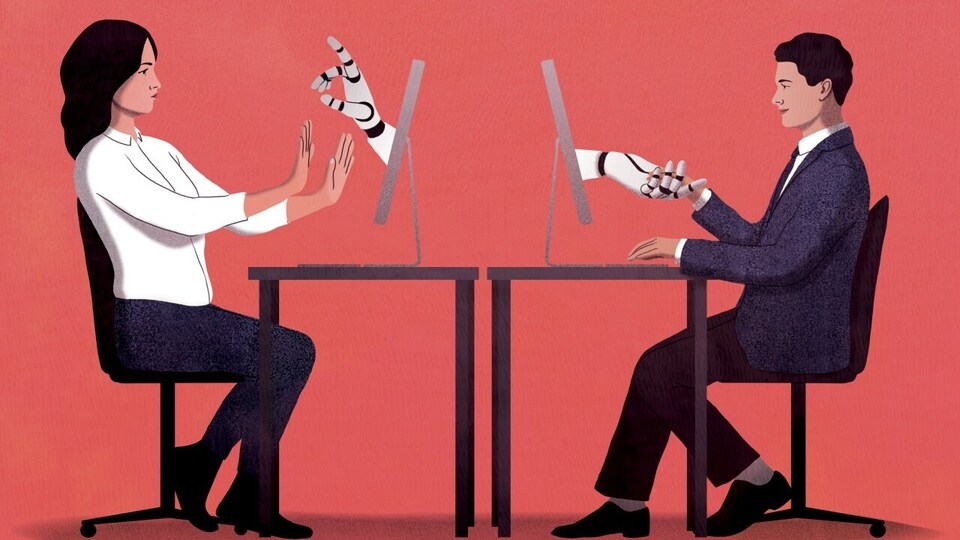
The answer, according to a recent working paper, is yes. The authors looked at generative AI adoption globally and found a pronounced gap in men’s and women’s usage of AI, both professionally and in everyday life.
For example, in one part of the study the authors found that women made up 42% of the roughly 200 million average monthly users at ChatGPT, 42.4% at Perplexity and 31.2% at Anthropic’s Claude. This data was collected between November 2022 and May 2024 and reflects monthly averages.
The gender gap was even more pronounced when the authors looked at AI usage on smartphones. Between May 2023 and November 2024, only 27.2% of total ChatGPT application downloads are estimated to have come from women. Similarly low shares of mobile downloads by women were seen on Anthropic’s Claude and Perplexity.
Happens everywhere
The results were largely the same from country to country, says Rembrand Koning, an associate professor at Harvard Business School and one of the paper co-authors. He says the trend was clear “in high-income countries like the U.S., Canada and Japan, and low- and middle-income countries, like India, Brazil and Kenya. It was shocking.”
The authors also looked at the genders of people using tools and apps powered by generative AI and its data for specific purposes. Once again, they found a similar pattern: For the 3,821 AI tools for specific purposes that the authors studied, only 34.3% were visited by women. This data was collected between August 2022 and July 2025.
The paper includes a meta analysis of 18 scholarly and practitioner studies that surveyed men and women about their usage of generative AI. Overall, the meta analysis showed that women were about 20% less likely than men to use generative AI.
Combined, the 18 studies involved about 143,000 people globally, and the gender gap was persistent. One study looked at postdoctorate students and found a 21 percentage-point gender gap globally. Another looked at business owners in the U.S., Australia, the U.K. and Canada and found an 11-point gender gap. Two studies looked at college students in the U.S. and Sweden and found a 25-point and 31-point gender gap, respectively.
A female penalty?
In some studies, female participants expressed concern that using AI would penalize them professionally or allow colleagues or peers to question their competency.
“To close the gap, employers could make generative AI usage mandatory,” says Koning, adding that it is critical that both genders use generative AI, so that the artificial intelligence learns from everybody and develops in a way that is gender neutral. If men are the primary users, generative AI could exacerbate gender biases or stereotypes, he says.
Lisa Ward is a writer in Vermont. She can be reached at reports@wsj.com.

Stay updated with the latest Technology News, gadget launches, app updates, artificial intelligence and digital trends. Find reviews, comparisons and useful insights from the world of tech.


