A transparent cup that’s strong, sustainable, and actually vanishes in the ocean? It might sound like a stretch in our plastic-heavy world, but it’s very much a reality thanks to a team of Japanese researchers who are reimagining the future of packaging, one cup at a time.
Science meets sustainability
You may be interested in
50% OFF
The Sleep Company Onyx Orthopedic Office Chair | Patented SmartGRID Technology | Adjustable Lumbar Support for Ergonomic Sitting Posture | High Back Office Chair for Work, Home, Study | Black
₹12,999
₹25,999Get This
59% OFF
GoMechanic Cordless Pressure Washer | High Pressure Car Washer Pump for Cleaning & Bike Washing | Rechargeable with 5-in-1 Nozzle & 5M Hose Pipe | Versatile Use with Bucket, No Tap Required
₹2,199
₹5,300Get This
79% OFF
Aristocrat Oasis Plus Set of 2 Cabin & Large Size (Check in) Soft Luggage (59 cm & 79 cm) | Spacious Polyester Trolley with 4 Wheels and Combination Lock | Dazzling Blue | Unisex| 5 Year Warranty
₹3,699
₹17,800Get This
For decades, the beverage industry has relied on glass or plastic to show off the vibrant colours of their drinks. Glass looks great but breaks easily and costs a pretty penny. Plastic is cheap and convenient, but its environmental toll is written across beaches and oceans worldwide. The world has been waiting for a material that combines the best of both: clarity, strength, and sustainability, without the baggage.
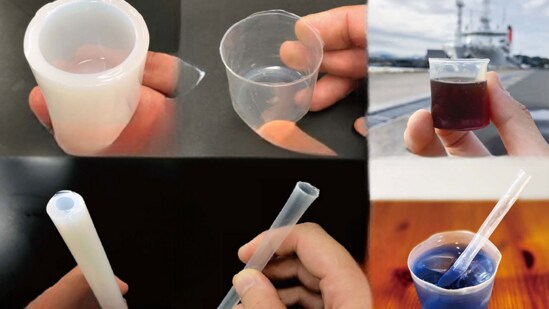
Enter the new transparent paperboard from the Japan Agency for Marine-Earth Science and Technology (JAMSTEC). This isn’t your average paper, according to a JAMSTEC press release. Crafted from plant-based cellulose nanofibres, it’s as clear as plastic, as tough as polycarbonate, and as eco-friendly as, well, paper. The secret is in science. By packing cellulose nanofibres densely, the researchers have created a sheet that lets light pass through with barely any scattering. The result is a cup that’s see-through, sturdy, and ready to take on both hot and cold drinks.
But the story doesn’t stop at good looks. This material is a multitasker. It shrugs off moisture, holds its shape, and can even be made from recycled wastepaper or old clothes. Drop it in the sea, and within four months, it’s almost entirely broken down by marine microbes, a far cry from the centuries it takes for plastic to disappear. In lab tests, the transparent paperboard held up against leaks, resisted repeated soakings, and kept its cool (and heat) when filled with beverages.
The road ahead: Challenges and possibilities
Of course, every breakthrough has its hurdles. Right now, producing a single cup costs lakhs of rupees, which is hardly a bargain. But plastics had decades to get cheap, and researchers believe that with the right manufacturing tweaks, costs could soon be slashed to just a few times that of regular paperboard. If that happens, the days of plastic-choked oceans and fragile glassware might finally be numbered.
So, the next time you pick up a drink, imagine a future where you can see what’s inside, enjoy your beverage guilt-free, and know that your cup will quietly return to nature when its job is done. JAMSTEC’s transparent paperboard is a glimpse of packaging’s next chapter, where style and sustainability finally go hand in hand.
{{/usCountry}}So, the next time you pick up a drink, imagine a future where you can see what’s inside, enjoy your beverage guilt-free, and know that your cup will quietly return to nature when its job is done. JAMSTEC’s transparent paperboard is a glimpse of packaging’s next chapter, where style and sustainability finally go hand in hand.
{{/usCountry}}