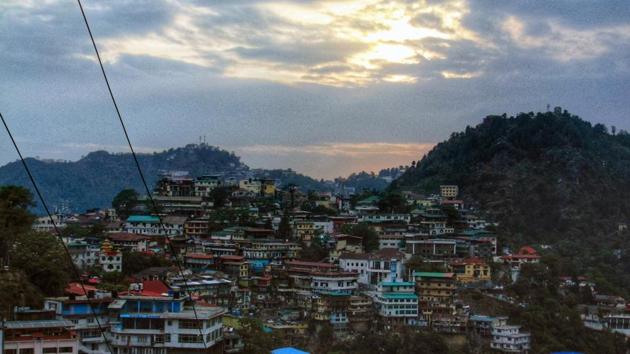
I first learned that Ruskin Bond had his home in Mussoorie when I was about the same age as his loved protagonist, Rusty. Bond tucked himself away here in the adjoining hamlet of Landour, but the enchanting, delightful spectres he created lurk all around Mussoorie, lingering farther into the dense jungles of Rajpur, Dehradun. He lives on the walls of the Mall Road, the speed dials of rickshaw pullers wheeling their open rigs to Company Garden and Kempty Falls, and in the old-world aura of an unlikely local attraction — the Cambridge Book Depot.
Holding its own among curio shops, modern-day apparel showrooms and proliferating hotels on the mall road, the bookshop, established in 1952, has been the author’s stamping ground for the last few years. Bond spends the closing couple of daylight hours here every Saturday, talking to fans and readers and signing copies. One can notice and be awed by a massive section devoted to Bond at the entrance, with neatly-arranged stacks of probably every book Bond ever published. If Ruskin is a lone fox, this is his lair.
But this morning, the owner of the shop had told us that Ruskin won’t be coming that Saturday. “He’ll come on the following day, Sunday, since that’s his birthday.” And instantly, I entered a short story of my own mind: A pudgy, pale-skinned old man in a sweater stepped out of a car and ambled into the bookshop. As he settled down, excited twelve-year-olds huddled around him, busting out their Bonds for him to sign. Some even got him to smile for a selfie. But what happened thereafter is not my business — I’m no fiction writer. I just happened to be a rambling wayfarer, headed at the moment for the charming Char Dukan cluster of cafes in Landour.
{{/usCountry}}But this morning, the owner of the shop had told us that Ruskin won’t be coming that Saturday. “He’ll come on the following day, Sunday, since that’s his birthday.” And instantly, I entered a short story of my own mind: A pudgy, pale-skinned old man in a sweater stepped out of a car and ambled into the bookshop. As he settled down, excited twelve-year-olds huddled around him, busting out their Bonds for him to sign. Some even got him to smile for a selfie. But what happened thereafter is not my business — I’m no fiction writer. I just happened to be a rambling wayfarer, headed at the moment for the charming Char Dukan cluster of cafes in Landour.
{{/usCountry}}It takes three churches to get one from Mussoorie to Char Dukan. Walk from the pretty Central Methodist Church (established in 1885) in Kulri Bazaar in the Mall Road, towards the Picture Palace area. About half a kilometre of cafes, restaurants and shops selling handicrafts, garments and other curiosities later, one comes upon a grim, imposing structure painted in stone blue. This is the Union Church, built in 1874, and the point where Landour pretty much comes in sight. The honeymooning couples and the vacationing families grow sparser and a quiet seclusion — marred by the whizzing past of the occasional smoke-spouting vehicle — descends upon the scene.
As we entered Landour, it was a bright, pleasant day and the clocks were striking twelve, including the one in the ghantaghar. The clock tower, painted in a whimsical tones of brick red, is like a sentry at Landour’s doorstep, which leads into a collection of eateries, homestays, an extravagant gazebo doubling up as a viewing point, and the curiously furtive Survey of India office. Further up, are a bunch of shops selling umbrellas, an auto repair shop with a vintage Royal Enfield stripped of its sundry accoutrements, and Landour’s famous shoemakers — men going about their business sewing and cutting up bespoke pieces in suede with mercenary precision.
The scenic trail from the town centre to the café cluster can be deceptive. It starts off as an alluring vantage point overlooking a patchwork of colourful rooftops and fluttering Buddhist flags, not to forget a view that stretches away far, betraying the triumphant glint of a meandering water body. But before you even realise, it segues into a steep, winding trail that’ll soon have those with desk jobs huffing and puffing. However, relief comes in the form of the majestic deodars at your side, whining mountain dogs scurrying uphill and waiting for you to catch up, and what else but the tireless eyes of trekkers headed for Lal Tibba. Oh how they shake you up with shame.
After a brief stop to admire our newly-purchased hemp wallets, we came upon Doma’s Inn — a dreamy, intriguing façade with a bright red base and impressive, vibrant Tibetan thangka figures done by artists from Nepal. Astounding. But what is truly amazing is the fact that Doma’s shares its premises with the literarily-named Ivy Cottage — Ruskin Bond’s home.
Anyway, as one trudges on, soon enough, the third church in the countdown — the St Paul’s Church reveals itself. To the left is Char Dukan (four shops quite literally). Almost identical, the eateries sit lined up at the side of the road. The shops are divided by differing awnings and united by the large, hairy dogs grabbing a bite from everywhere. The Nepalese Noodles at one of these shops have earned commendation from Sachin Tendulkar. I’m usually not inclined towards popular opinion, but the pizza, chai and honey-ginger-lemon tea at Anil’s Café make it worth labouring uphill on a woefully empty stomach. Oh, and one must also dig into the pancakes and waffles.
I did pack an old copy of The Room on the Roof for this trip, largely in the hope of creating something truly exemplary for Instagram. However, it is plain disappointing to see so many literature lovers and travel freaks railing out against Ruskin Bond for being a recluse and not meeting them when they turned up at his home. It’s preposterous, guys. The hamlet is home to more than a few men of letters and thespians (Victor Banerjee and Tom Alter, not to mention filmmaker Vishal Bhardwaj), but you need not exercise your sense of entitlement when you show up here. If you were about to fling a stone in any direction in Landour, there’s a chance it’ll hit someone important. And you are hereby warned against trying that.
Instead, just try walking back from Char Dukan, and you could meet a lively elderly gentleman who has the warmest manner, the smoothest walk and a face that reminds you of Ben Kingsley’s Mahatma Gandhi. So far, I have assumed that locals in Landour are pronouncing its name wrong. But when Vijay Pokhriyal says ‘Land-ohr’, you have to believe. The retired schoolteacher spotted us trying to click his pretty house, perched on a little hillock, and offered to walk us down to the bazaar. Mr Pokhriyal has taught at famous schools in famous capitals — The Doon School in Dehradun, St Columba’s in Delhi, and St Edward’s School in Oxford, London. He takes a keen interest in history and literature and has endless tales to tell — much like the other illustrious residents of Landour.
Pokhriyal is a passionate conversationalist who talks effusively not just about real numbers, his love of analogies as a teaching tool and the dynamics of the student-teacher relationship — he relishes talking about film stars and even their kids. However, he reserves the best of his faculties for the star-crossed love story of Dilip Kumar and Madhubala. And funnily, just as he mentions the latter, my mind at once wanders off to the stunning portrait of the 50s actress I saw at the display window of the Mussoorie Heritage Museum in Landour’s Parade Point building. Shops with similar facades abound on the mall road, bursting with jewellery, handbags, wall hangings, fridge magnets and what have you. To know what separates those from the present prospect, one must step inside.
The facility houses valuable artefacts documenting the history of the place and crafts supporting the livelihoods of the locals. The curator, Surbhi Agarwal, is proud and protective of the pieces, though she eventually allows us one picture of the place after she has given us a comprehensive tour of the area. There is an awful lot at display — old photographs, documents and maps — and for sale — handmade bookmarks, fern samples to spruce up your office desk, wall art pieces, bangles made out of pine needles, aipan (geometric patterns that are part of a local art form) pottery.
Meanwhile, the three of us have reached the market, and with Mr Pokhriyal, the stories never end. He obliges us with a picture and we agree to his offer of steaming, fragrant chai, samosas and jalebis. As he steps into the shop, smiling the same, all-knowing smile we have now come to know to be his, he starts with the tale of the famous English army deserter Frederick Wilson, “There was a Britisher, known as the Pahari...”
Catch your daily dose of Fashion, Taylor Swift, Health, Festivals, Travel, Relationship, Recipe and all the other Latest Lifestyle News on Hindustan Times Website and APPs.
Catch your daily dose of Fashion, Taylor Swift, Health, Festivals, Travel, Relationship, Recipe and all the other Latest Lifestyle News on Hindustan Times Website and APPs.