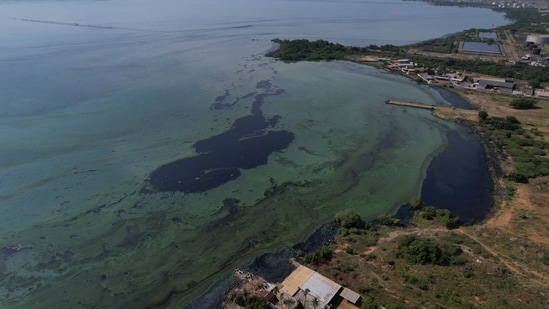
Venezuela’s Lake Maracaibo, one of the largest and oldest lakes in the world, has been severely polluted with crude oil. This environmental crisis is so vast that it can be seen from outer space. According to reports, the waterbody is coated with iridescent slicks and neon green algae blooms. Despite the gravity of the situation, limited efforts have been made to address it. Now, Selene Estrach, a 28-year-old environmental activist, has taken it upon herself to clean Lake Maracaibo.
Read| Gary Bencheghib and team clean water body in Indonesia, collect over 2,400 kgs of plastic
The activist founded Proyecto Sirena, a national network of activists dedicated to saving the lake, and is asking people to donate hair. According to The Washington Post, the activist came across this idea in July while browsing the Internet for easy, cost-effective and sustainable ways to clean Lake Maracaibo. “It seemed like a crazy idea, but I always like to think that everything’s possible,” Estrach told The Washington Post.
Since her appeal, many have donated hair for the cause. Some even brought their dogs for the hair donation drive. Her car has been filled with bags of donated human and pet hair since then, the outlet further reported.
{{/usCountry}}Since her appeal, many have donated hair for the cause. Some even brought their dogs for the hair donation drive. Her car has been filled with bags of donated human and pet hair since then, the outlet further reported.
{{/usCountry}}The activist and her team will use the donated hair to weave pantyhose-like nets that will be strategically placed in Lake Maracaibo. They will surround oil slicks to prevent them from spreading or separating. Additionally, the team has crafted mat-like devices designed for shoreline cleanup. These innovative tools are set to undergo testing next week. According to the activist, two pounds of hair can soak up between 11 and 17 pounds of oil, making this a cost-effective and sustainable way to address the environmental crisis.
Also Read| Cities switching to robots to tackle water, sanitation issues
To ensure the sustainability of this initiative, Estrach and her team are also researching environmentally responsible methods for safely disposing of the oil absorbed by their devices. “It will be our contribution to a growing field of research about this technique,” she told The Washington Post.
Back in 1989, Philip McCrory, an Alabama-based hairstylist, initially conceptualized a hair-filled net for use in the aftermath of oil spills. This ingenious approach was later tested and proven effective by NASA.
Hair has been used over the years to clean oil spills in different parts of the world. It was employed this year, along with used clothes, to remediate the oil slick resulting from the sunken tanker Princess Empress in Pola, Oriental Mindoro.