E-Paper



Indian man travels into deep jungles to meet remote cannibalistic tribe, asks them ‘Do you eat humans?’
Indian vlogger Dheeraj Meena documented his trek to the remote Korowai tribe and explored the historical practice of cannibalism within the tribe.

 Prefer HTon Google


An Indian travel vlogger recently travelled deep into the jungles of Indonesia to meet the Korowai tribe, often referred to as a ‘human-eating’ tribe, and documented his experience on social media. Dheeraj Meena met members of the remote Korowai tribe that has lived in relative isolation for centuries, surviving on hunting, gathering and fishing.
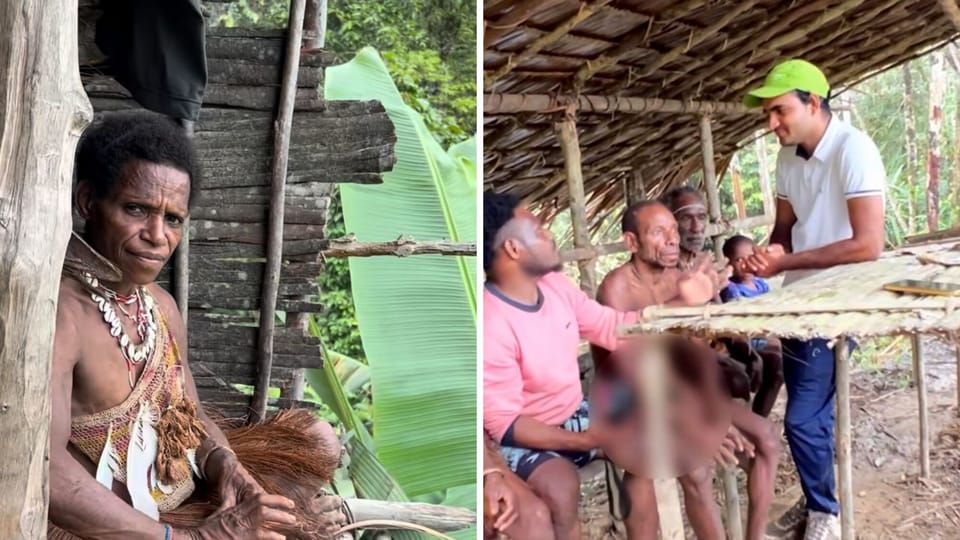
Indigenous to the Papua province of Indonesia, the Korowai people have been sensationalised in modern day media for their association with cannibalism, the practice of eating human flesh. Today, it is widely believed that the tribe practised cannibalism historically as part of their spiritual and social beliefs, but the practice has died down with time.
Meena said he took a flight, followed by a 10-hour boat journey, and then spent four hours trekking through dense jungles to reach the tribe. “The Korowai live in extremely remote areas, maintaining a traditional lifestyle that includes hunting for survival. In accordance with their customs, they don’t wear clothes, and men and women live in separate houses,” he wrote on Instagram, adding that Korowai people live in tree houses high above the ground.
“Do you eat humans?”
During his interactions with tribe members, the Indian travel vlogger asked them questions about their historical cannibalistic practice. “We heard that Korowai people eat humans. Is that true? Do you eat humans?” he was heard asking a man.
The Korowai man explained that people of his father’s generation used to eat human flesh as little as 16 years ago. However, the practice is no longer followed today. The man also explained that within the Korowai, there are several groups. When two groups fought each other, the Korowai would sometimes capture and kill their rivals, which is when cannibalism was usually practised.
“Known in the past for their practice of cannibalism, especially during tribal conflicts, the Korowai would sometimes kill rivals who captured their women, a practice that has mostly faded now,” Meena explained on Instagram.
He added that despite their “fierce history,” he found the Korowai people extremely warm and welcoming as he spent several days learning their way of life.
“What does human flesh taste like?”
Dheeraj Meena also asked the tribe another controversial question about cannibalism - what does human flesh taste like. The travel vlogger said that the taste of human flesh is not widely documented due to ethical and legal reasons.
The Korowai man who answered him this time clarified that his father used to eat humans, but the tribe no longer does that.
“However, in rare accounts from anthropologists and certain historical sources involving cannibalistic cultures, human meat has been described as somewhat similar to pork or veal, with a texture like beef,” Meena noted in his Instagram post.
The Korowai have been known to practice ritual cannibalism, although anthropologists say this practice had largely died down by the 21st century as the tribe came into increased contact with the outside world.
More contemporary research indicates that the Korowai people sometimes claim to still eat human flesh to perpetuate the myth that cannibalism is still an active practice. This is because the tribe is today dependant on tourism, and a large number of tourists only want to meet them due to their association with cannibalism.
“Most of these groups have 10 years' experience in feeding this [cannibal] stuff to tourists,” Chris Ballard, an anthropologist from the Australian National University, told the Sydney Morning Herald in 2006.