
 E-Paper



Amid border clashes, Jaishankar to meet foreign ministers of China, Russia
The trilateral meeting assumes significance as it comes in the wake of tensions along the disputed India-China boundary in eastern Ladakh.


External affairs minister S Jaishankar will have a luncheon meeting with his Chinese and Russian counterparts on the sidelines of the Shanghai Cooperation Organisation (SCO) council of foreign ministers’ summit in Moscow, the Chinese foreign ministry announced on Wednesday.
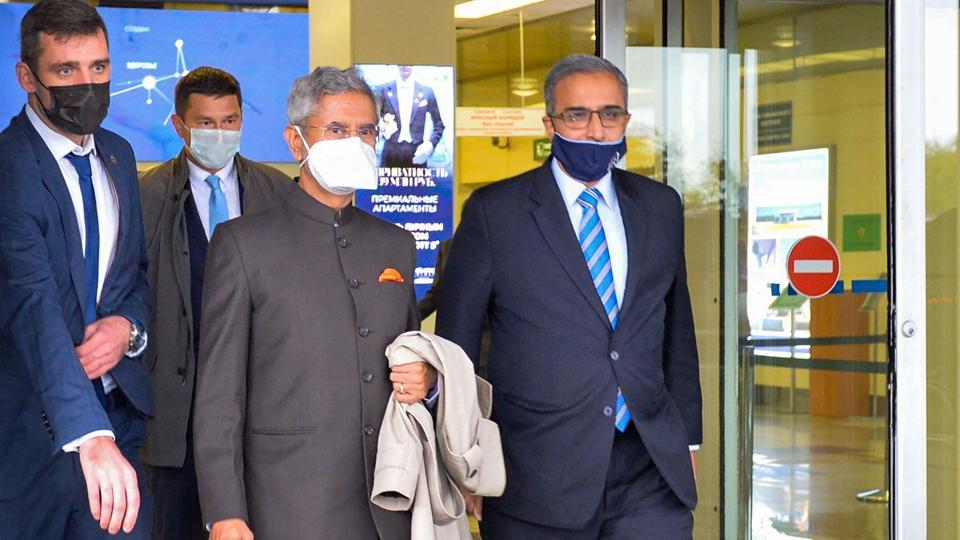
The ministry said Chinese foreign minister Wang Yi will also have bilateral meetings with counterparts from other SCO member states, but did not say anything specific about a one-on-one with Jaishankar.
The Russia-India-China (RIC) meeting between Jaishankar, Wang and their Russian counterpart Sergey Lavrov is likely to be held on Thursday. The meeting is significant as it comes in the wake of escalating tensions at multiples points along the disputed boundary between India and China in eastern Ladakh.
Jaishankar is already in Moscow for the two-day meeting of foreign ministers, which began on Wednesday.
“During this (SCO) meeting, state councillor and foreign minister Wang Yi will discuss with foreign ministers of other member states of the SCO, cooperation amid Covid-19 and exchange views on major international and regional issues,” Chinese foreign ministry spokesperson Zhao Lijian said at the regular briefing.
Wang “will also hold bilateral meetings with relevant member states and attend a luncheon for Chinese, Russian and Indian foreign ministers,” Zhao added.
When specifically asked about a bilateral meeting between Jaishankar and Wang, Zhao said: “Like I said, I talked about state councillor and foreign minister Wang Yi’s visit, and regarding the bilateral meeting you mentioned, if there is information, we will release it in due course”.
India’s external affairs ministry said on Tuesday that Jaishankar’s Moscow visit will “include the participation in the Council of SCO Foreign Ministers and other bilateral meetings.”
The RIC foreign ministers had last met by video conferencing on June 23 in the backdrop of the spreading Covid-19 pandemic.
A meeting between the three ministers in Moscow indicates that Russia, an ally of both India and China, is keen to mediate between the two countries to defuse the tension at the border.
A one-on-one meeting – and in-depth exchange - between Jaishankar and Wang is also widely expected as a possible way forward from the months-long standoff between the border troops in eastern Ladakh.
Wang Dehua, South Asia expert at the Shanghai Municipal Centre for International Studies, said the RIC meeting may also pave the way for a meeting between Prime Minister Narendra Modi and Chinese President Xi Jingping.
“After Chinese defence minister Wei Fenghe and Indian counterpart Rajnath Singh’s meeting in Moscow on September 4, the meeting of foreign ministers is of great significance as it’ is conducive to ease the tension along the border while helping to reset relations of our two countries. Perhaps, it will prompt early meeting between PM Narendra Modi and President Xi Jinping,” Wang said.
“I think it is also beneficial to the RIC mechanism. The border dispute can only be solved through talk or dialogues. Military confrontation is not an option,” he added.
Incidentally, Jaishankar is the longest serving Indian ambassador to China, with his Beijing tenure lasting four-and-half years between 2009 and 2013.
Speaking at the launch of his book, The India Way: Strategies For An Uncertain World last week, Jaishankar had said he knew Wang for a long time. “As to what I will be talking to my Chinese colleague when I meet him, we have known each other a long time so you can have a reasonable guess,” he had said.
The two had last spoken over phone on June 17, two days after the Galwan Valley clash in which 20 Indian soldiers were killed.
Jaishankar had conveyed to Wang that the need of the hour was for the Chinese side to reassess its actions and take corrective steps.
“The two sides should scrupulously and sincerely implement the understanding that was reached by the senior commanders on 6th June. Troops of both sides should also abide by the bilateral agreements and protocols. They should strictly respect and observe the Line of Actual Control and should not take any unilateral action to alter it,” he had said.


