
 E-Paper



China’s growth forecast could be lowered at annual Parliament session
In 2018, the Chinese economy grew 6.6 per cent year-on-year, the slowest pace in 28 years: the forecast in state media is that the growth target will be lower this year at around 6.5 per cent.


An economy facing downward pressures amid a grinding trade war with the US will be under sharp focus as China’s rubber-stamp Parliament gathers in Beijing for the two-week annual session beginning this week.
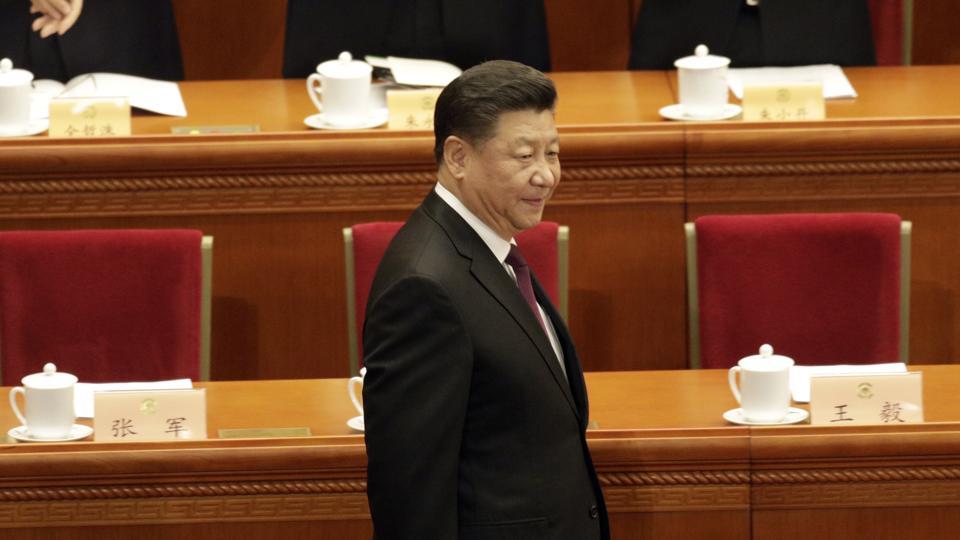
Nearly 3,000 members of the National People’s Congress (NPC), China’s rubber-stamp Parliament and more than 2000 members of the Chinese People’s Political Consultative Committee (CPPCC), the top advisory body in China, have gathered in the Capital to take part in the meeting, called the “Two Sessions”.
In 2018, the Chinese economy grew 6.6 per cent year-on-year, the slowest pace in 28 years: the forecast in state media is that the growth target will be lower this year at around 6.5 per cent.
The international community will scrutinise the sessions for signs and announcements to reforms in the state-owned companies and for changes - if any - in the business environment for private companies.
Also read: Military reforms have put China’s combat capability way ahead of India’s
Government reports will be tabled, policy directions will be charted, the annual budget - including the defence outlay - will be announced and the economic and GDP outlook will be shared - all under the gloomy shadow of a slowing economy.
Official news agency Xinhua listed job creation, regulating the property market, poverty alleviation, fiscal deficit and trade growth as among the important focus areas of the session
“The Chinese economy expanded 6.6 per cent in 2018, meeting the official target as high-quality development accelerated. Stable growth in 2019 is essential as this year is a ‘key year’ in China’s goal to build a moderately prosperous society in all respects,” the Xinhua report said.
Also read: As world economy stumbles into 2019, eyes turn to China
“As an overall indicator of economic expansion, China’s GDP growth target has been set unchanged at around 6.5 per cent for two consecutive years from 2017 to 2018. On the provincial level, the majority of China’s local governments have lowered the number this year, while over ten provincial regions set the target within a range,” it added.
“Economic topics are usually the hottest topics during the two sessions each year, but given the tremendous internal and external challenge we face, there will be even greater focus on economic policies this year,” Li Daxiao, chief economist at Shenzhen-based Yingda Securities, told the state-controlled tabloid Global Times.
“I think the hottest topic will be the business environment for private companies,” Wang Jun, an expert at the China Center for International Economic Exchange, said, adding: “It is an issue that has attracted a great deal of debate in the past year and touches on deeper, broader issues in the country from employment to the reform of state-owned enterprises.”
Focus will also be on creation of jobs.
“Employment comes first in the six fields the country aims to stabilise in 2019. China first set the goal of surveyed urban unemployment rate in government work report in 2018. Over 13 million urban jobs were created last year, beating the official target of 11 million,” the Xinhua report said.
NPC deputies will vote on a draft law on foreign investment, which if passed, will ensure greater market access to foreign companies and provide equal protection.
“This could be one of the most significant legislative efforts from this year’s two sessions,” economist Li Daxiao said.


