Amid President Donald Trump's recent emphasis that Iran has the "last chance" to reach a peace deal to end the five-month-old war, the US military reportedly asked its analysts to find "new creative and unconventional ways to punish Iran" last week.
Meanwhile, Iran's Islamic Revolutionary Guard Corps (IRGC) reportedly carried out an attack on US military base in Kuwait. At least three drones were used in the strike, The Jerusalem Post reported. Follow US-Iran war live updates
A senior officer from the US Central Command (CENTCOM) intelligence branch, who was executing Trump's war with Iran, sent an email to a group of military analysts, CNN reported, citing a source familiar with the matter.
Military officials said that receiving such a query via email was unusual, indicating that the Trump administration has limited options for pressuring Iran into a deal on terms favourable to it.
Besides seeking new ideas via email, a second source cited by CNN said CENTCOM is looking at everything, analysing its need to reevaluate the strategy in this war.
Captain Timothy Hawkins, a spokesperson for CENTCOM, reportedly said in a statement that the US military has a "long way of thinking and working in innovative ways."
{{/usCountry}}Captain Timothy Hawkins, a spokesperson for CENTCOM, reportedly said in a statement that the US military has a "long way of thinking and working in innovative ways."
{{/usCountry}}Especially Admiral Brad Cooper, said Hawkins, reaches out to team members to achieve the "highest levels of operational performance possible."
The email came before Trump threatened Iran with new strikes and ended up calling them off over the previous weekend after regional allies urged them to de-escalate.
US military's various plans to hit Iran
Since the war broke out on February 28, after the US and Israel launched joint strikes on Iran, American forces have pounded Tehran with attacks in a bid to bring it to the negotiation table.
However, no deal has been reached so far despite multiple attempts to conduct peace talks.
Additionally, the US military is reportedly planning to hit Pickaxe Mountain and other Iranian sites they believe are linked to nuclear enrichment material or equipment.
ALSO READ | Trump reveals US planned 'biggest attack since World War II' against Iran, but called it off | Here's why
Despite Washington having the powerful weapons, Iranian nuclear sites are unlikely to be destroyed with just missiles and bombs alone, CNN reported, citing sources. This is because, they said, these facilities are buried deep underground.
Trump would likely have to deploy ground forces, which is a massive risk, to destroy these underground facilities.
So far, 18 US service members have lost their lives in the ongoing Middle East war.
Trump has also been reportedly considering "fireworks-like" strikes to hit the same or similar sites as those struck a year ago. However, at this point, attacks are unlikely to resolve the focal issue of this conflict -- a functional Strait of Hormuz.
"At the end of the day, POTUS will want a deal, so he'll continually look for ways to get tough and get out of this," CNN reported, citing one of the sources familiar with the recent planning. He added, "You need creative minds at times, especially if you're running out of conventional options."
During a Cabinet meeting last week, Trump had said that he believes the US just "wants to win." He said the forces are going to hit Iran "very hard" at some point, where the Islamic Republic will say, "We just can't take it anymore."
Iran's 'last chance': Trump
On Monday, President Trump said that talks with Iran were underway, warning that this was Tehran's "last chance" to sign a good deal to end this prolonged war.
Iran, however, has denied that any negotiations were being held or planned with the US.
The contradictory statements undermine hopes for a diplomatic resolution to the war.
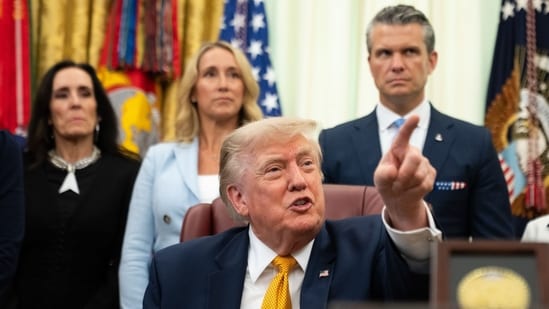
Speaking to reporters at an Oval Office event, Trump responded to a question about the status of peace talks, saying, “They are going on right now.”
The US President said the talks were taking place at the request of Iran, Saudi Arabia, the United Arab Emirates and Qatar, among others.
"This is a last chance for them (Iran) to sign a good document," he stated.
Earlier in the day, Trump had also revealed that the US had planned a "massive attack" against Iran. He said that if the strike had been carried out, the US force's attack would have been the "biggest since World War II."
"It was going to be a massive attack. It was going to be an attack that would have been by far the biggest attack since World War II," he told reporters on Air Force One. He reiterated that Washington decided to pause its attacks after Gulf nations and the Islamic Republic called on his office to stop the attacks to reach a peace deal.
"We were all set to go, just about at this time right now, and it would've been a massive attack... The reason they asked [to call it off] is that they think there's a deal. There's a deal on Hormuz, and then there will be a deal on the denuclearisation of Iran," the US President added.
He said he was holding off he strikes for the time being, adding that he will "see" where the negotiations go.
Trump affirmed that he prefers a prefer deal, not "killing people".
Trump vs Iran claims on talks
On the one hand, Trump said negotiations were underway with Iran, but the Islamic Republic's foreign ministry spokesman, Esmail Baghaei, reportedly said no talks were taking place with the US, nor were any meetings scheduled.
Baghaei further said that Iran had no plans to host foreign delegations or send negotiators abroad in the coming days.
All Iranian negotiators were in the country except foreign minister Abbas Araghchi, Reuters reported, citing Baghaei.
Araghchi is on a religious pilgrimage in Iraq, he said. Baghaei further clarified that the only ongoing talks were discussions with Oman over the management of the Strait of Hormuz.
No talks are planned as Araghchi would be unavailable at least until the end of the week, a senior Iranian source told Reuters.
Trump, later on Monday, described Iran's leadership as "unbelievably duplicitous," adding that they had asked for a meeting and more talks were scheduled for the "immediate future."
Regarding the crucial waterway, Trump said the US Navy had total control over the Strait of Hormuz, through which a fifth of the world's oil and liquefied natural gas flowed before the war.
"'The United States Wall of Steel!' Nothing gets through to Iran, unless we want it to, and nothing will get through, unless a Deal, or Total Surrender, is accomplished," Trump wrote on Truth Social.