US President Donald Trump on Tuesday signed an executive order directing the departments of the treasury, labour, and health and human services (HHS) to implement his 2019 healthcare price transparency regulations.
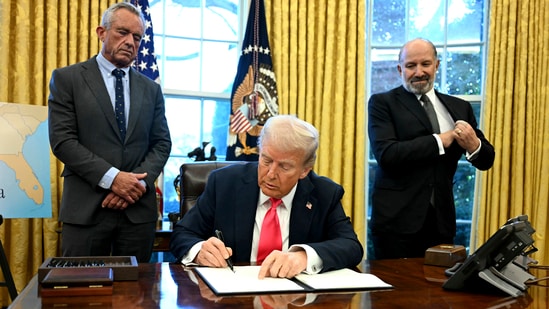
The order, according to the White House, is aimed at empowering patients with clear, accurate, and actionable healthcare pricing information.
Trump had signed the order for improving price transparency on healthcare costs back in 2019, during his first term in the Oval Office.
The federal agencies have been ordered to come up with a framework to enforce the executive order within 90 days. Under this, the departments are required to ensure hospitals and insurers disclose actual prices and 'not estimates' and take action to make prices comparable across hospitals and insurers, including prescription drug prices.
ALSO READ | Vaccine critic RFK Jr. confirmed as Trump's health secretary, Mitch McConnell the sole GOP 'no' vote
Other than this, "the departments will also update their enforcement policies to ensure hospitals and insurers are in compliance with requirements to make prices transparent".
{{/usCountry}}Other than this, "the departments will also update their enforcement policies to ensure hospitals and insurers are in compliance with requirements to make prices transparent".
{{/usCountry}}While signing the executive order at the Oval Office, Trump told reporters, "You are not allowed to even talk about it (the prices) when you're going to a hospital or see a doctor. And this allows you to go out and talk about it. It's been unpopular in some circles because people make less money, but it's great for the patient."
According to a White House fact sheet on the executive order, the price transparency will help lower healthcare prices and help patients and employers get the best deal on healthcare.
The President's initial order from 2019 required hospitals to maintain a consumer-friendly display of price information for up to 300 shoppable services. It also required health plans to upload their negotiated rates with providers, their out-of-network payments to providers, and the actual prices they or their pharmacy benefit manager pay for prescription drugs.
ALSO READ | Trump deportation pledge raises concern over U.S. health system
The order also directed the health plans to maintain a consumer-friendly internet pool that made it easier for them to access information related to all the pricing.
Several hospital groups firmly opposed the executive order and even challenged it in court, but turned out to be unsuccessful. They argued that the order forced them to disclose private negotiations with insurers which undermined their competition and violated their free speech rights, a claim which was dismissed by the court.
The White House fact sheet cited an economic analysis to say that if Trump's original price transparency rules are to be fully implemented, then it could help save $80 billion for consumers, employers and insurers by 2025.
The former Joe Biden-led administration was also apparently sued in 2023 for not enforcing the prescription drug transparency rules. This move is being dubbed as another one of Trump's step towards ensuring that American patients are put first. "Our goal was to give patients the knowledge they need about the real price of healthcare services. They'll be able to check them, compare them, go to different locations, so they can shop for the highest-quality care at the lowest cost. And this is about high-quality care. You're looking at that," Trump was quoted as saying.
Donald Trump further mentioned, "You're looking at comparisons between talents, which is very important. And then, you're look at cost. And, in some cases, you get the best doctor for the lowest cost. That's a good thing."
(with Reuters inputs)