
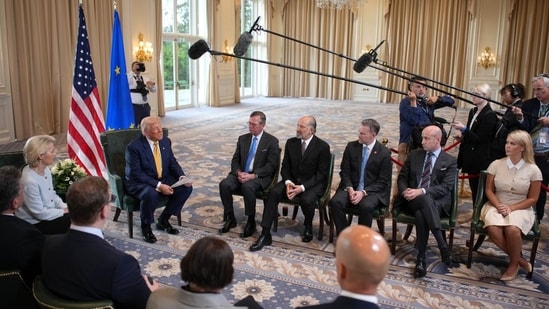
Soon after he sat down to negotiate Sunday with European officials on a potential tariff agreement at his Scotland golf club, President Trump said he wanted assurances that Europe would follow through on its pledges to increase investment in the U.S.
Trump questioned how the U.S. could be sure European companies wouldn’t shrug off their plans, which came with a 15% levy on EU imports into the U.S. rather than the 30% Trump had threatened, according to people familiar with
Soon after he sat down to negotiate Sunday with European officials on a potential tariff agreement at his Scotland golf club, President Trump said he wanted assurances that Europe would follow through on its pledges to increase investment in the U.S.
Trump questioned how the U.S. could be sure European companies wouldn’t shrug off their plans, which came with a 15% levy on EU imports into the U.S. rather than the 30% Trump had threatened, according to people familiar with the matter. After EU leaders assured him that the investment plans they were talking about were real, Trump responded: “prove it,” according to one of the people.
EU officials rattled off the names of European companies they said were already prepared to invest. With a trade deal in place, planned investments of almost $200 billion would grow by even more, they told Trump.
At the end of the talks, Trump said the EU would now be investing $600 billion in the U.S. as part of the deal, which also included a plan to buy $750 billion of American energy products from the U.S. over three years. European officials said the $600 billion figure is based on private companies’ investment plans.
The agreement, widely seen as a victory for Trump, marked the culmination of monthslong talks between America and its largest trading partner and offered the biggest signal yet that nations see America’s tariff regime as more permanent than temporary. The pact followed a shift in thinking by the Europeans: EU officials in recent talks sought to contain the damage the duties will inflict on the bloc’s companies and economy, rather than try to negotiate the tariffs away outright.
Tariffs of 15% are “certainly a challenge for some,” European Commission President Ursula von der Leyen said. “But we should not forget it keeps [the EU’s] access to the American market.”
Just before Trump and von der Leyen met Sunday to iron out the agreement, Trump aides called European officials to solidify that part of the talks would focus on the EU giving U.S. companies better access to the bloc’s markets, according to a person familiar with the matter.
The EU’s decision to accept Trump’s 15% level for tariffs marked a contrast to its initial, more adversarial approach.
After Trump imposed in March 25% levies for steel and aluminum, the bloc started preparing retaliatory tariffs on U.S. imports, including American products such as peanut butter and Harley-Davidson motorcycles. Some of the products were chosen to try to maximize political pain for Trump, an EU official said when the bloc’s list was announced that month.
After the U.K. in May got a deal that pegged tariffs to 10%, Trump’s global baseline for duties, some European officials were dismissive. “If the U.K.-U.S. deal is what Europe gets, then the U.S. can expect countermeasures from our side,” Benjamin Dousa, Sweden’s minister for international development cooperation and foreign trade, said at the time.
But European officials eventually came to view 10% as a minimum level. They noticed Trump administration officials talking about the revenue the tariffs were pulling in.
“It was more and more clear that President Trump is dead serious about significantly transforming the landscape of global trade,” EU trade commissioner Maroš Šefčovič told The Wall Street Journal on Monday, adding, “the status quo of going back to last year, or before April 2, simply is not possible.”
As the EU tried to adapt, it relied heavily on Šefčovič to lead political discussions with U.S. officials. Since February, he has traveled to Washington seven times to meet with U.S. trade officials and had more than 100 hours of contact with them over recent months, including frequent phone and video calls.
On one occasion about a week before Trump and von der Leyen’s meeting in Scotland, Šefčovič said he spent half of a roughly 700-mile road trip to his home country of Slovakia talking with Commerce Secretary Howard Lutnick and U.S. Trade Representative Jamieson Greer, with his two golden retrievers panting in the back seat. At one point, “I said Howard, it’s not me,” Šefčovič said of the dogs’ heavy breathing.
When he needed to find documents to help with the discussion, Šefčovič looked for parking lots with a Wi-Fi signal, during what turned out to be a crucial late-stage discussion ahead of the leaders’ sit-down in Scotland.
A major inflection point in the talks came in May, when Trump threatened on social media to apply a 50% tariff on the bloc. “Our discussions with them are going nowhere,” Trump said at the time. After a phone call with von der Leyen two days later, he said he would hold off on that threat.
The bloc shifted its approach. It presented U.S. trade officials with a proposal that included plans to increase purchases of American energy products and an offer to lower tariffs for certain U.S. imports, people familiar with the matter said. Greer said in early June that the EU had provided “a credible starting point” for talks between the two economies.
Then on July 12 Trump published a letter on social media saying he would put 30% tariffs on the bloc in early August. The development was unexpected for European officials who had hoped they were close to a deal.
Days after the letter was posted, Šefčovič told Fox News, in comments that foreshadowed the eventual deal, that the EU was prepared to significantly increase purchases of U.S. energy products including oil, liquefied natural gas and nuclear fuel, and to spend about $40 billion on artificial intelligence chips.
He also said the EU was looking at about $500 billion in EU companies investments in the U.S. over a three-year period.
Ahead of the Scotland meeting, Šefčovič sought advice from Japan’s chief negotiator to get a better sense of what to expect, people familiar with the matter said. He learned that Japan’s final-stage talks with Trump went beyond surface level discussions and delved into the details of the agreement.
The Europeans hunkered down in a hotel in Glasgow on Sunday to discuss what kind of messaging would be most effective during the meeting with Trump, a person familiar with their preparations said.
They showed up ready to talk specifics: including examples of companies’ planned U.S. investments.
Write to Kim Mackrael at kim.mackrael@wsj.com and Brian Schwartz at brian.schwartz@wsj.com
One Subscription.
Get 360° coverage—from daily headlines
to 100 year archives.
Archives
HT App & Website