Some mountain lakes in Spain are getting a second life. According to the Centre for Advanced Studies of Blanes (CEAB-CSIC), scientists treated two lakes in Alt Pirineu Natural Park in the Catalan Pyrenees with a biodegradable piscicide, removing all the minnows. Ten months later, amphibians and aquatic invertebrates returned. The team says neither group had been recorded there since monitoring began in 2014.
Why minnows are a problem in mountain lakes
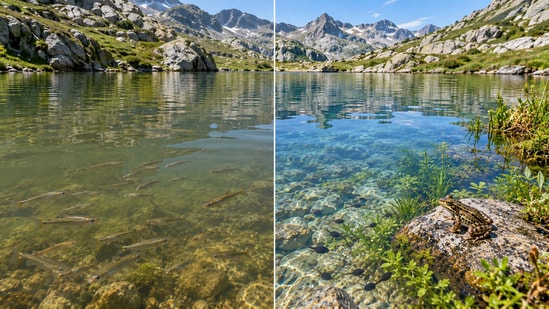
High mountain lakes are usually fishless. In a 2020 paper in Biological Conservation, Alexandre Miró and colleagues explain that natural barriers stop fish from swimming up from lower streams. According to the center, the arrival of minnows in Pyrenean lakes was accidental. They had been used as live bait for fishing for trout. Because they breed quickly and adapt easily, they spread. They also eat amphibian eggs, resulting in fewer amphibians and tiny water animals.
What the scientists did
The work is part of a European project called LIFE RESQUE ALPYR. In September 2025, the team treated the two lakes, Tres Estanys del Mig and Tres Estanys de Baix. They used rotenone, a chemical that kills fish and breaks down naturally. The aim, the researchers say, was to restore the balance of the lakes and see how well and safely this works. This was the project's second pilot. The first was held in September 2024 at Lake Manhèra, in the Val d'Aran.
Deep Dive
What is the impact of invasive minnows on high mountain lakes in Spain?
How did researchers restore two mountain lakes in the Pyrenees?
Why is it important to monitor the recovery of mountain lakes after removing invasive species?
What came back after 10 months
Initial results were encouraging. There were no minnows in either lake. The water was also much clearer. Amphibians and aquatic invertebrates, small water animals with no backbone, had also returned hom. Marc Ventura, who coordinates the project, said in the release that early data show faster recovery at Tres Estanys del Mig. It is slower at Tres Estanys de Baix and Lake Manhèra. However, Manhèra was treated a full year earlier, so it has had roughly twice as long to recover, making its slower pace, by comparison, even more notable. One reason might be that minnow numbers had been kept low for several years by previous work with nets, traps, and electric fishing. That may have saved a hidden reserve of species in the lake mud. It might help the lake recover faster.
Was the treatment safe?
{{/usCountry}}Initial results were encouraging. There were no minnows in either lake. The water was also much clearer. Amphibians and aquatic invertebrates, small water animals with no backbone, had also returned hom. Marc Ventura, who coordinates the project, said in the release that early data show faster recovery at Tres Estanys del Mig. It is slower at Tres Estanys de Baix and Lake Manhèra. However, Manhèra was treated a full year earlier, so it has had roughly twice as long to recover, making its slower pace, by comparison, even more notable. One reason might be that minnow numbers had been kept low for several years by previous work with nets, traps, and electric fishing. That may have saved a hidden reserve of species in the lake mud. It might help the lake recover faster.
Was the treatment safe?
{{/usCountry}}According to Barend van Drooge, one of the researchers at IDAEA-CSIC, rotenone concentration in the water went down as expected. The half-life was between 10 and 20 days. It is the amount of time required for half of a chemical to break down. That short persistence, separate from how effectively the chemical kills fish in the first place, is what suggests the treatment's broader footprint on the wider ecosystem would be minimal. The team also found no traces of it in the river below the lakes.
Why recovery can be quick
Previous research points the same way. The Miró study in 2020 looked at eight naturally fishless lakes in the Pyrenees. Between 2015 and 2019, the team eradicated 95 to 100 percent of the non-native trout or minnows in them. They also examined 56 nearby lakes for comparison. A year after removal began, the composition of amphibian species in the treated lakes was consistent with the typical levels found in the area. Typical numbers followed after three years, except for the common frog. All of the new arrivals documented by the team came from the same valley. The authors say this shows how important nearby healthy populations are.
What happens next
The project partners stress that full recovery takes time. It needs long-term monitoring, which will continue over the coming years. Marc Garriga, director of the Alt Pirineu Natural Park, said the first results are very encouraging and that they show it is possible to restore lakes that have lost much of their biodiversity. These two high mountain lakes have quietly shown how native wildlife can come back once the invader is no longer there.