With the death toll over 1,000 and thousands missing, Nepal has now sought climate compensation for the deadly floods which struck the Himalayan nation last week.
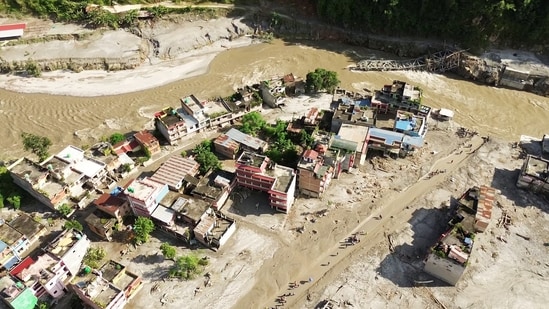
In an interview with a local news outlet, Nepal's foreign minister Shisir Khanal reportedly said that the country, despite contributing "virtually negligible" greenhouse gas emissions, is bearing the disproportionate consequences of global warming, including rapid glacier melt and extreme mountain disasters.
"We are paying the ultimate price for a global crisis we did not create. The rapid melting of glaciers and these catastrophic mountain tsunamis are direct consequences of global climate change," he said in an interview with Kantipur TV, according to the Kathmandu Post.
Deep Dive
Why is Nepal seeking climate compensation from major greenhouse gas emitters?
What factors contribute to the catastrophic floods in Nepal?
How do historical greenhouse gas emissions impact Nepal's current climate crisis?
Also Read | Rescuers battle flood debris, mud at Nepal hydropower tunnel as victims' families say ‘we still have hope’
The minister added that any assistance to help Nepal recover from the flash floods should be treated as a "moral liability," rather than charity. Khanal added that the country's diplomatic framework will also be switching from "receiving aid" to “justice and compensation.”
{{/usCountry}}The minister added that any assistance to help Nepal recover from the flash floods should be treated as a "moral liability," rather than charity. Khanal added that the country's diplomatic framework will also be switching from "receiving aid" to “justice and compensation.”
{{/usCountry}}China, India, and US named top three greenhouse emitters
The Nepali foreign minister also named India, China and the United States as the world's largest greenhouse gas emitters. Khanal added that the three countries have a "historical responsibility to compensate vulnerable nations like Nepal".
According to the European Commission's Emissions Database for Global Atmospheric Research 2025 report, China, the United States, India, the EU27, Russia, and Indonesia were the world's largest GHG emitters in 2024.
As per the report, these countries account for "51.4% of global population, 62.5% of global gross domestic product, 64.2% of global fossil fuel consumption and 61.8% of global GHG emissions."
Also Read | Ice-rock avalanche triggered flash floods, not GLOF event: What Nepalese scientists' report reveals
The report added that while the EU's emissions reduced, developing nations such as China and India have shown "substantial increases."
"China’s emissions rose more than four-fold, while India’s nearly tripled. Brazil’s emissions doubled over the same period, showing a very small increase in 2024 (+0.2%) compared to the previous year," states the 2025 report.
Meanwhile, India has emphasised climate equity and highlighted its relatively low per-capita emissions, by stating that climate obligations should take into account differences in countries' historical emissions, development needs and capacities.
New Delhi maintains that Western nations, which industrialised first, occupy the majority of the global carbon budget. India has also called on developed countries to provide the necessary financial resources to help developing nations deal with climate impacts.
Nepal suffers due to emissions of other nations
Saswata Sanyal, a disaster risk resilience expert at the International Centre for Integrated Mountain Development based in Kathmandu, told AP that Nepal has suffered due to larger emissions of wealthier countries, as he called for better planning and early warning systems.
Manjeet Dhakal, a Nepali climate policy expert and United Nations climate negotiator, added that Nepal emitted less than 0.1% of the greenhouse gases that cause global warming, even as it grapples with some of its most severe effects.
"We should blame those who are responsible for increasing the global temperature, those who have benefited from the fossil fuel economy for such a long time," he said. "We can at least use this devastating example as an inspiration to urgently reduce carbon emissions," the climate negotiator told news agency AP.