When I called my friend Karl Olafsson in Iceland, he was up on the wooden roof of his house, repairing it. It was a clear sunny day, and he said he was making the most of his time under lockdown. He’s not the only thing to have gone through the roof. “Bicycle sales are up like crazy. We’re all biking to enjoy the outdoors and get some exercise. The youngsters, who normally fly away to Copenhagen or to NY for holidays are discovering their own lakes, waterfalls and volcanoes and absolutely loving it.’
Karl is the co-founder of Nordic Luxury, a travel company, and over the last few years they’ve added sleigh-journeys pulled by huskies. He’s been breeding rare white Siberian huskies. ‘The bi-eyed ones are particularly rare, with a blue and brown eye each. At night, the light makes them shine red and green.’ While playing with them has been a lot of fun (you can visit them on www.huskyiceland.com), Karl and the huskies are hoping to get back to business with the arrival of visitors. ‘When folks are allowed in June 15th onwards, they must show a clean bill of health from their own authorities, else test for Covid, or self-quarantine for 2 weeks. They’ll be asked to install the Rakning C-19 contagion tracing app on their phones.
With summer around the corner, Icelanders understandably want to salvage the tourism the high season draws. ‘I’m enjoying my quarantine a lot.’ says Flavia Liz di Paolo, an urban activist and trendsetter working in the luxury-tourism space from Sao Paolo, Brazil. She’s been walking up a storm, over two and a half hours at a stretch sometimes, as she paces in her apartment, talking to friends and family. She’s been taking self-care classes with a nutritionist coach who has helped her lose weight by giving up carbs and sugar, and by getting her to sit down by a pretty table-setting to enjoy her meals slowly rather than swallowing them hastily on the run. She’s been receiving reiki every morning, writing her biography (for herself) and creaming her face as she watches Brazilian soap operas at night. ‘While most people in affluent neighbourhoods are obeying lockdown rules, in lower income areas such as the favelas, commerce is open and people are out and about, trading, playing football and meeting each other without masks.’ She’s noticed that there’s much less dust, and the views are prettier with more birds in the trees outside. While she’s amazed at how quickly nature has bounced back, she feels ‘people are ignorant and selfish and likely to go back to living exactly as they did before.’
{{/usCountry}}With summer around the corner, Icelanders understandably want to salvage the tourism the high season draws. ‘I’m enjoying my quarantine a lot.’ says Flavia Liz di Paolo, an urban activist and trendsetter working in the luxury-tourism space from Sao Paolo, Brazil. She’s been walking up a storm, over two and a half hours at a stretch sometimes, as she paces in her apartment, talking to friends and family. She’s been taking self-care classes with a nutritionist coach who has helped her lose weight by giving up carbs and sugar, and by getting her to sit down by a pretty table-setting to enjoy her meals slowly rather than swallowing them hastily on the run. She’s been receiving reiki every morning, writing her biography (for herself) and creaming her face as she watches Brazilian soap operas at night. ‘While most people in affluent neighbourhoods are obeying lockdown rules, in lower income areas such as the favelas, commerce is open and people are out and about, trading, playing football and meeting each other without masks.’ She’s noticed that there’s much less dust, and the views are prettier with more birds in the trees outside. While she’s amazed at how quickly nature has bounced back, she feels ‘people are ignorant and selfish and likely to go back to living exactly as they did before.’
{{/usCountry}}Kuban Karashev tutors English and guides in Kyrgyzstan where Covid cases have been relatively few, and the strict lockdown will be relaxed soon, starting with the opening of little shops and businesses. Their kids are home as school is closed till September. ‘Even in a little house you can find lots of things to do’ he says. His wife has been planting in pots and making curtains and he’s been cleaning up, even wiping down the wallpapered walls. He’s learning to speak Chinese, and they walk outside in the evenings. ‘The air is fresher, and it’s green everywhere. Cherries, strawberries and apricots are starting to make an appearance. The village folk in the mountainous and by the lakes are affected less as theirs is a local economy. Soon they’ll be taking the livestock to higher pasture and setting up their circular tents as usual, and hopefully by the time the apples and walnuts are ready to harvest for trade in September, this will all be behind us.’ From what he reads, fights will likely start in July and tourism will resume by September. But it’ll be tough, as the Kazakhs and Russians have suffered Covid as well as a drop in oil prices. Tajikistan has only just reported Covid cases this week, while Turkmenistan, (like North Korea), has reported none, he says with an amused tone, for similar reasons.
Elizabeth Feroy from the pristine Lofoten Islands in northern Norway, says ‘It’s very different here as we even put restrictions on visitors from the south of the country. Schools and businesses are closed but luckily there’s plenty of nature here and we’re allowed to use it in max groups of 5. I’ve been using my extra time to decorate my surfboard, draw, paint, fixing my worn-out wool socks and mittens. I’m also more of an introvert so for me being at home gives me peace and I can focus on all the creative things I love. On Tuesdays my friends and I dance outdoors with headphones and a shared playlist. The seasonal fisheries have been going on as normal, but this has been devastating for local economy with so many people working in tourism.’
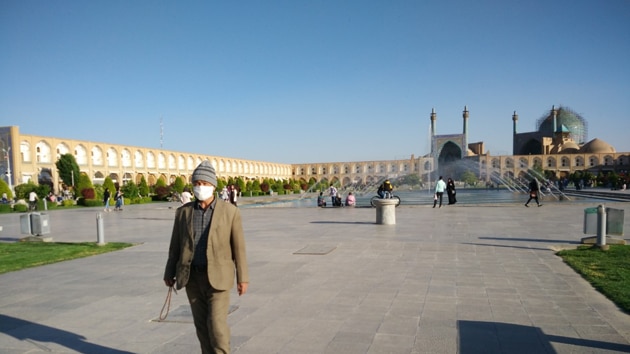
Ramin Khosfian notices that the massive main square in Esfahan, the prettiest Iranian city, is virtually empty as he cycles by on a 70 km ride. The grassy plains between the mosques and palace are usually enlivened by families enjoying a picnic on a summer’s eve and visitors admiring the architectural details. “The virus came to Qom first, likely via two Chinese businessmen after the new year, and has taken 7000 lives. His wife, Zainab, who is doing her residency in radiology says the cases have dropped compared to the first two weeks. ‘Staying home,’ Ramin noticed, ‘people are sleeping in, and having only two meals a day, a late brunch and early dinner.’
Domestic airports are open and active and trains and busses are now running, but there are no travellers. ‘Human beings are thinking only of themselves, destroying nature and jungles and wildlife, and if we continue the wrong we’re doing, we’ll have another reminder soon. But sadly, it is human nature to forget quickly.’
You can follow Geetika Jain on insta @geetikaforest