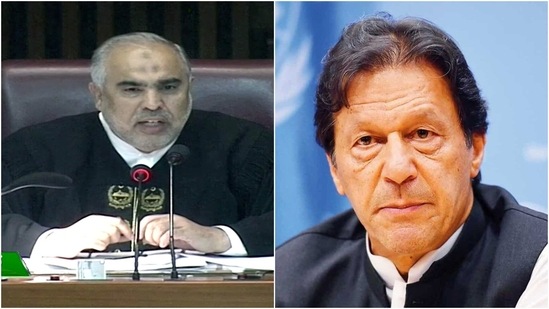
By refusing to conduct voting on the Opposition’s now successful no-confidence motion to oust the Imran Niazi government, National Assembly speaker Asad Qaiser has exposed himself to contempt of Pakistan Supreme Court order and is thus liable for punishment.
Ex National Assembly speaker Asad Qaiser tried to sabotage the no-confidence vote on the direction of ousted Pak PM Imran Niazi.
{{^htLoading}} {{/htLoading}}
While the post of Speaker in either Assembly or Parliament is expected to be non-partisan and above the political parties, Qaiser cited his 30-year-old relationship with ousted PM Niazi and refused to follow the directions of the Pakistan Supreme Court's five-judge bench. Rather than conduct the no-confidence vote as mandated by the Court on Saturday, Speaker Qaiser chose the partisan route and resigned from the post.
{{^usCountry}}{{/usCountry}}
His deputy Qasim Suri on April 3 dismissed the no-confidence motion on grounds of an alleged foreign conspiracy to dismiss the Niazi government and prorogued the Assembly session. It was only after the Opposition approached the Supreme Court of Pakistan that the Chief Justice on April 7 ordered the National Assembly to be restored and the vote to take place on April 9.
{{^htLoading}} {{/htLoading}}
{{^usCountry}}
While the voting on the motion was conducted by a PML (N) speaker on the chairman panel of the Assembly, Niazi was not present in the house but at his private home on the outskirts of Islamabad. It is understood that the Army Chief Gen Qamar Jawed Bajwa and the DG (ISI) Lt Gen Nadeem Anjum met Niazi at his Bani Galla residence before the vote finally took place amidst theatrics inside and outside the Assembly premises.
{{/usCountry}}
{{#usCountry}}
While the voting on the motion was conducted by a PML (N) speaker on the chairman panel of the Assembly, Niazi was not present in the house but at his private home on the outskirts of Islamabad. It is understood that the Army Chief Gen Qamar Jawed Bajwa and the DG (ISI) Lt Gen Nadeem Anjum met Niazi at his Bani Galla residence before the vote finally took place amidst theatrics inside and outside the Assembly premises.
{{/usCountry}}
Even as the ousted former cricketer has called for protests today against what he calls a foreign conspiracy to dismiss his government, the public mood as envisaged from the social media appears to be that of relief from a political drama that continued for nearly a month.
{{^htLoading}} {{/htLoading}}
According to Pakistan watchers, PML (N) leader Shehbaz Sharif will be sworn in as Prime Minister of Pakistan on Monday, paving a way for a general election at a suitable time. While a sole PTI member in the Assembly before the vote said that Niazi will return to power with a two-thirds majority, the seat of Pak PM will be hot for anyone to handle in future given the state of the economy of the Islamic Republic. With external debt in three figures, rising food inflation and a weak Pakistani rupee, the next PM of Pakistan has a very tough job at hand.
Shishir Gupta is Executive Editor at Hindustan Times and one of India's top journalists covering national security, strategic affairs, foreign policy and geopolitics. Over the past three decades, he has extensively reported on India's military, diplomatic and security landscape, covering every major conflict and national security challenge, from the 1999 Kargil War and the 2020 East Ladakh standoff to Operation Sindoor in 2025. He has also covered major terror attacks, including the IC-814 hijacking, the 26/11 Mumbai attacks and the 2025 Pahalgam terror strike, along with numerous Pakistan-backed terrorist incidents in the Kashmir Valley and across India. He has reported on national and state elections for more than three decades. A recognised authority on strategic affairs, Gupta has covered India's nuclear programme since the Pokhran-II (Shakti series) tests in May 1998 and has written extensively on global nuclear issues, Indian diplomacy and the country's expanding global outreach. He has also reported widely on international conflicts and terrorism, with a special focus on the Indian subcontinent. Gupta has interviewed Prime Minister Narendra Modi more than four times, including Modi's first interview with the print media after becoming Prime Minister in May 2014. His other interviews include three with the Dalai Lama, as well as conversations with Benjamin Netanyahu, Amit Shah, Yogi Adityanath, S. Jaishankar, Nirmala Sitharaman and Piyush Goyal. He is the author of Indian Mujahideen: The Enemy Within (Hachette, 2011) and Himalayan Face-off: Chinese Assertion and Indian Riposte (Hachette, 2014). He was awarded the Chevening-Wolfson Joint Scholarship at Wolfson College, University of Cambridge, UK, in 1998 and participated in the International Visitor Leadership Program (IVLP) of the US State Department in 2006. He received the Ben Gurion Prize from Israel in 2011 and the K. Subrahmanyam Prize for Strategic Studies in 2015 from the Manohar Parrikar Institute for Defence Studies and Analyses (MP-IDSA). Since 2024, he has hosted Point Blank, Hindustan Times' weekly YouTube show on global geopolitics.
Get the latest World News, breaking headlines and global updates from the US, UK, Pakistan, Bangladesh, Russia and other countries. Follow major international events on Hindustan Times.
Get the latest World News, breaking headlines and global updates from the US, UK, Pakistan, Bangladesh, Russia and other countries. Follow major international events on Hindustan Times.
Home/World News/Loyalty to Niazi may legally cost the ex-Pak Assembly Speaker
{{^htLoading}}
Advertisement
{{/htLoading}}
SHARE THIS ARTICLE ON
{{#usCountry}}{{/usCountry}}
Notifications
Get breaking alerts directly from the newsroom
Notifications are on!You'll be notified when news breaks