E-Paper



Nepal PM Oli hints at ‘Indian hand’ in attempts to dislodge him
Embattled Nepal Prime Prime Minister KP Sharma Oli, facing a no-confidence motion, has hinted India could be playing a role in attempts to oust him from office.


Embattled Nepal Prime Prime Minister KP Sharma Oli, who is facing a no-confidence motion, hinted on Thursday that India could be playing a role in attempts to oust him from office.
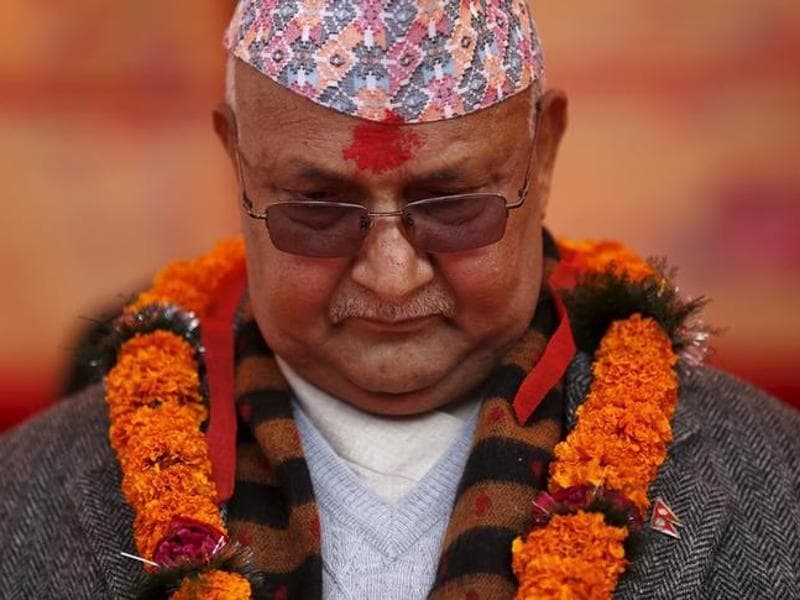
Oli, a known India-baiter, made remarks to this effect at a seminar on national security in Kathmandu a day after the Maoists and the Nepali Congress registered a no-confidence motion against him in parliament.
“Meetings to remove the government have not taken place on their own, but are being (remotely controlled) by batteries. It’s a sad situation for the country,” he said.
Oli, who used the nationalist plank to reach his office last October, stressed he wouldn’t compromise on national security in the name of having cordial relations with neighbours. “Neither we think against anyone, nor have we spoken against anyone. We won’t let this country be used against others,” he said.
In New Delhi, external affairs ministry spokesperson Vikas Swarup he wasn’t aware of Oli’s reported remarks. “I haven’t seen any such comments. Even it there is one, we reject it,” he said.
Communist Party of Nepal-Maoist Centre chairman Pushpa Kamal Dahal Prachanda and Nepali Congress president Sher Bahadur Deuba were invited to the seminar but they were conspicuous by their absence.
“Competition should be on other issues. But not on the question of national security,” Oli quipped about their absence.
The CPN-MC and Nepali Congress have inked a seven-point agreement on power-sharing. If the no-confidence motion is passed, Prachanda is likely to assume the premier’s chair first, followed by Deuba.
Both parties and their allies have the number of votes needed in parliament to oust Oli. The Madhesi parties, which have been seeking amendments to the constitution, have decided to support the motion.
Oli has refused to resign and plans to face the motion, which could come up for voting on July 23.
This is not the first time Oli and his party, the Communist Party of Nepal-Unified Marxist Leninist, have accused India of making attempts to remove him from office. They did it earlier in May, when the Maoists made an unsuccessful bid to dislodge the prime minister.
It was followed by the cancellation of President Bidhya Devi Bhandari’s visit to India and the recall of Nepal’s ambassador to New Delhi.
Despite India’s denials of involvement in the five-month border blockade imposed by Madhesis last year, Oli, who had not become prime minister then, had accused New Delhi of imposing it.