With Iran-backed Houthis opening a new front in the war in West Asia, Pakistan has now addressed its defence pact with Saudi Arabia and its position on the conflict.
Speaking to Al Arabiya English, Pakistan Army spokesperson Lieutenant General Ahmed Sharif Chaudhry said the defence pact between Saudi, Pakistan and Turkey had “no aggressive element” and was based on “collective deterrence”, terming it as “purely defensive.”
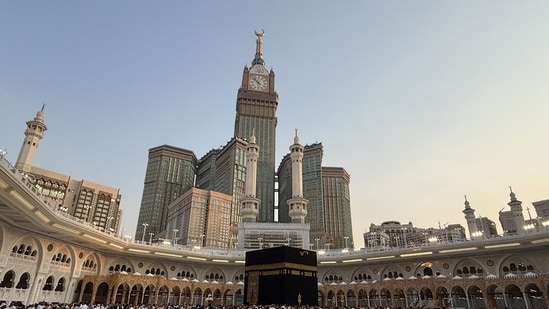
The remarks come after the Saudi-led coalition in Yemen accused the Houthi rebels on Wednesday of targeting Islam's holy city Mecca, triggering outrage across the Muslim world and deepening the already raging conflict in the region. Yahya Saree, the Houthis' military spokesperson, denied the group had targeted Mecca and called the Saudi reports a set-up for propaganda.
Deep Dive
What does Pakistan's defence pact with Saudi Arabia entail?
Why did the Houthis deny targeting Mecca despite accusations?
How has Pakistan responded to the recent Houthi attacks near Mecca?
‘No offensive, aggressive element’: What Pakistan said
The Pakistan Army spokesperson, when asked whether the defence pact with Saudi Arabia and Turkey complicates Islamabad's position towards Iran, said the military alliance was not forged “out of the blue.”
{{/usCountry}}The Pakistan Army spokesperson, when asked whether the defence pact with Saudi Arabia and Turkey complicates Islamabad's position towards Iran, said the military alliance was not forged “out of the blue.”
{{/usCountry}}“This military alliance that we have got into, it is not something that has come out of the blue. It is based on decades-old strategic relationships between the countries. And these relationships that Pakistan has with both these countries are special,” Chaudhry said. He added that Pakistan's relationship with Saudi Arabia and Turkey was based on “an emotional connection”, a “cultural connection”, people-to-people ties as well as a “military connection which spans over decades.”
Underscoring the agreement under the pact which was made public, Chaudhary said a “simple reading” shows that the alliance “is based on collective deterrence.”
“This alliance is a formalisation of these strategic relationships in a peculiar environment…It has got no offensive, no interference, no aggressive element about it and it is purely defensive in nature,” the Pakistan Army spokesperson said.
Saudi draws ‘red line’ as Houthis open new front
Recent Houthi attacks on Saudi Arabia have opened a new front in the conflict in West Asia. Houthi missile and drone attacks on Saudi Arabia had injured at least 73 civilians last week.
On Wednesday, the Saudi-led coalition fighting Yemen's Houthis said it had shot down a drone south of Mecca a day earlier before it could enter the restricted airspace over Islam's holiest city.
The coalition said "the security of the Two Holy Mosques and the pilgrims is a red line" and promised deterrent measures against the Iran-backed group. A lightning offensive last week gave the Houthis effective control of Yemen's entire Red Sea coast, including the port of Mocha and Perim Island in the Bab al-Mandab strait.
Iranian weapons, funding and tactical advice helped the Houthis take Mocha, Reuters reported on September 10 citing sources who said Islamic Revolutionary Guard Corps (IRGC) personnel helped guide the operation.
What has Pakistan said on the Houthi strikes?
Last week, Pakistan expressed "complete solidarity" with Saudi Arabia following Houthi attacks, and warned that the strikes threaten regional security and global energy supplies. Pakistan Prime Minister Shehbaz Sharif conveyed the support to Saudi Crown Prince Mohammed bin Salman during a phone call, according to Pakistan's Prime Minister's Office. This came after Saudi temporarily shut its 1,200-km East-West oil pipeline following a drone attack launched from Iraq.
The pipeline is a key alternative route for Saudi oil exports because it allows crude to reach the Red Sea without passing through the Strait of Hormuz, where shipping has been severely disrupted by the wider conflict involving the US and Iran since February.
Sharif also condemned the alleged drone attack by Yemen's Houthis near the holy city of Mecca, describing the same as “dastardly and heinous”. "The people of Pakistan are saddened and perturbed by this outrageous act. There can be no words strong enough to capture the depth of anguish and sorrow felt by us at this reprehensible and unforgivable act," the Pakistani PM wrote on X.