E-Paper



Shringla raises Manipur ambush, restoration of democracy during visit to Myanmar
India’s foreign secretary Harsh Shringla met the State Administrative Council chairman, Gen Min Aung Hlaing, who has ruled Myanmar since he seized power in a coup on February 1


NEW DELHI: The speedy restoration of democracy and the fallout of the instability in Myanmar on the security situation in India’s northeast, including the ambush on an Assam Rifles convoy in Manipur, were raised by foreign secretary Harsh Shringla in his meetings with Myanmar’s military leadership.
Shringla, on a two-day working visit to Myanmar, met the State Administrative Council chairman, Gen Min Aung Hlaing, who has ruled the country since he seized power in a coup on February 1, and representatives of civil society and the opposition, including the National League for Democracy.
The restoration of democracy and a complete end to violence figured in all these meetings, the external affairs ministry said in a statement on Thursday. Shringla also pointedly raised matters related to India’s security, especially in light of the ambush on an Assam Rifles convoy in Manipur’s Churachandpur district on November 13 that killed Col Viplav Tripathi, his wife and six-year-old son.
The Indian side has for long sought to strike a balance between backing the democratic process in Myanmar and maintaining cooperation with the military, mainly to contain the activities of insurgent groups from northeastern states that have bases in the neighbouring country.
Also Read: Myanmar hands over 5 RPF militants to Manipur Police: Report
“During his meetings with all concerned, the foreign secretary emphasised India’s interest in seeing Myanmar’s return to democracy at the earliest; release of detainees and prisoners; resolution of issues through dialogue; and complete cessation of all violence,” the statement said.
Shringla reiterated India’s “strong and consistent” support to the Association of Southeast Asian Nations’ (Asean) initiative on Myanmar and expressed the hope that progress will be made in a “pragmatic and constructive manner” on the grouping’s five-point consensus.
The external affairs ministry said India has been involved in the democratic transition in Myanmar and has worked with various stakeholders in developing capacities for democratic systems and practices. “India proposes to renew these efforts for Myanmar to emerge as a stable, democratic, federal union in accordance with the wishes of the people of Myanmar,” the statement said.
The visit was also an opportunity to “raise matters relating to India’s security, especially in the light of the recent incident in Churachandpur district in southern Manipur”, the statement said, referring to the recent ambush that has been blamed on the militant groups People’s Revolutionary Party of Kangleipak (PREPAK) and People’s Liberation Army (PLA).
Shringla “stressed the need to put an end to any violence and maintain peace and stability in the border areas”, the statement said. “Both sides reiterated their commitment to ensure that their respective territories would not be allowed to be used for any activities inimical to the other,” it added.
Any developments in Myanmar “have a direct impact on India’s bordering regions”, and peace and stability in Myanmar “remain of utmost importance to India, specifically to its northeastern region”, the statement said.
Experts believe the instability in Myanmar’s border regions, especially the spike in activities of armed pro-democracy groups, has allowed anti-India insurgent groups to step up their activities in Nagaland and Manipur. The security situation has been further complicated by some 15,000 people fleeing Myanmar to take refuge in the northeastern states.
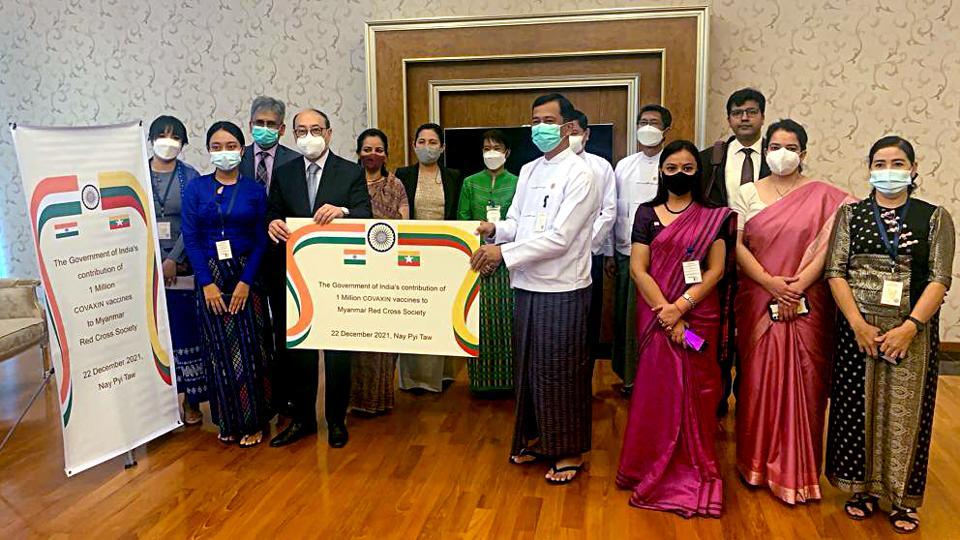
While pointing to nearly 1,700km border that India shares with Myanmar, Shringla conveyed India’s continued humanitarian support for the people of Myanmar. He handed over one million doses of Indian-made Covid-19 vaccines to the Myanmar Red Cross Society. Part of this consignment will be used for communities living along Myanmar’s border with India.
A grant of 10,000 tonnes of rice and wheat for Myanmar was also announced by the Indian side.
The foreign secretary also expressed India’s continued support for socioeconomic developmental projects, including those in the India-Myanmar border areas, and commitment to the speedy implementation of connectivity initiatives such as the Kaladan multimodal transit transport project, which will link Sittwe port in Rakhine state to Kolkata port and the Trilateral Highway between India, Myanmar and Thailand.
Shringla reiterated India’s commitment to continue with projects under the Rakhine State Development Programme and Border Area Development Programme.
Besides senior representatives of the military junta and political parties, Shringla was also scheduled to meet Myanmar-based ambassadors and representatives of the UN.