The attacks on Israel of October 7th 2023 fell on the first day of the Labour Party’s conference, and the scale of the slaughter was still emerging when it was taken as a proxy for a more trivial conflict: the battle between Labour’s factions for control of the party. Acolytes of Sir Keir Starmer, then its leader and now prime minister, wanted delegates to stand for a moment’s silence. Could it pass, live on television, without a heckle?
It did.
The attacks on Israel of October 7th 2023 fell on the first day of the Labour Party’s conference, and the scale of the slaughter was still emerging when it was taken as a proxy for a more trivial conflict: the battle between Labour’s factions for control of the party. Acolytes of Sir Keir Starmer, then its leader and now prime minister, wanted delegates to stand for a moment’s silence. Could it pass, live on television, without a heckle?
It did. In the zero-sum struggle with followers of Jeremy Corbyn, Labour’s leftist former leader, it was a symbolic victory. For the Starmerites, how the conference responded to the massacre was a test of their boss’s project to change the party. It would reveal whether Labour could be a home again for British Jews after antisemitism had flourished in its ranks, and whether a Labour government would be able to tell Britain’s allies from its enemies. Above all, they saw a test of whether Labour could elevate the priorities of its working-class electorate over the passions of its middle-class activists, and talk about Nuneaton more than Nablus.
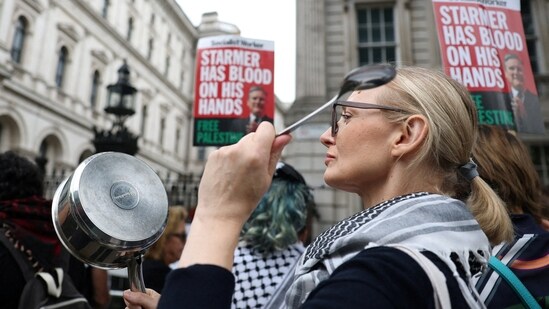
But that declaration of victory now looks like hubris. Palestine is, again, the animating force within Labour’s internal politics. Sir Keir, a leader who defined himself against his members’ concern with the Middle East, will now be defined by it.
On July 29th he announced that Britain would recognise the state of Palestine at the UN General Assembly in September, unless Israel acted to end Gaza’s humanitarian crisis, implement a ceasefire, repudiate settlement-building in the West Bank and commit to a two-state solution. It was a shift from Labour’s position, tucked away on page 124 of the manifesto, to recognise Palestine as part of a peace process (currently conspicuous for its absence). The prime minister had let himself be pushed. More than a third of MPs, half of them Labour, had signed a letter demanding recognition. A third of the cabinet agreed, some publicly.
If pleasing his colleagues was the aim, it is unlikely to work. The government’s supporters describe a systematic shift in policy on Israel. It restored funding to UNRwA (an aid body accused of harbouring Hamas), stopped many arms exports to Israel, ended trade talks, indicated it would uphold an International Court of Justice arrest warrant for Binyamin Netanyahu, Israel’s prime minister, and imposed sanctions on his most extreme ministers. Yet Labour’s pro-Palestine supporters regard these shifts as wholly inadequate given the enormity of the crisis now unfolding.
Sir Keir may have given his MPs most of what they wanted, but he looks slow, moving after rejecting the declaration days before by France’s Emmanuel Macron (the Élysée is now thrilled). Making the recognition dependent on Mr Netanyahu sticking to his course was intended to maximise Britain’s leverage, but in practice may waste it. Action over words is Sir Keir’s mantra: judge him by his plodding results rather than bold rhetoric. Yet words are what his critics want above all, and Sir Keir struggles to find them. Nine in ten Labour activists want him to criticise Israel more harshly. For them, Palestine is a moral crisis more than a strategic one, and for those who characterise the war in Gaza as a genocide, his low-volume approach is not a sign of statecraft but complicity.
What Sir Keir cannot admit is that what he says on Palestine does not matter all that much. His members think him indifferent; in truth he is impotent. Mr Netanyahu angrily accused the British government of “appeasement towards jihadist terrorists”, but in reality it is not Britain or France but America that can make Israel change course. The British-made arms exports to Israel that really matter—spare parts for F-35 jets—could be stopped only by pulling out of a global components pool, which ministers will not do. In a letter to the Guardian Andy Burnham, Emily Thornberry and other Labour bigwigs declared it would be “fitting” for Britain and France to take the lead in recognising Palestine because together they “conspired together to carve up the Ottoman Levant” in the Sykes-Picot Agreement of 1916. This is the sort of appeal to imperial grandeur last seen on the Brexit right.
A migraine without a cure
Sir Keir’s election landslide last year masked how much Gaza had gouged his electoral coalition. Across the electorate Labour gained six percentage points in support compared with 2019. Among those voters who said they sympathised “much more” with Palestinians than Israelis, it fell by 18 points.
Gaza was to many Muslims what Brexit was to the white working class, argues More in Common, a polling firm. It was the moment a poor, patronised, socially conservative underclass asked what the Labour Party had ever done for them. In the 21 seats where more than 30% of the population is Muslim, Labour’s share dropped by 29 points, to 36%. Five pro-Gaza independents were elected, among them Mr Corbyn. One in three Muslims say they would vote for the new left-wing party Mr Corbyn has launched with Zarah Sultana, another ex-Labour MP, according to Stack Data Strategy, a consultancy. Nigel Farage, the leader of Reform UK, speaks with glee of how Gaza has fractured Labour’s coalition in northern English towns, bringing them closer to his grasp. Expect the Labour Party to repeat that logic ad nauseam in the next three years: its best hope of retaining power lies in a terror of Mr Farage gluing its coalition of progressives back together.
But Gaza breaks the old rules of politics. Labour officials admit they struggle with a new media, in which TikTok is flooded with horror that would be cut from the television news. For such voters, Gaza is much bigger than Mr Farage; bigger than Westminster itself. “We have to vote for them or it’s Farage? We’re saying screw your false choice,” declares Ms Sultana, who terms her former colleagues the “genocide party”. The Starmerites thought they had defeated the politics of Palestine. It may defeat them.
One Subscription.
Get 360° coverage—from daily headlines
to 100 year archives.
Archives
HT App & Website