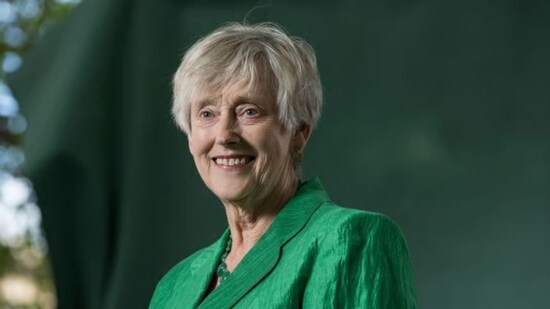
Watch her closely and—or so the upper echelons of British espionage felt—you could see the signs. There was the cut of her hair, for one thing: that close, spiked crop. Something, too, in the way she held herself. And she was a woman. There was, everyone agreed, little doubt. Dame Judi Dench’s “M” in the 1995 film “GoldenEye” was based on Dame Stella Rimington, the first female head of MI5, Britain’s domestic counter-intelligence and security agency. Dame Stella agreed: she “holds her hands in the same way as me”.
Her opportunity came when she was walking through the British High Commission in New Delhi and someone “tapped me on the shoulder” and asked, with the subtle tradecraft of MI5 legend, “Psst…Do you want to be a spy?”
There are many ways to judge the importance of the career of Dame Stella, who died on August 3rd, aged 90. She rose through MI5’s august alphabet of espionage—from lowly F-Branch, to head of K-Branch, then G-Branch—to “DG” (director general) in 1992. She caused Britons to question tired preconceptions about women’s roles at work and in the home. (Or, as one headline put it, was a “Housewife Superspy”. ) Perhaps most radically of all, she caused a nice sensible woman with a nice sensible haircut to appear in a James Bond movie, and explicitly and implicitly told him he was “a sexist, misogynist dinosaur”.
Housewives were not, in those days, expected to become spies. Certainly not super ones. The criterion that Vernon Kell, the founder of MI5, looked for in his male recruits was “the ability to make notes on their shirtcuff while riding on horseback”. For women, his criteria were rather different. “I like my girls”, Kell said, “to have good legs”. There were indeed, Dame Stella felt, clever men in MI5. There were also “a lot of stupid men”. On the prevalence of galloping horses, she remained silent.
Her greatest career move was, paradoxically, to abandon her own career (as an archivist) for her husband’s. He had been posted to Britain’s High Commission in New Delhi and she followed. Her opportunity came when she was walking through the commission compound and someone “tapped me on the shoulder” and asked, with the subtle tradecraft of MI5 legend, “Psst…Do you want to be a spy?”
She was soon immersed in the thrilling world of intelligence. She found it “pretty dull”. Her first job was to spy on communists in Sussex but, since the comrades of Sussex seemed peaceable, passed the time reading novels under her desk. This, by the standards of MI5, was energetic. One colleague arrived at 10am, went for “breakfast” at 11am; returned “smelling strongly of whisky” at noon; went for lunch then fell asleep at four. Eventually he collapsed in a lift and was never seen again.
Her capability (or perhaps sobriety) got her noticed and her work became increasingly interesting. She moved from cold-war work to Irish terrorism before, in 1992, becoming the first female DG—and the first holder of the top job to have her name formally announced. Paparazzi duly descended, to her horror: you could never be quite sure whether someone was trying to shoot a photograph or just “shoot you”.
Her lack of anonymity became an asset. When she left, she published an autobiography, then started writing spy novels. Here too she did things her way. The key to a thriller, Ian Fleming had said, was to “write about what people are really interested in: cards, money, gold”. In Bond novels, Bond has a housekeeper, lots of sex with characters called things like “Pussy Galore” and spends his time musing on “the sweet tang of rape”. In Dame Stella’s first novel, her heroine has no housekeeper, very little sex and spends her time musing about whether the washing machine will have finished its run. (Spoiler alert: Chapter One ends with it “stopped mid-cycle”.)
Critics sniffed. Her autobiography was “a dull read”; her novels “predictable”. But whether or not she changed MI5, she has changed the portrayal of spies. The most highly rated spy thriller on Netflix is not about a male spy, but “Black Doves”, about a female spy and mother. One of its best moments comes when the heroine, played by Keira Knightley, pauses mid-job, to hiss “Go back to bed!” into her child’s baby monitor. Fleming was correct: thrillers should cover what people are interested in. But as Dame Stella showed, they are interested in women and domesticity too.
Get the latest headlines from US news and global updates from Pakistan, Nepal, UK, Bangladesh, Russia and US Iran war Live, get all the latest headlines in one place on Hindustan Times.
Home/World News/Stella Rimington Battled Communists, Terrorists And Literary Critics

 E-Paper