E-Paper



Tajikistan donates ice cores to study climate history
Ice cores are a vertical column of ice extracted from glaciers and ice-sheets; they hold records of what the planet was like hundreds of thousands of years ago

 Prefer HTon Google


New Delhi: Tajikistan became the first country to donate two ice cores to the international scientific community -- one each to the Pamir Research programme and the Ice Memory sanctuary in Antarctica on Monday.
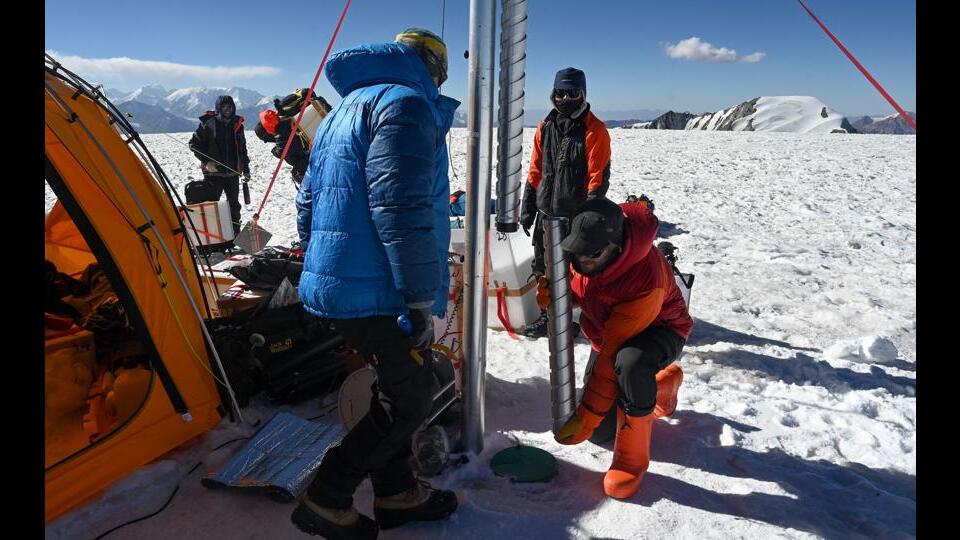
The ice cores were collected from the Kon Chukurbashi area of Pamir, one of the regions covered by what the scientific community calls the “Karakoram Anomaly”.
Ice cores are a vertical column of ice extracted from glaciers and ice-sheets; they hold records of what the planet was like hundreds of thousands of years ago. Older ice cores could be between 500,000 and 800,000 years old.
On September 24, an international team of scientists launched a new ice coring expedition on the Pamir Mountains , Tajikistan, at an altitude of 5.800m, on the Kon Chukurbashi ice cap, 13 scientists led by the Swiss-funded PAMIR Project and a team of Tajik partners extracted the first ever deep ice cores from the Pamirs from a depth of around 105 metres.
The Pamirs remained one of the last major high-altitude regions from where no deep ice core had ever been retrieved, according to glaciologists. “If many glaciers in the Pamir Mountains of Tajikistan still seem resilient in the face of global warming, scientists do not know how long this will last. Past efforts to extract ice cores have been inhibited by challenging site access, complicated logistics,” a statement by the Pamir Research Programme said.
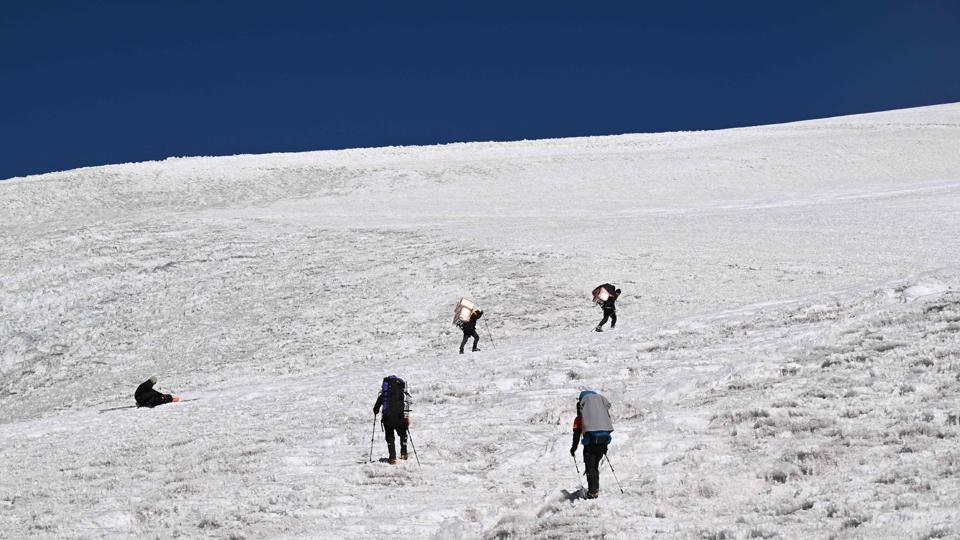
These ice cores will eventually be shipped to Japan and Antarctica for research into the climate history of the region. In Antarctica, they will be available at the Concordia Station which houses the Ice Memory Sanctuary hosted by the governments of Italy and France.
Though the ice cores have not been assessed yet, there is increasing evidence that the Karakoram anomaly may be ending, scientists said. The Karakoram Anomaly refers to the phenomenon of glaciers in the Karakoram Range remaining stable or even growing, contrary to the global trend of widespread glacier retreat due to climate change.
“So the primary evidence right now that the glaciological community has suggested that the Karakoram anomaly could be ending is based on what we call geodetic measurements of glacier change. So these are height measurements from satellites primarily. And there’s a landmark study published in 2021 which actually re-analysed an extensive satellite data set globally and showed that there was quite a strong tendency towards less mass gain where glaciers were gaining mass and towards a transition towards mass loss for the regions that had been previously close to zero mass balance from my slides,” said Evan Miles, leader expedition (Pamir) from Fribourg University.
“What I can tell from our own observations of glaciers here in this region over the last five years is that there has been a strong tendency towards glaciers losing mass increasingly over the last five years and that’s from direct and in-situ measurements of glacier mass balance and measuring at stakes on an annual basis from stations and from satellite data as well. However, actually out of those last six or seven years the primary smoking gun for mass loss has not been the temperatures necessarily which have been extremely warm relative to the climatic record but actually the severe precipitation deficits and for a cold dry region we would expect glaciers to be very sensitive to precipitation and so that is indeed one of the things that we think is partly responsible for the poor glacier health over the last seven years,” Miles added.
A paper published in Nature’s Communications Earth & Environment on September 2 found that snowfall shortages are now destabilising some of the world’s last resilient glaciers, as shown by a new study in Tajikistan’s Pamir Mountains.
Located in one of the most remote and extreme environments on Earth, the Kon Chukurbashi ice cap is expected to hold at least 700 years of climate history and regional climate variations. Although the glaciers of the Pamirs have been resilient to anthropogenic climate change until now, the vital climate signals preserved within them are already at risk following a decade of hot and dry years - possibly a turning point for the region, the Pamir Expedition said in a statement.
Using a monitoring station on Kyzylsu Glacier, researchers discovered that stability ended around 2018, when snowfall declined sharply and melt accelerated. The work sheds light on the Pamir-Karakoram Anomaly, where glaciers had resisted climate change longer than expected, the paper said.
“We are thrilled to count on this irreplaceable archive from the Pamir mountains and include it into the Ice Memory Sanctuary,” said Prof. Thomas F. Stocker, Chairman of Ice Memory Foundation from the Oeschger Centre for Climate Change Research at the University of Bern, Switzerland. “Today more than ever, we must protect the data that enable us to make science-based decisions — to better guide our societies, adapt to the global changes threatening our planet, and ensure that future generations are able to anticipate the profound transformations underway. This is a responsibility we all share”, said Thomas Stocker.
The Ice Memory Sanctuary already has some ice cores from France and Italy saved for research.