
 E-Paper



‘The Most Successful Dictator of Modern Times’
The generalissimo died 50 years ago. A historian argues that he gets a bum rap in Spain.


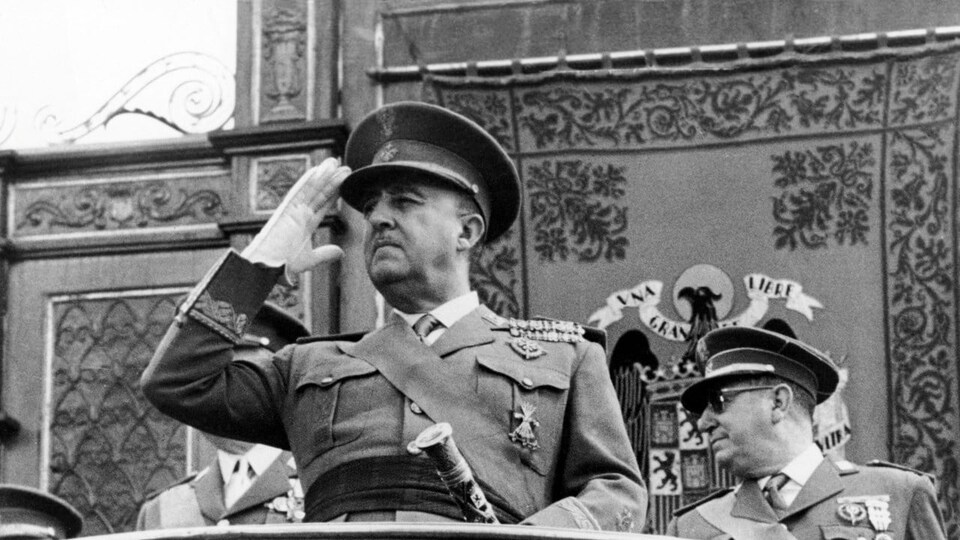
Madison, Wis: n a scale of 1 to 10—1 being Christ, 10 being Hitler—where would we rank Generalissimo Francisco Franco, the dictator who ruled Spain from the end of the Spanish Civil War in 1939 until his death on Nov. 20, 1975?
I put that question to Stanley G. Payne, 91, a professor emeritus of history at the University of Wisconsin. “Oh, 4 or 5,” he says. “Maybe 4 rather than 5. As a dictator he had many virtues in the long run, and that rates him higher in my estimation.”
Mr. Payne’s response would confirm the prejudices of progressive historians of Spain, many of whom regard Mr. Payne as unsuitable for the modern discourse on Franco, which is dominated by leftist universities and distorted by successive Socialist governments in Madrid that “seek to weaponize Franco.”
“You could call me a right-wing democrat,” Mr. Payne says. “I’m definitely a conservative historian, no question about that.” He’s also the most prolific historian of modern Spain, author of more than two dozen books in English and Spanish. He began to feel a certain “marginalization” in 1970, shortly after the publication of “The Spanish Revolution.” It was “the first historical account of the Spanish Revolution in any language.” That revolution, in 1936, brought the hard left to the fore: The economy fell under the control of workers’ organizations, and subversion of the constitution was widespread. Mr. Payne had been a man of the left, but “I was appalled by what I learned about the Spanish left out of the Republic, and that changed my orientation toward just about everything.” The left’s mass executions “were as extensive as those by Franco’s supporters.”
Mr. Payne doesn’t mind the “hostility and avoidance” he faces from liberal Hispanists. “You have to be thick-skinned in life. You have to support what you believe is correct and true.” But Spain now has “freedom of the press and freedom of expression. So I have never been short of very good publishers in Spain, and I have an extensive reading public there.” Only the professional historians are squeamish.
Franco has been “demonized,” but he wasn’t demonic, Mr. Payne says. “He did things that I think were mistaken, but he was placed in difficult circumstances. The civil war was not his idea. Franco’s was a response to a historical necessity. The Franco regime did not destroy democracy. There’d been a destruction of democracy by the Popular Front.” There was “no democratic utopia at hand in Spain in 1936. Quite the opposite. Had the Nationalists lost the Civil War, it’s unlikely the result would have been political democracy.”
In Mr. Payne’s estimation, Franco was the “most successful dictator of modern times,” one whose “creative pragmatism” over 36 years produced stability and, eventually, transformative economic growth. He dismisses as “simplistic” the few pro-Franco polemicists who would give the dictator credit for the tolerant and democratic Spain that emerged after 1975. But he asks us to acknowledge that “the depolarization and depoliticization” of Spain—especially after 1945—ensured that “a new start could be made, shorn of the extremism of the civil-war generation.”
Spain today is one of the freest countries in the world. The “atrocity of Pedro Sanchez notwithstanding,” Mr. Payne says, referring to the current prime minister. Mr. Sanchez “is the most evil politician in the Western world I’ve seen in recent years,” Mr. Payne says. “He is totally unprincipled, totally unscrupulous.” The professor has in mind, among other things, Mr. Sanchez’s willingness to form a coalition government with Communists and Basque and Catalan separatists. The prime minister is also the Western leader most openly hostile to Israel.
After World War II, Franco was regarded as the “primary resident ogre of Western Europe.” Mr. Payne contrasts the damning of Franco in his own lifetime—and after—with the liberal evaluation of the Communist Josip Broz Tito in Yugoslavia as “a kind of beacon of progressive achievement.” He scoffs at “hysterical” comparisons of Franco to Hitler (and has fiercely criticized the leftist British historian Paul Preston for describing the Spanish Civil War as a “holocaust”). He offers other comparisons: Franco, he says, was “the most dominant figure in Spain since the time of Philip II”—king from 1556 to 1598—and regards Napoleon Bonaparte as his “earliest modern prototype.”
Mr. Payne isn’t Catholic—his parents were Texan Protestants. But he stresses that “one of the achievements of the Franco movement was to save the religious structure of Spain, to save the Catholic Church, which was being destroyed by the revolution.” The Spanish Civil War was “a war of religion. This was the main source of moral support of the Nationalists. The left did not have a single moral, spiritual, cultural, unifying factor in the same way that the right did.”
The anticlericalism of the left, with its burning of churches and slaughter of priests, resulted in some of the worst atrocities of the war. “It was the greatest persecution of Christianity at one time in one country in modern history, possibly in all of Christian history.”
Mr. Varadarajan, a Journal contributor, is a fellow at the American Enterprise Institute and at NYU Law School’s Classical Liberal Institute.


