Over a year before deadly floods tore through Nepal, a US-backed programme tracking landslide risks in the Himalayas was abruptly shut down by the Donald Trump administration, a CNN report said on Wednesday.
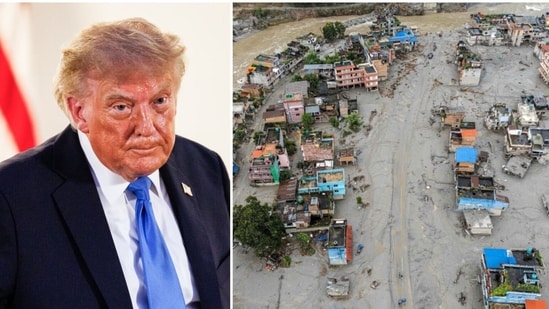
On August 26, an ice-rock avalanche near the Nepal-Tibet border sent a wall of water and debris racing through valleys, towns and hydropower projects. Over 1,200 people have died, and thousands are still missing, as per the Nepal health ministry.
The programme, Project SERVIR-Hindu Kush Himalaya, spent years identifying areas vulnerable to landslides and other hazards. It was also working on tools that could help authorities understand how extreme rainfall was affecting unstable slopes and where landslides were becoming more likely.
The SERVIR programme’s website says its work in the Hindu Kush Himalaya region, including Nepal, “concluded” in January 2025. HT couldn't independently verify this.
Birendra Bajracharya, the project's former director, told CNN that the funding cut brought some of that work to an abrupt stop.
The programme had been working to improve “landslide situational awareness” linked to extreme rainfall. Another effort, aimed at detecting movement on slopes that could help with landslide forecasting, was also left unfinished.
{{/usCountry}}The programme had been working to improve “landslide situational awareness” linked to extreme rainfall. Another effort, aimed at detecting movement on slopes that could help with landslide forecasting, was also left unfinished.
{{/usCountry}}ALSO READ | 'Very confident they are alive': Official on workers trapped in Nepal's Rasuwagadhi hydropower plant
“Slope motion detection for landslide forecasts could not be completed,” Bajracharya said.
Some programmes continue, including streamflow prediction for major rivers and forest-fire monitoring. But flood inundation mapping is no longer operational, and Nepal’s monitoring work was disrupted.
“We got the stop work notice around the end of January 2025,” Bajracharya said. The contract had been expected to run through 2026.
A sudden funding cut
The Trump administration, partly through the Department of Government Efficiency, dismantled parts of USAID and cancelled scores of grants, including projects flagged through keyword searches involving “climate”, the project's former director said.
Bajracharya said he was told the decision showed changes in US priorities on foreign aid and cuts to USAID. The abrupt halt also left projects little time to wind down or transfer work to other organisations.
A State Department spokesperson said in January 2025 that the funding cut came before the USAID reorganisation and that SERVIR-HKH tools and services remained active through ICIMOD.
ALSO READ | Rescuers battle flood debris, mud at Nepal hydropower tunnel as victims' families say ‘we still have hope’
The US also said it continued supporting flood mitigation in Nepal through a World Meteorological Organization grant, while NOAA and Nepal’s Department of Hydrology and Meteorology had an agreement covering flood early warning, disaster response training and forecast data.
How the programme would have been useful
SERVIR was helping identify places where such hazards could occur, giving communities downstream a better picture of where they might be exposed.
Marco Tedesco, a geophysicist at Columbia University, said building warning systems for landslides, glacier collapses and glacial outburst floods requires long-term investment.
“For sure, taking away resources from existing projects is not the way to go,” Tedesco told CNN. “We knew that this could have happened, and we know that it will happen again eventually,” Tedesco said of the deadly glacial collapse. “The area is so exposed to hazards from a geological perspective, but it’s also so densely populated, that even small areas impacted, they are going to be paying a high price.”
ALSO READ | Exclusive: After Air India tragedy, same Indian forensic team battles Nepal flood toll
Thousands remain missing
The floods devastated parts of northern and central Nepal. By Wednesday, the death toll was 1,243. Thousands remained missing.
Rescuers were still searching tunnels and underground powerhouses along the Bhotekoshi River, where hydropower workers may have been trapped beneath tonnes of debris.
Ganesh Karki, former president of the Independent Power Producers’ Association, Nepal, said the scale of destruction had made the search extremely difficult.
“The material carried by the river has reached over the tunnels,” he said, as per PTI. At least 947 people from hydropower projects were reported unaccounted for as of Wednesday.
Rescue teams from the Nepali Army and Armed Police Force, along with foreign technical experts and hydropower workers, continued searching damaged sites. Rain in Rasuwa, Nuwakot and nearby areas has further complicated the operation.
Prime Minister Balendra Shah has called for the disaster’s climate-change dimension to be raised internationally. The country has received assistance from India, China, Pakistan, Bangladesh, Sri Lanka, the US, Australia, Qatar, Switzerland, the UK, Japan and Singapore, while the Asian Development Bank, World Bank, European Union and UN have pledged support.