E-Paper


Explained: Donald Trump's landmark $1.35 trillion trade deal with EU before tariff deadline
Donald Trump announced a massive USA-EU trade agreement just days before tariffs were set to triple on European goods.

 Prefer HTon Google


In a significant breakthrough, President Donald Trump on Sunday announced that the United States and the European Union have reached a comprehensive trade deal, just days before a 30 per cent tariff on European imports was due to take effect.
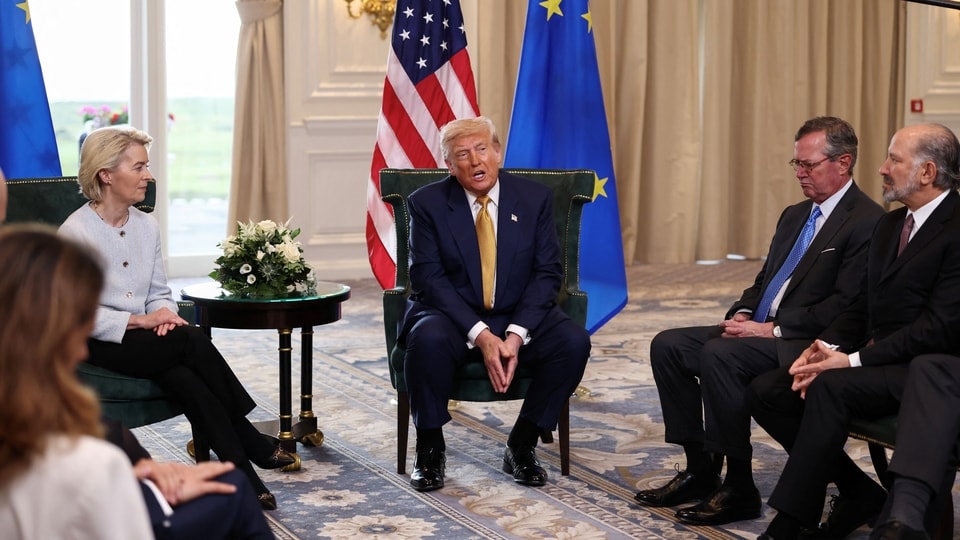
After high-stakes negotiations in Scotland's Turnberry with European Commission President Ursula von der Leyen, the two leaders revealed a new trade framework aimed at averting a full-blown transatlantic trade war. The deal, according to CNN, hailed by both sides as ‘powerful’ and ‘historic’, centers around new tariffs, large-scale energy purchases, and significant investment commitments.
Also read: Donald Trump turns up to play golf amid protests against his Scotland trip
What does the US-EU deal include?
Under the terms of the agreement, the EU will purchase $750 billion worth of US energy, marking a massive expansion in transatlantic energy cooperation. Additionally, the 27-member bloc has committed to investing $600 billion more into the US than its current levels, stated another CNBC report.
The report added that in exchange, Trump has agreed to impose a 15 per cent tariff on most European imports to the US, down from the 30 per cent rate he previously announced. The deal is expected to significantly ease trade tensions between the long-time allies.
A CNBC report quoted Donald Trump declaring that this was a “very big deal, biggest of all” as he stood alongside von der Leyen. Meanwhile, the European Commission chief, speaking after the meeting, acknowledged the difficulty of the talks and said, “It is a good deal, it is a huge deal, with tough negotiations.”
Donald Trump-EU deal impact
The agreement was finalized just before the August 1 deadline, after which the Trump administration had vowed to raise tariffs on most EU goods from 10 per cent to 30 per cent. Earlier in the day, US Commerce Secretary Howard Lutnick had reaffirmed that Washington would not give further extensions, calling the deadline ‘firm’, reported CNN.
Had the talks collapsed, Brussels was prepared to launch a major counter-tariff package targeting a wide range of US exports and invoke its new Anti-Coercion Instrument, a legislative mechanism designed to push back against economic pressure.
Also read: Trump says US will work with Thailand and Cambodia, adds both 'want to settle'
A fractured trade relationship
The US-EU trade relationship is among the world’s largest, valued at nearly $1.97 trillion in 2024, including both goods and services. While the EU ran a goods trade surplus, it faced a deficit in services, resulting in an overall $58.7 billion surplus with the US.
Trump repeatedly criticized the imbalance and used it to justify tougher trade terms. “The US and EU have one of the largest trade deficits,” he had said, defending the imposition of tariffs as leverage.
FAQs
What is the latest trade deal Trump announced?
Trump and EU President Ursula von der Leyen finalized a deal where the EU will buy $750 billion in US energy and invest $600 billion more into the country in exchange for lower tariffs.
Why was this deal considered urgent?
It came just days before Trump was set to increase tariffs on European imports from 10 per cent to 30 per cent on August 1.
What was at stake in the US–EU trade balance?
The EU had a $58 billion overall surplus with the US in 2023, mainly due to goods exports, prompting Trump to demand fairer trade terms.
What other trade deals has the Trump administration secured?
The administration has renegotiated NAFTA (now USMCA), reached agreements with Japan and South Korea, and imposed tariffs on China during its broader trade overhaul.
What is the proposed new tariff structure?
Instead of the planned 30 per cent hike, the new deal imposes a 15 per cent across-the-board tariff on most EU imports.
What are the key risks or criticisms?
Critics argue the deal may strain diplomatic ties, shift costs to consumers, and provoke retaliation from other trading partners not offered similar terms.