E-Paper


The U.S. Alcohol Industry Is Reeling From Canada’s Booze Boycott
The trade fight is prompting a pullback in purchases by the biggest export market for U.S.-made wines, costing American brands tens of millions in sales.


 Prefer HTon Google


Canada’s prohibition on U.S. alcohol is creating a headache for American liquor and winemakers.
On the shelves of many Canadian liquor stores, bottles of Jack Daniel’s, Maker’s Mark and Sailor Jerry Spiced Rum are nowhere to be found. Thousands of bottles of U.S. wine and spirits sit in storage across the country. At tastings, Canadian drinkers are turning their noses up at American alcohol.
After President Trump initiated a series of trade battles with Canada earlier this year, Canadian provinces, which largely handle alcohol imports and distribution in the country, stopped placing orders for American-made spirits, beer and wine. In liquor stores, clerks pulled U.S. brands off shelves, replacing them with Canadian products.
Mike Brisebois, who runs a digital magazine called The Whisky Explorer, held a tasting in June where he served only Canadian, Irish and Scotch whiskies—on the recommendation of his guests. “The general theme was that they were boycotting the U.S.,” he said.
In the roughly six months that have passed since the U.S.-Canada trade spat kicked off, the hit to the U.S. alcohol industry is coming into view.
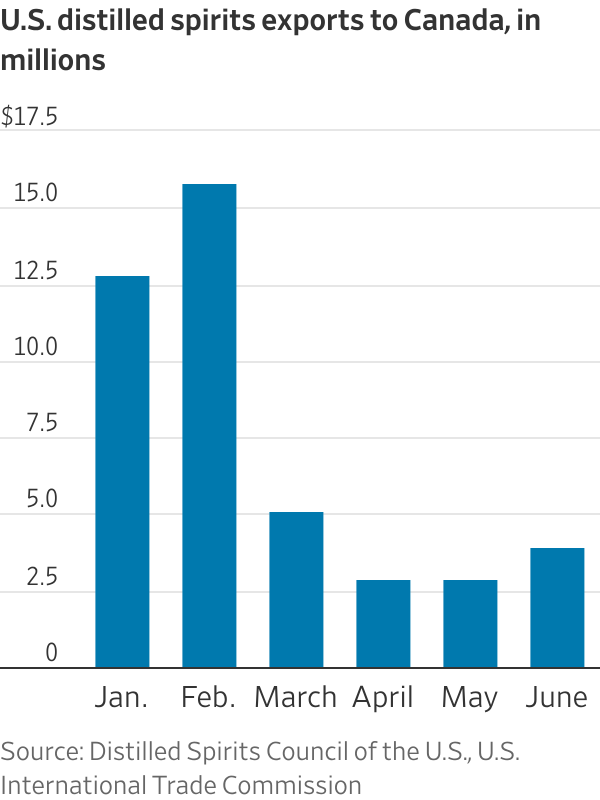
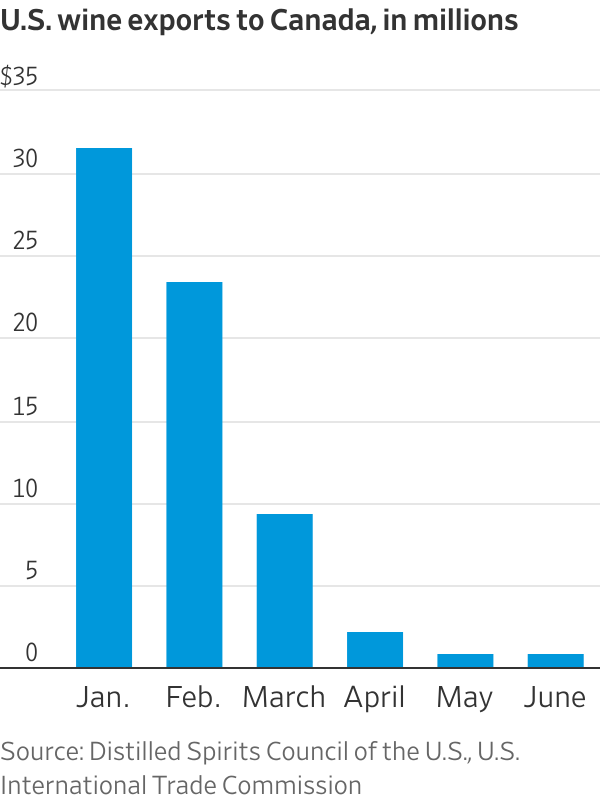
The Distilled Spirits Council, an industry group, estimated exports of U.S. distilled spirits to Canada at $43.4 million over the first six months of 2025, down about 62% from the same period in 2024. Exports of American wine were about 67% lower, the group said, citing U.S. trade data.
Ontario, Canada’s most populous province, sells spirits and wine to residents through 688 stores operated by the Liquor Control Board of Ontario. Last year, the LCBO sold more than $700 million worth of American liquor and wine, sales that have now dwindled to zero.
Wine Institute, a trade group representing California-based wineries, estimated that in six months this year, U.S. wineries have lost more than $173 million in export value. In 2024, Canada comprised 35% of all U.S. wine export business, making it the industry’s largest export destination by far.
“The absence of U.S. wine from Canadian stores is not just a market disruption, it’s a breakdown in a trusted relationship built over decades,” said Wine Institute Chief Executive Robert Koch. “This is not just about wine. It’s about farming families, rural jobs and businesses that depend on access to international markets.”
At Paso Robles, Calif.-based Hope Family Wines, sales to Canada have fallen by about 10% so far this year. Gretchen Roddick, an executive vice president at the winery, said bottles of its Cabernet Sauvignon and other products have been sitting in storage in Canada since being taken off shelves earlier this year.
“It’s definitely going to hurt us personally,” she said.
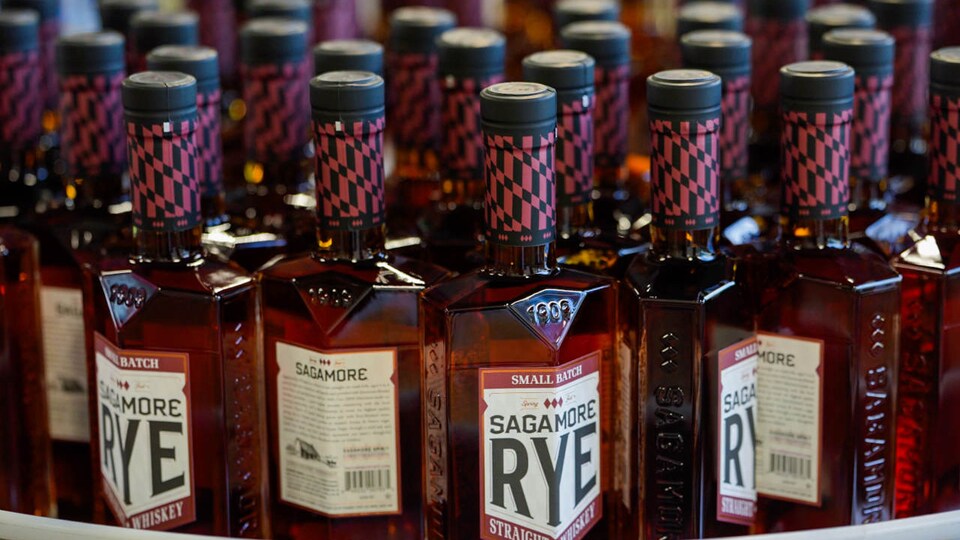
Robert Cullins, CEO of Baltimore-based Sagamore Spirit, said it can take around three years to get Canadian market approval for the rye whiskey made by the distillery on the city’s waterfront. Until earlier this year 10% of the company’s exports had gone to Canada, but that number has now dropped to zero, Cullins said.
Cullins estimates Sagamore will lose out on roughly $2 million of sales this year, equivalent to a container of rye comprising roughly 1,200 nine-liter cases. “We’re a small craft distillery,” he said, “so a couple of million dollars is pretty significant.”
Canadian liquor stores these days are heavily stocked with domestically produced brands like Maverick Distillery’s Barnburner Whisky and Kavi Reserve Coffee Blended Canadian Whisky. A spokesman for Ontario’s finance department said that since the boycott on U.S. alcohol, sales of Canadian-made products have risen 14% in the province.
Ontario removed the alcohol “in the face of President Trump’s tariffs taking direct aim at our economy,” he said.
U.S. Ambassador to Canada Pete Hoekstra told a conference in Washington state last month that the U.S. booze boycott is one of the reasons Trump and White House officials have called Canada “mean and nasty to deal with.”
Some Canadian consumers still have a thirst for U.S.-made alcohol. After the province of Alberta halted purchases of American liquor in March, wholesale purchases of U.S. liquor dropped 40% for the three months between April and June, compared with the same period last year, according to a spokeswoman for the Alberta Gaming, Liquor and Cannabis Commission. Sales of American wine fell 55.5%.
Alberta in June resumed U.S. alcohol purchases in a bid to improve the tone of Canada-U.S. trade talks, said Dale Nally, the province’s minister of red tape reduction. The American booze carries a 25% tariff, but customers are still buying.
Jasmeen Grewal, who owns Platina Liquor in Calgary, Alberta’s largest city, said U.S. wine sales have jumped 30% in recent weeks, while sales of U.S. bourbon have risen 7%. She said Canadians from other provinces are bulk-buying U.S.-produced Bread & Butter Cabernet Sauvignon and wines from California-based Josh Cellars.
“People are scared that maybe they won’t be able to get them again,” Grewal said.
Write to Laura Cooper at laura.cooper@wsj.com and Vipal Monga at vipal.monga@wsj.com