
 E-Paper



Venezuela earthquakes, in graphics: Ruptures, sideways collision & tremors that tore through coastline
The two earthquakes struck Venezuela 39 seconds apart, rupturing the boundary between two tectonic plates.

 Prefer HTon Google


The earthquakes in Venezuela on Wednesday were unusual not just because of their size, but because they struck just 39 seconds apart, ruptured along the boundary between two tectonic plates and sent the strongest tremors towards the country's most densely populated coastline.
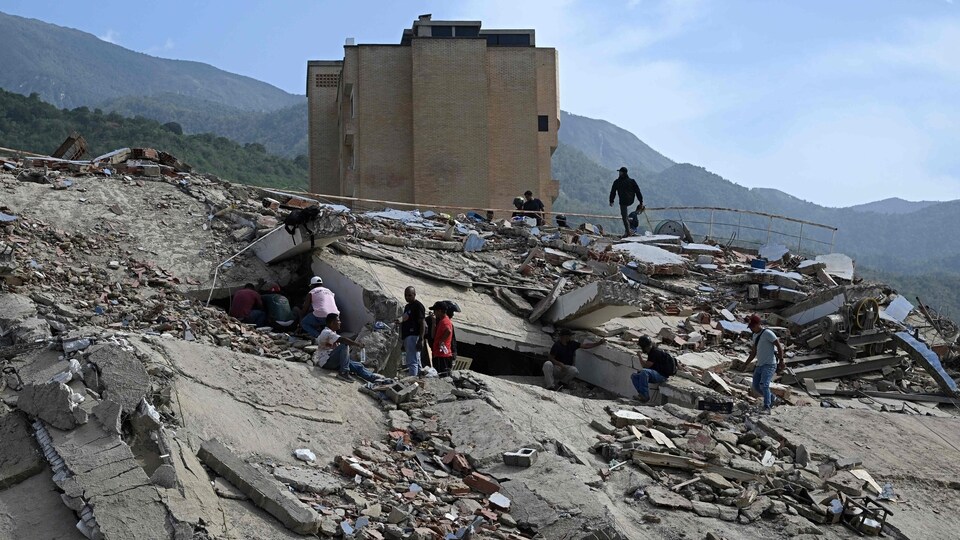
Follow Live| Venezuela earthquake death toll LIVE: 235 killed after mega ‘doublet’ earthquakes; hunt on for scores missing
The first earthquake measured magnitude 7.2, but instead of being followed by a series of smaller aftershocks, it was followed almost immediately by a larger magnitude 7.5 earthquake. Seismologists describe such events as an earthquake "doublet"—when two major earthquakes occur close together in both time and location.
The graphics below explain why this earthquake sequence proved so destructive.
A sideways collision between tectonic plates

The earthquakes occurred along the boundary where the Caribbean Plate and the South American Plate slide horizontally past one another.
Unlike subduction-zone earthquakes, where one plate dives beneath another, this was a strike-slip earthquake. In these events, the plates grind sideways, building up enormous stress over decades before suddenly slipping.
The rupture occurred near Venezuela's northern coast, west of Caracas, close to the San Sebastián fault system. Instead of one isolated shock, the fault produced two powerful ruptures within seconds.
Scientists say the 7.2-magnitude quake was followed by an even stronger 7.5-magnitude mainshock just 39 seconds later.
This "doublet" meant the ground began shaking, briefly eased, and then shook violently again, extending the duration of intense shaking and increasing the likelihood of structural damage compared with a single earthquake of similar size.
The graphics also highlight another important finding: the rupture appears to have propagated mainly eastward rather than evenly in both directions. That focused much of the earthquake's energy towards Venezuela's central coast.
Step 1: How the ground moved

The first stage of the earthquake was the sideways movement of the Caribbean and South American plates.
As stress that had accumulated over many years was suddenly released, the two sides of the fault slid past one another horizontally.
That rapid movement generated the seismic waves that travelled through northern Venezuela.
Step 2: Where the rupture began

According to the rupture model, the earthquake started offshore along Venezuela's northern coastline, roughly 150 kilometres west of Caracas.
The epicentre lay near a stretch of coast that includes La Guaira, one of the country's most important ports and the gateway to the capital.
Being relatively close to heavily populated areas meant strong shaking reached cities within seconds.
Step 3: Why the shaking became stronger towards Caracas

Earthquakes do not always spread their energy equally in every direction.
Scientists believe this rupture tore predominantly eastward along the fault.
As the rupture raced towards Caracas, the seismic energy became concentrated in the same direction—similar to how sound appears louder in front of a moving siren than behind it.
This phenomenon, known as rupture directivity, can make ground shaking significantly stronger for communities lying in the direction of the rupture.
Early analyses indicate that is exactly what happened in Venezuela.
Step 4: Why Caracas and the coast were hit so hard

Because the rupture travelled eastward, the strongest seismic waves were channelled along the densely populated coastline.
Cities such as La Guaira, Caracas, Valencia and Maracay experienced particularly intense shaking, even though some were not located directly above the epicentre.
Instead of the energy spreading evenly around the fault, much of it was directed along the coast, amplifying the impact on urban centres.
French seismologist Bertrand Delouis' preliminary rupture model suggests the earthquake behaved as one continuous rupture with two distinct pulses of energy. Other researchers are still examining whether the event may instead have consisted of two separate but linked earthquakes, with the first triggering the second.
Because the second earthquake arrived before buildings and infrastructure had fully settled from the first, the combined shaking substantially increased the destructive potential.


