
Authorities issued tsunami alerts and warnings for Hawaii, Alaska and parts of the U.S. West Coast after a massive earthquake struck off a peninsula in Russia’s far east.
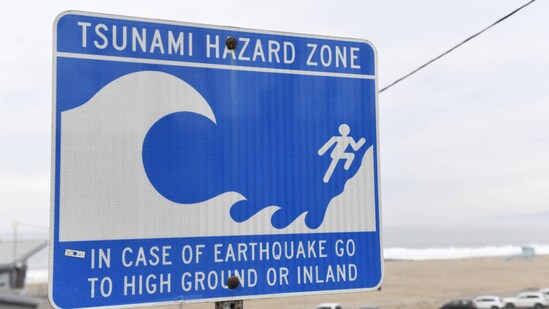
Authorities cautioned people to avoid the coast and waterways.
Here’s what to know.
What is a tsunami?
Imagine propelling a chunk of the ocean upward. That pile of water will fall and make a giant wave. That’s a tsunami.
Earthquakes often cause tsunamis and the Russian quake was measured at magnitude 8.8.
Authorities issued tsunami alerts and warnings for Hawaii, Alaska and parts of the U.S. West Coast after a massive earthquake struck off a peninsula in Russia’s far east.
Authorities cautioned people to avoid the coast and waterways.
Here’s what to know.
What is a tsunami?
Imagine propelling a chunk of the ocean upward. That pile of water will fall and make a giant wave. That’s a tsunami.
Earthquakes often cause tsunamis and the Russian quake was measured at magnitude 8.8. If confirmed, it would be one of the 10 biggest in recorded history, according to the U.S. Geological Survey.
Russian media reported injuries near the epicenter. In 2011, a 9.0-magnitude quake off Japan’s coast triggered a 32-foot tsunami that killed thousands of people.
How can something as far away as Russia threaten Hawaii and the U.S. West Coast?
Tsunami waves travel thousands of miles at commercial-jet speeds, said Emily Brodsky, professor of earth and planetary sciences at the University of California, Santa Cruz. Though its force decreases en route, it surges as water piles up near shore, potentially forming a wall of water.
Residents of Hawaii’s Big Island recall the 1960 Hilo tsunami, which killed 61 people. It was triggered by a 9.5-magnitude quake in Chile, more than 6,000 miles away.
What do the alerts mean and what should I do?
The National Weather Service outlines three alerts: warning (red), advisory (orange) and watch (yellow).
Hawaii and part of California’s coast currently have a warning, urging people to move to higher ground. Waves could be 3- to 10-feet high in Hawaii, authorities said. Wave heights can vary just a few miles apart depending on the shoreline’s shape, Brodsky said.
Most of the West Coast has an advisory, warning people to stay out of the water and away from beaches and waterways.
What can we learn for the future?
Predicting tsunami wave size is hard because few earthquakes have been big, Brodsky said. Scientists will scrutinize data to make better models.
Brodsky is interested in whether this Russian earthquake was predictable. She said the 2011 Japanese earthquake and a 2014 Chilean temblor had foreshocks—smaller quakes preceding the big one. This Russian quake could be the third such example.
Write to Stu Woo at Stu.Woo@wsj.com
One Subscription.
Get 360° coverage—from daily headlines
to 100 year archives.
Archives
HT App & Website