
Eight decades after the end of World War II, China’s Communist Party is still battling for recognition of its role in securing final victory and its claims to the territorial spoils—amid a bruising rivalry with the U.S.
Chinese leader Xi Jinping has directed an expansive propaganda campaign in recent months to trumpet the party’s account of how it helped defeat Japan. On Sept. 3, he will oversee a grand parade of troops, missiles and tanks rumbling through central Beijing to
Eight decades after the end of World War II, China’s Communist Party is still battling for recognition of its role in securing final victory and its claims to the territorial spoils—amid a bruising rivalry with the U.S.
Chinese leader Xi Jinping has directed an expansive propaganda campaign in recent months to trumpet the party’s account of how it helped defeat Japan. On Sept. 3, he will oversee a grand parade of troops, missiles and tanks rumbling through central Beijing to commemorate the 1945 victory.
Xi’s goal is to rouse popular support for the party and for his agenda as he grapples with a sluggish economy and the escalating competition with the U.S., officials and scholars say.
By promoting the party’s war narratives, Xi aims to boost China’s standing as a world power, justify Beijing’s territorial claim over the island democracy of Taiwan and rally international support for China’s efforts to challenge U.S. pre-eminence.
“Xi Jinping is rewriting the history of the Second World War” to serve his political interests, said Hans van de Ven, a professor of modern Chinese history at Cambridge University.
In China, the party’s messaging is unavoidable ahead of the 80th anniversary celebration. Films and television shows lionize Communist guerrillas for resisting the Japanese invasion. Party scholars and curators produced essays and exhibitions portraying the Communists as a foundation of Chinese war efforts against Japan—diluting the credit traditionally given to Chiang Kai-shek’s Nationalist Party, which governed mainland China until 1949.
Chiang Kai-shek, the leader of China’s Nationalist Party.
Abroad, Chinese diplomats have stressed that China helped defeat the Axis powers and build an international order centered on the United Nations—a multilateral system that Beijing accuses President Trump of trying to dismantle to advance his “America First” agenda.
In its place, Beijing has cast itself as a force for global stability.
China’s Communist Party, by stressing its role in World War II, is seeking “co-ownership of the postwar international order,” said Rana Mitter, a China historian at Harvard’s Kennedy School of Government. The goal is to cast Beijing as a rule-maker in global governance, not a revisionist power trying to rewrite the rules, Mitter said.
The ‘correct outlook’
Since taking power in 2012, Xi has sought to enforce what he calls a “correct outlook on history”—one that advances his “China Dream” of national rejuvenation and justifies his autocratic rule.
In practice, this means presenting the Communist Party as the sole guarantor of China’s rise, while quashing alternative views about the past.
Xi paid particular attention to World War II. China’s fight with Japan started years before the 1939 outbreak of war in Europe and the 1941 attack on Pearl Harbor that brought America into the conflict. Historians estimate that some 14 million to 20 million Chinese died during the war—a sacrifice that Chinese officials and scholars feel has been overlooked in the West.
When marking the 70th victory anniversary in 2015, the party put more emphasis on how Mao Zedong’s Communist forces wore down Japanese forces through guerrilla warfare, challenging the broad scholarly consensus that the Nationalists did most of the heavy fighting. Authorities also sought more international recognition of China’s significance in the broader conflict.
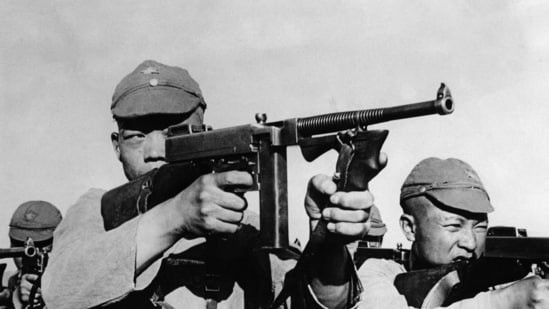
Chinese Communist soldiers in training in 1937.
“For a long time, there have been various prejudices” that emphasized the Western role in defeating fascism and ignored China’s contributions, Qi Weiping, a professor at Shanghai’s East China Normal University, wrote in a recent essay. China fought in a battlefield with “the highest number of casualties and the highest cost,” and played “an important role in the establishment of the United Nations,” Qi wrote.
Such messaging has intensified as China pushes back against mounting Western criticism of Beijing’s allegedly unfair industrial policies and its continued support of Moscow as Russia waged war on Ukraine.
Xi has cited the events of World War II to account for China’s close ties with Russia, describing the two countries as forces for good that jointly defeated fascism.
The claim to Taiwan
The Chinese leader also used the anniversary to assert Beijing’s sovereignty over Taiwan, which was a Japanese colony for five decades before it came under Nationalist control in 1945. In an essay published in Russia ahead of Moscow’s Victory Day celebration in May, Xi backed his claim by citing wartime statements by Allied powers—including the 1943 Cairo Declaration, which pledged to return “all the territories Japan has stolen from the Chinese” to the Nationalist-governed Republic of China.
Chinese officials say the Communist Party, upon seizing power in 1949, became the rightful ruler of all territory that the Nationalists took from Japan after the war, including Taiwan, where a defeated Chiang retreated with his government. The Communist Party has never governed Taiwan but has vowed to take control of it, by force if necessary.
Going into the Sept. 3 war anniversary, Chinese diplomats around the world have echoed Xi’s arguments. “Taiwan’s return to China is an important part of the World War II victory and the postwar international order,” Beijing’s ambassador to Germany, Deng Hongbo, said at a July seminar in Berlin. “Its historical and legal facts are beyond doubt.”
Western officials and historians, as well as those in Taiwan, typically dispute that conclusion. Some say the Cairo Declaration’s intent was fulfilled when the Nationalists took control of Taiwan in 1945, while others argue that the declaration, issued by President Franklin D. Roosevelt, British Prime Minister Winston Churchill and China’s then leader, Chiang, wasn’t legally binding.
Within China, the party is projecting its war narratives on television and cinema screens. A 10-part documentary, “Victory,” recounted the Communist Party’s “mainstay role” in fighting Japan. One new historical drama depicted how a band of Communist guerrillas in northeastern China, after being routed by Japanese forces, regrouped and fought back.
Promoting the Communists’ “mainstay” role in the resistance will help people understand the party’s “greatness, glory, and correctness,” and “unite the masses more closely around the party center with Comrade Xi Jinping as the core,” Zhu Jiamu, a senior historian at the state-run Chinese Academy of Social Sciences, wrote in a recent essay.
In theaters now
In Chinese cinemas, messaging about Japanese war crimes has resonated. A film set during the 1937 Nanjing Massacre, “Dead to Rights,” has grossed more than $400 million since its release in late July, drawing audiences with its depiction of how a group of people at a Nanjing photography studio preserved negatives of photos documenting the massacre, during which Japanese troops killed hundreds of thousands of Chinese civilians, by some estimates.
Authorities recommended visits to World War II-themed exhibitions at some 80 museums and historical sites across China. A Beijing museum, for instance, focused on how Communist forces helped the Allies win the war by pinning down Japanese troops.
Without the Communists’ guerrilla warfare, “it would have been impossible to open up and sustain the battlefield in the enemy’s rear” and thus achieve victory, Luo Pinghan, a party historian, wrote in a party-run magazine.
Such messaging is meant to rouse the nation behind Xi’s efforts to reshape the economy and win a grueling confrontation with the West, Chinese scholars say.
“We are embarking on a new journey of building a strong country and rejuvenating the nation with our heads held high,” the Chinese Academy of Social Sciences said in a leading party journal. “Although this is no longer a life-or-death struggle of blood and fire, it is a tenacious struggle of hardships and dangers.”
Write to Chun Han Wong at chunhan.wong@wsj.com
One Subscription.
Get 360° coverage—from daily headlines
to 100 year archives.
Archives
HT App & Website