US secretary of state Marco Rubio on Wednesday said there was no evidence that recent technology outages in the US air travel, banking and national security systems were related to each other or to any cybercrime.
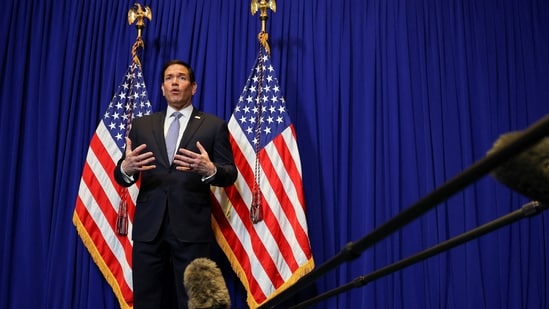
"We are not under systemic attack," he told reporters in Manila.
"We have zero evidence or any reason to believe that any of these isolated or individual instances have anything to do with nefarious actors, with cyberhackers, with criminals, with another nation state, with a malign actor of any kind," Rubio added.
Deep Dive
Were the Microsoft, FAA, banking and Apple outages part of a coordinated cyberattack?
What caused the recent outages affecting US technology, banking and air travel?
Why did the outages prompt fears of a cyberattack?
Rubio, who doubles as US national security adviser, acknowledged the incidents as "unsettling" but reiterated that the incidents were “completely unrelated” to each other.
“In essence, the Microsoft incident has nothing to do with what we saw with the FAA. The FAA has nothing to do with what we saw with the banks a few days ago. These issues that we've seen from a technical standpoint are completely unrelated one from another. That is what we have seen,” he said.
Rubio said that the US government is always on the lookout for potential threats to America, its economy or national security.
{{/usCountry}}Rubio said that the US government is always on the lookout for potential threats to America, its economy or national security.
{{/usCountry}}“We're always on the lookout for anything that poses a threat to the American people, to the American economy or to the national security. We are always hyper vigilant about that and we're always on the lookout for it. But we see no indications that these things are interrelated one event to the other or that they're the work of malign actors,” he added.
Microsoft, FAA, Apple services affected
His remarks came after technology outages in the last few days shut down email for many companies, grounded thousands of flights and affected bank services.
On Thursday, November 12, Microsoft services were disrupted. Outlook, Teams, SharePoint and several other Microsoft services were affected, leaving users and businesses unable to access their emails and documents.
A day later, on November 13, the Federal Aviation Administration called for a nationwide ground stop that lasted 4-1/2 hours, the longest halt to US air travel since the attacks of September 11, 2001.
The spate of outages included a United Airlines technology failure on Monday that delayed about 150 flights.
On Monday itself, several major US banks faced service disruptions, leaving customers unable to access some banking services, check account balances or complete transactions. The affected institutions included JPMorgan Chase, Bank of America, US Bank, Wells Fargo, Capital One and Truist.
Customers also reported problems with Zelle, a popular digital payments service used to send and receive money
On Tuesday, November 17, several Apple users were unable to access services such as iCloud, the App Store and Wallet. The company said it was working to restore its systems after an internal update caused an outage.
A highly classified network used for internal communications by the National Security Agency was also disrupted on Tuesday, CNN reported. The communication channel was identified as NSA Net, a platform used by employees to share classified information internally.
Companies rule out cyberattack
The companies affected by the outages ruled out the possibility of cyberattacks, saying the disruptions stemmed from internal technical issues.
While Microsoft said its outage was caused by a combination of a hidden software defect in its servers, a sudden increase in network traffic and reduced server capacity, Apple blamed its service disruption to an internal software update.
JPMorgan Chase also ruled out a cyberattack, saying the disruption was caused by a technical software bug.
The National Security Agency (NSA) said its network experienced a "temporary degradation" during routine maintenance, but that "mission-critical capabilities" remained operational, Reuters reported.
US President Donald Trump earlier played down the incidents, which raised questions about whether the government and private sector had moved too quickly to cut technology staff.
"It's like when you're big and powerful, and you have all the money. Things like that happen. It's fine," Trump told reporters in Manila, where he was attending meetings of the Association of Southeast Asian Nations.