For the first time, scientists have found a planet beyond the solar system that not only is the same size as Earth, but has the same proportions of iron and rock, a key step in an ongoing quest to find potentially habitable sister worlds.
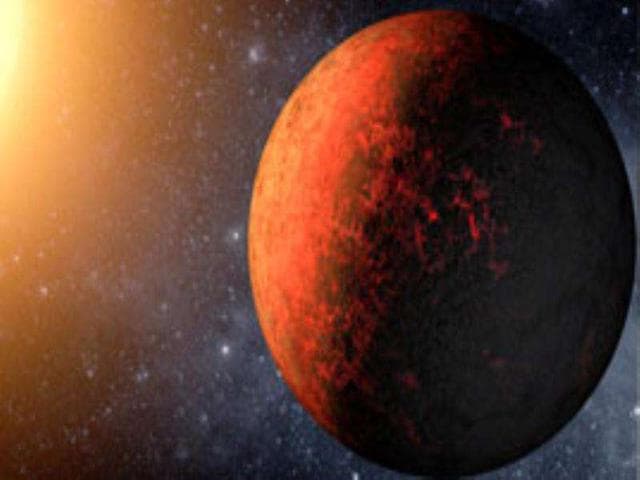
The planet, known as Kepler-78b, circles a star that is slightly smaller than the sun located in the constellation Cygnus, about 400 light years away.
One light year, is the distance light, moving at 186,282 miles per second (299,792 kilometers per second) travels in a year, or about 6 trillion miles (10 trillion kilometers).
Kepler-78b was discovered last year with NASA's now-idled Kepler space telescope, which detected potential planets as they circled in front of their parent stars, blocking a bit of light.
That measurement not only revealed that Kepler-78b was relatively small, with a diameter just 20% larger than Earth's, but that it was practically orbiting on the surface of its host star.
While the planet's presumably molten surface and searing temperatures make it ill-suited for life, two independent teams of astronomers jumped at the opportunity to follow up the discovery with ground-based measurements to try to determine the density of Kepler-78b.
Using different telescopes, the teams zeroed in on how strongly the little planet's gravity tugs at its parent star, information that could be used to figure out Kepler-78b's weight and composition.
{{/usCountry}}Using different telescopes, the teams zeroed in on how strongly the little planet's gravity tugs at its parent star, information that could be used to figure out Kepler-78b's weight and composition.
{{/usCountry}}In two papers in this week's journal Nature, the teams report that not only were they successful, but that they came to the same conclusion: Kepler-78b has roughly the same density as Earth, suggesting that it also is made primarily of rock and iron.
Earth's density is 343 pounds per cubic foot (5.5 grams per cubic centimeter). Kepler-78b is 331 pounds per cubic foot (5.3 grams cubic centimeter).
Scientists would like to be able to make the same measurements of Earth-sized planets in more life-friendly orbits, but that is beyond today's technology.