E-Paper



Hindu invitation, Jain feast at Muslim wedding: Family’s message for harmony
The decision to organise the marriage in this manner was taken by the bridegroom Mohammad Saleem and his elder broth Mohammad Arif, especially to send out a message to miscreants trying to create communal tension in the region.

 Prefer HTon Google


With images of Ganesha and Radha-Krishna on the wedding invitation card and a Jain menu for the feast, a Muslim family has sought to allay apprehensions of communal tension in their small town in Madhya Pradesh’s Jhabua district.

Mohammad Shabeer Makrani, father of the groom and resident of in Ranapura area of the district, termed the marriage, held on Wednesday, a Ganga-Jamuni tehzeeb, a phrase used to signify social harmony among different communities.
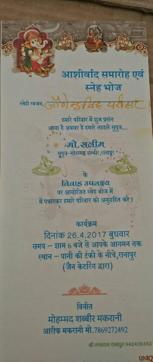
The decision to organise the marriage in this manner was taken by the bridegroom Mohammad Saleem and his elder broth Mohammad Arif, especially to send out a message to miscreants trying to create communal tension in the region.
“About a month ago, a clash took place between Hindus and Muslims over a trivial issue. A large number of people were injured in stone pelting. The tension after the incident was palpable. So, I decided to have my marriage with a fusion of all elements representing different religions—Hindu, Jain and Muslim—to teach a lesson to anti-social elements who are out to disturb the peace,” Saleem said.
When Saleem decided to print the invitation cards with the images of Lord Ganesha and Radha-Krishna, his father and elder brother supported him.
“Initially, my father was concerned about how our relatives and community would react upon it. Some relatives did raise objections to it but my family stood by me and my decision,” Saleem said.
“When I heard that Saleem wanted to get invitation cards in sync with Hindu religion, I told him why not a pure vegetarian menu according to Jains for the reception. My family agreed to that suggestion also,” Saleem’s brother, Arif said.
Even, people who attended the marriage appreciated the effort.
A guest, Arun Jain said the marriage revived the ‘Ganga-Jamuni tehzeeb’ in the area. “In our religion, there are a lot of restrictions on taking food items so I seldom eat at marriages. But in this marriage, I enjoyed the food.”
Another guest, J S Parihar said it was a commendable step by Saleem’s family. “In future, we will also try to do something like this,” he said.
(With inputs from CB Singh)