
 E-Paper


Follow the latest breaking news, major developments and agenda-setting stories from India and around the world with the newsdesk at Hindustan Times. Operating round the clock, the desk brings together experienced editors, reporters and correspondents to deliver fast, accurate and contextual reporting across subjects that influence public policy, governance, business, society and international affairs. The HT News Desk covers politics, elections, government policies, the economy, business and markets, science and technology, the environment, law and order, infrastructure, education, climate issues and geopolitics, while closely tracking developments across states, institutions and global capitals. The team also leads coverage of major breaking news events, policy announcements, court proceedings, natural disasters, public emergencies and significant international developments. Reports published by the newsdesk are based on information gathered from reporters on the ground, official statements, government agencies, court records, regulatory filings, recognised institutions and other authoritative sources. Stories undergo editorial scrutiny and verification processes to ensure accuracy, fairness and relevance, and are updated as events evolve and additional information becomes available. Whether covering a key political decision in New Delhi, an economic policy shift affecting millions, a landmark court ruling or a major global event, the HT News Desk aims to provide readers with reliable, fact-based journalism that delivers not only the latest developments but also the context and analysis needed to understand their wider implications.
NSA Doval discusses ‘major problems’ with top Chinese diplomat meet in Beijing
Earlier, there was a question mark on whether Doval and Yang Jiechiwould have a one-on-one meeting.


India’s National Security Adviser Ajit Doval and top Chinese diplomat Yang Jiechi discussed “major problems” in bilateral relations during a meeting in Beijing on Thursday, the first substantial contact since the two sides became engaged in a military standoff in Doklam (Donglang) area near the Sikkim border in mid-June.
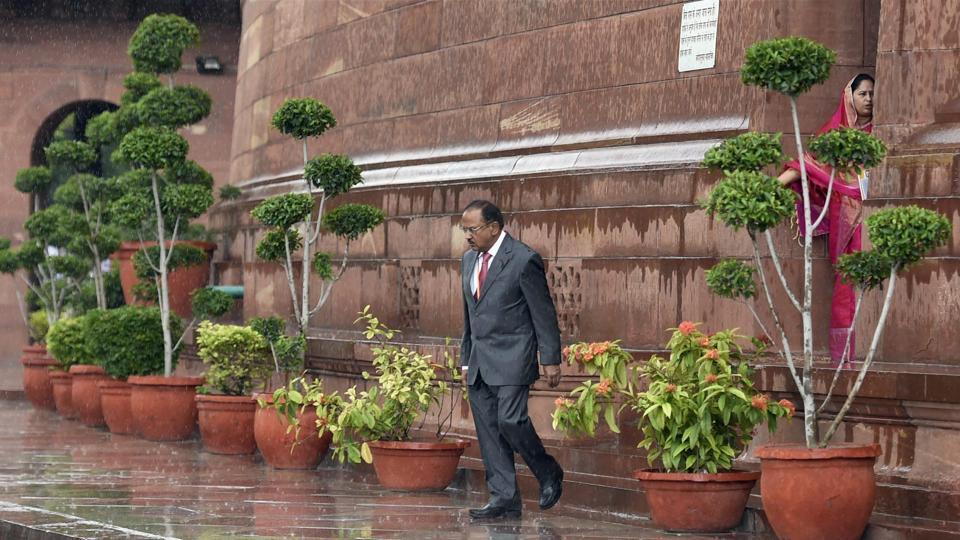
Details of their discussions were not immediately available but a brief readout from the Chinese side said Yang brought up “bilateral issues” and “major problems” during the meeting.
Doval is in Beijing to attend a two-day BRICS security summit but the focus has been on his bilateral interactions with the Chinese leadership against the backdrop of the standoff and intense speculation on whether the two sides would begin a conversation to ease tensions, if not resolve the impasse.
Earlier, there was a question mark on whether Doval and Yang would have a one-on-one meeting given that China had set the withdrawal of Indian troops from Donglang as a precondition for a “meaningful dialogue” on the standoff.
Official Xinhua news agency didn’t share details of the meeting between Doval and Yang but gave a broad outline.
“Chinese State Councilor Yang Jiechi Thursday met separately with senior security representatives from South Africa, Brazil and India,” Xinhua reported.
“Yang also separately exchanged views with the three senior representatives on bilateral relations, international and regional issues and multilateral affairs, and set forth China's position on bilateral issues and major problems,” it added.
Earlier this month, Prime Minister Narendra Modi had briefly met president Xi Jinping where they reportedly discussed a “range of issues” during an informal gathering of BRICS leaders in Hamburg.
China has blamed India for the standoff at Donglang or Doklam, accusing Indian soldiers of “trespass” and preventing Chinese soldiers from building a road in the area. The region is under the control of China but claimed by Bhutan.
India said it acted in coordination with Bhutan to oppose the road construction, which “would represent a significant change of status quo with serious security implications”.
Foreign minister Wang Yi told reporters Bangkok earlier this week the “problem was very straightforward” and “even Indian officials publicly said that Chinese soldiers didn’t enter the Indian territory. In other words, (the) Indian side admitted (crossing) into Chinese territory.”
The resolution of the problem is very “simple”, he said: “Indian troops have to go out”.
Doval and Yang are also the officials currently leading the talks under the “special representatives” mechanism between India and China to resolve the boundary issue. As many as 19 rounds of talks have been held under the mechanism.


