
Sign in

Third tiger cub reared with help of ‘dummy toy tigress’ dies at Bandhavgarh

Earlier, two other cubs, reared with the “dummy toy mother,” had died from Parvovirus infection at the tiger reserve.

Updated on: Apr 26, 2017, 20:37:22 IST
Hindustan Times, Bhopal | By
Share
Share via
  • facebook
  • twitter
  • linkedin
  • whatsapp
Copy link
  • copy link

Third tiger cub reared with the help of a ‘dummy toy tigress mother’ died at Madhya Pradesh’s Bandhavgarh Tiger Reserve on Wednesday morning.
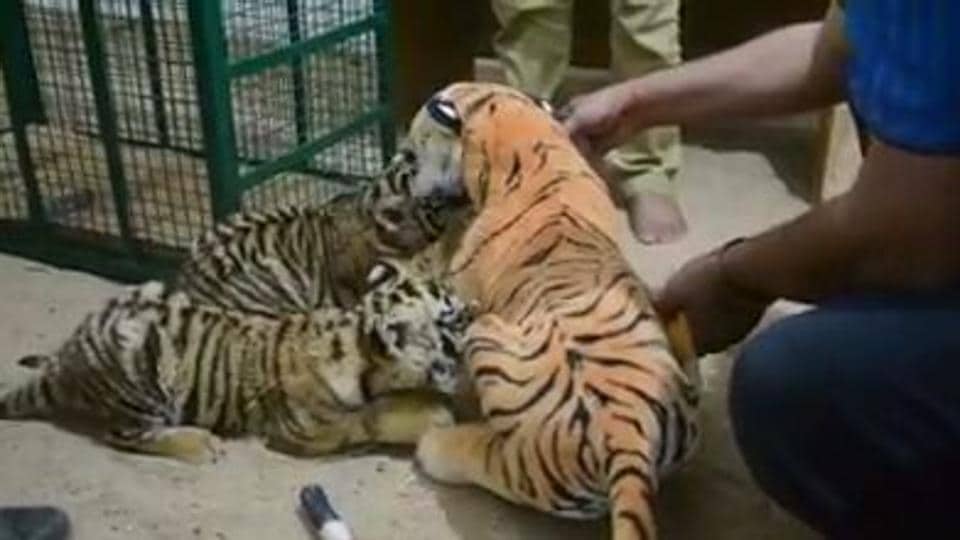
Two other cubs, reared with the “dummy toy mother,” had died from Parvovirus infection at the tiger reserve since Saturday. (HT Photo)

Two other cubs, reared with the “dummy toy mother,” had died from Parvovirus infection at the tiger reserve since Saturday last.

Bandhavgarh Tiger Reserve field director Mridul Pathak told HT over phone that the third cub died in the morning despite the best efforts of the four veterinary doctors to save its life.
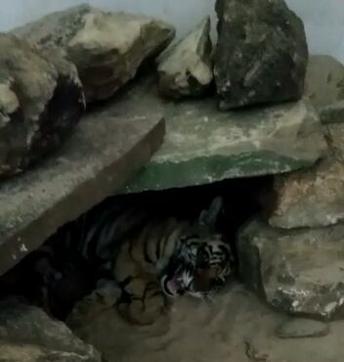
The third cub hours before it died in the tiger reserve. (HT Photo )

Pathak said the first tiger cub had died on Saturday night followed by another on Sunday.

A two-member team of the national tiger conservation authority (NTCA ) has reached Bandhavgarh to investigate under what circumstances the cubs have died.

Pathak said in the absence of mother’s milk, the immunity of the cubs was very weak. He said they didn’t receive antibodies from their mother’s milk due to which they were infected with Parvo viral infection on April 12.

The Parvovirus weakens the muscles of heart and cubs died from heart collapse, he added.

Pathak said the three cubs were brought to Bandhavgarh on January 22 this year after their mother died of electrocution in the buffer zone of Sanjay Dubri Tiger Reserve in mid-January.

Bandhavgarh management experimented with a dummy toy tigress mother to rear them. The toy tigress had been fitted with artificial nipples and a milk bottle to feed the tiger cubs.

The three cubs were born to a tigress T1 in December last year in the Sanjay Dubri Tiger Reserve in Sidhi district.

After the ten-year old tigress died in Banas river area near Sanjay-Dubari Tiger Reserve, eight elephants and a team of over 150 forest officials led by Mridul Pathak were pressed into service for locating its three cubs in the nearby forests.

After intensive search, the cubs were found and shifted to Bandhavgarh Tiger Reserve.

The tiger reserve, located between the Vindhyan and Satpura ranges in Umaria district, has one of the highest tiger densities in the country, with 85 adult tigers and fourty plus cubs.

Due to this, the reserve has been witnessing incidents of man-animal conflict in last few years, with both man and tiger getting killed or injured.

Five tigers have died in the state within a week, taking the death toll to 11 this year.

Since January 2015, MP has lost 52 tigers.

  • Neeraj Santoshi
    ABOUT THE AUTHOR
    Neeraj Santoshi

    Neeraj Santoshi is the Chief of Bureau for Hindustan Times in Uttarakhand, where he leads the state reporting team while covering government, politics, environment, wildlife, Uttarakhand High Court, and issues shaping the Himalayan region. With more than two decades in journalism across conflict zones, he has covered politically sensitive regions and environmentally fragile landscapes, and focused on stories that combine public interest with in-depth storytelling. An alumnus of Pune University with a Master’s in Communication Studies, he has reported extensively from Jammu & Kashmir (2003-2010), Madhya Pradesh (2010 to 2018 ) and Uttarakhand (Since 2018), covering subjects ranging from insurgency, elections and governance to wildlife conservation, mining, climate change, agriculture, human rights and social justice. He has covered politics and legislative assemblies of both Jammu & Kashmir and Madhya Pradesh over more than a decade. Before taking over as Chief of Bureau in Uttarakhand, he served as Special Correspondent with Hindustan Times in Madhya Pradesh and earlier reported for both Hindustan Times and The Indian Express in Jammu & Kashmir, where he covered state politics, environment and insurgency-related developments. Over the years, his stories have focused on environmental degradation, wildlife, illegal mining, governance and the changing social fabric of Himalayan states and Central India. He is particularly interested in long-form explanatory journalism, and stories that explore the intersection of ecology, conservation, governance and society. Outside the newsroom, Neeraj enjoys reading widely on neuroscience, consciousness studies, Artificial Intelligence and quantum physics, with a special interest in Kashmiri Tantric Shaivist traditions. He is also passionate about wildlife, mountaineering and the Himalayas, interests that continue to inform his reporting and deepen his understanding of the region he covers.Read More