E-Paper



Tourists to soon be greeted with a mud-covered Taj Mahal when restoration begins
More than a year since the Taj Mahal began sporting scaffoldings on its minarets, a mudpack on the famed monument of love to restore it to its ivory-white splendour will disappoint tourists over the next two seasons.

 Prefer HTon Google


More than a year since the Taj Mahal began sporting scaffoldings on its minarets, a mudpack on the famed monument of love to restore it to its ivory-white splendour will disappoint tourists over the next two seasons.
Set to start from next fiscal, the cleaning works can turn out to be a major eyesore till its completion in 2018.
It was in end-September 2015 that the ongoing maintenance work began on the 17th-century marble mausoleum to reverse the yellowing of the four towers. If the sight of the planks and poles distracted one from the famed picture-perfect sight, workmen will be next be seen scrambling over the dome.
“Scaffoldings on the cupola (dome) may come in the 2017-18 fiscal. We may start from its rear side,” said Dr MK Bhatnagar, who is in charge of the Archaeological Survey of India (ASI)’s chemical branch.
“We have to first assess the dome’s bearing capacity; how much weight of metal it can take,” he added, saying the current work pertains to one of the minarets on the eastern side of the mausoleum.
Bhatnagar further said the ASI “cannot predict” the time the scaffoldings will cover the dome. “It depends on the requirement of the work. Even the velocity of wind matters.”
The ASI initiated a cleaning project at the start of the 2015-16 fiscal, applying additives-laced Multani Mitti (Fuller’s earth). This anti-corroding and non-abrasive technique is more scientific as well as detailed than the ones the government agency employed in the past quarter century to clean parts of the Taj wall — in 1994, 2001 and 2008.
The dome is 240-feet-tall with a diameter of 58 feet and is built over a 17-acre plot. Originally ivory-white in colour, the 1653-constructed tomb alongside the Yamuna has been losing sheen due to increasing industrialisation in the area. As public anxiety and expert criticism grew over a ‘slow death’ of the UN-deemed world heritage site, authorities stepped in with fresh conservation plans.
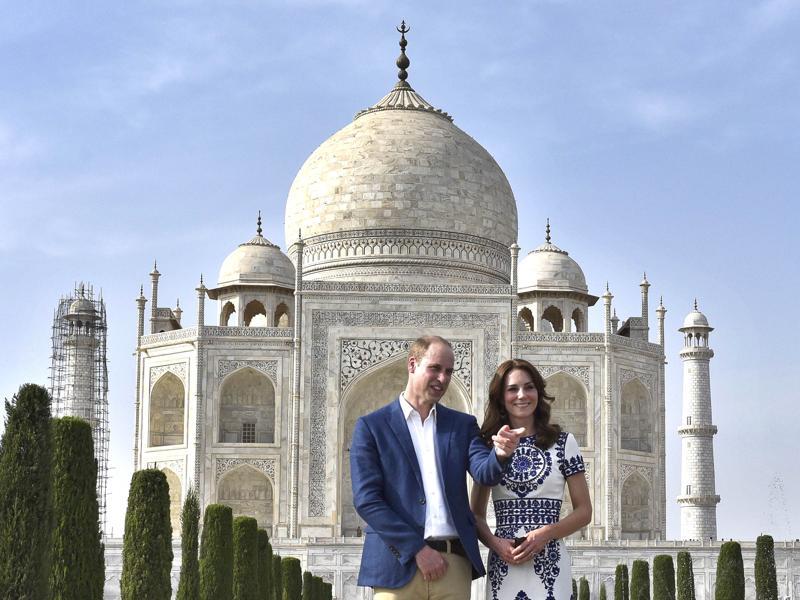
The project received international focus this April when Britain’s Prince William and Duchess Kate Middleton, on their maiden India visit, posed for a picture in front of the Taj, scaffoldings and all; the ASI said it could not remove the structures.
Those from the tourism and hospitality industry plan on asking for minimising the work period during which they expect a decline in visitors.
“The beauty of the Taj lies in the totality of its view,” said Rajiv Tiwari, chairman of the Federation of Travel Association in Agra. “Already, the scaffolding on the minarets has affected the sight, but their coming up on the main dome would totally take away the charm. It will affect our trade for another year.”
The tourist body wants the ASI to cut short the maintenance period or complete it in phases. “We are not against cleaning the Taj, but the authorities should look at all parties associated with tourism,” said Tiwari.
The last time the Taj’s dome bore scaffoldings is said to be in 1940-42 during the World War II. The monument was later covered twice — during India’s wars in 1965 and 1971 with Pakistan.
Dr Bhatnagar notes that mudpack therapy per se does not take “long”. “It is laying and the removal of scaffoldings that involves months of work.”
The ASI’s superintending archaeologist at Agra office, Dr Bhuvan Vikram, said the current work on the eastern wall of main mausoleum will be followed by the other three sides. “It is only after these we will come to the dome.”
The brass pinnacle over the dome will also be attended to, officials said.